You are now subscribed
Your newsletter sign-up was successful
Want to add more newsletters?

Every Friday
GamesRadar+
Your weekly update on everything you could ever want to know about the games you already love, games we know you're going to love in the near future, and tales from the communities that surround them.

Every Thursday
GTA 6 O'clock
Our special GTA 6 newsletter, with breaking news, insider info, and rumor analysis from the award-winning GTA 6 O'clock experts.

Every Friday
Knowledge
From the creators of Edge: A weekly videogame industry newsletter with analysis from expert writers, guidance from professionals, and insight into what's on the horizon.

Every Thursday
The Setup
Hardware nerds unite, sign up to our free tech newsletter for a weekly digest of the hottest new tech, the latest gadgets on the test bench, and much more.

Every Wednesday
Switch 2 Spotlight
Sign up to our new Switch 2 newsletter, where we bring you the latest talking points on Nintendo's new console each week, bring you up to date on the news, and recommend what games to play.

Every Saturday
The Watchlist
Subscribe for a weekly digest of the movie and TV news that matters, direct to your inbox. From first-look trailers, interviews, reviews and explainers, we've got you covered.

Once a month
SFX
Get sneak previews, exclusive competitions and details of special events each month!
Steam baron Valve owes much of its current, enviably profitable position to products and policies that were ahead of their time, and the leadership of founder Gabe Newell played a major part in the company's vision. A particularly timeless comment from Newell has, rather amusingly, resurfaced after 16 years in glorious 180p resolution thanks to a YouTube channel with 750 subscribers and, suddenly, over 244,000 views on its latest upload: Newell tidily explaining why piracy is, and always will be, a service issue.
This clip comes from Newell's comments on a 2009 ABC Good Game segment (Season 5, Episode 24, it appears). The snippet uploaded on January 2, 2026 is already poised to become the most-viewed variant on Youtube. "This is the un-abridged, web-exclusive [Australian] version of ABC Good Game's interview with Gabe Newell," uploader PostScript says in the video description.
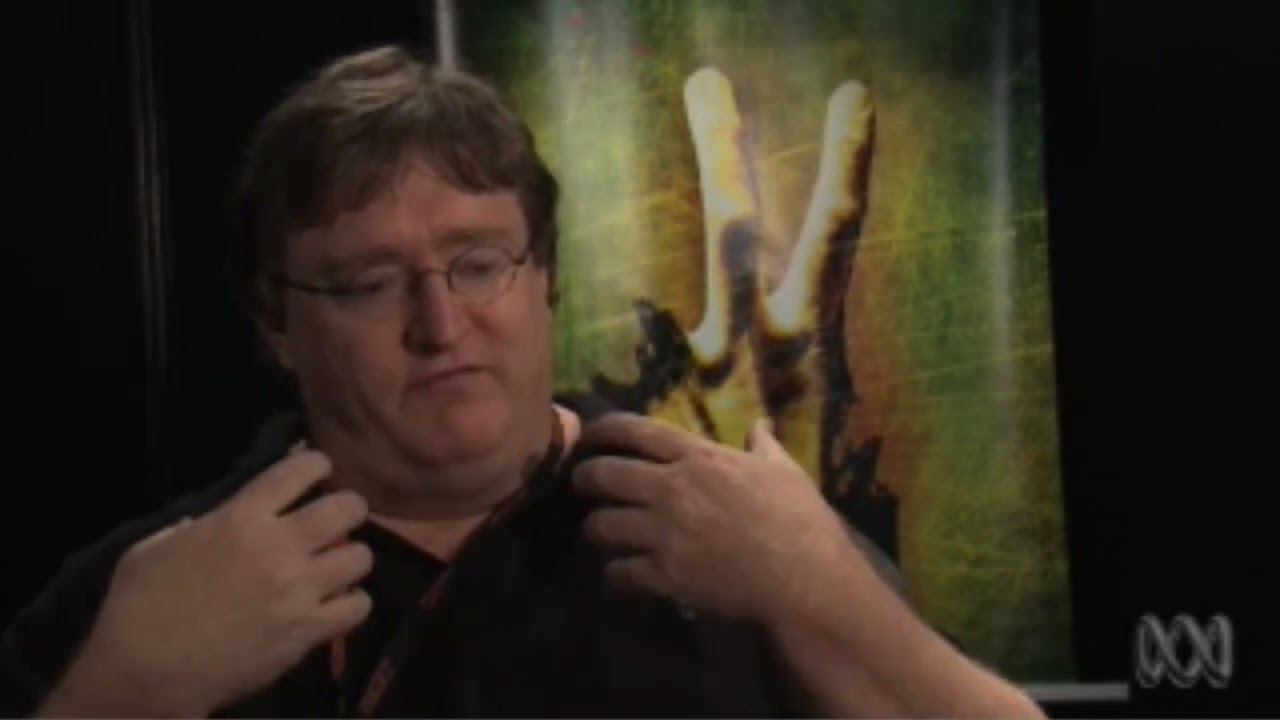
Newell's argument held up in 2009, and deep in the enshittification that we're only seeing more of in 2026, it's arguably more relevant than ever. "We don't really worry about piracy," Newell said at the time, adding that piracy as a topic is "almost never" even going to crack the top 10 issues discussed at Valve.
"The reason that we think that we don't have issues with piracy is that there's misconceptions in the industry about what piracy is, right?" he says. "There's this assumption. What is piracy? Piracy is about people wanting to steal stuff from you, right? They don't want to pay any money and they wanna get your content. But when you look at the fact that these people have $2,000 PCs and they're spending 50 dollars US a month or more on their internet connections, clearly, they're willing to spend money."
Oh, to pay just $2,000 for a premium PC and spend just $50 a month on good internet. Here in 2026, that might get you a top-of-the-line GPU alone, or if you're lucky, a photograph of 64GB of RAM.
Newell continues: "What we saw more and more is that piracy was a result of bad service on the part of game companies." He points to the Russian games market as one example, dismissing the assertion that the Russia market is unviable because it's full of pirates. Instead, he argues that Russian pirates were simply doing a better job with game distribution than actual paid storefronts, so users flocked to them. If you could beat the quality bar of pirates, which shouldn't be hard for companies with incomparably more resources available to them, you could win players over.
"If I wanted the product, and I didn't want to wait six months to get the product, and if I wanted it in Russian, I was gonna have to go to a pirate simply because I couldn't get it any other way," Newell offers as a hypothetical. And so, in this example, "as soon as the product became available at the same time as it was available in Australia or the UK or the United States, and it was localized in Russia, all of the sudden our piracy problems in Russia disappeared."

Summing up his stance, which can still fairly be described as a pillar of Steam, Newell says evaluating piracy is "a question of offering or viewing yourself as, 'How can you provide the best possible service to your customers?'" Newell and several other faces of Valve say some version of this line regularly even today, and it's among the most palatable corporate lip service around because Steam, by and large, bears it out.
Pricing is obviously relevant, but, 2009 Newell says, it's actually one of the "less important" factors with piracy. "People are happy to pay money if they're getting what they perceive as a great product delivered on their terms," he explains. I do want to linger on the stipulation "on their terms" for a moment. In the increasingly fractured digital market – saddled with vestigial apps and launchers, and not just in games – terms of use and licensing (because true ownership has, broadly, gone the way of the dodo, or perhaps more charitably the way of the American buffalo) are only getting uglier.
Newell offers several examples of what buying a game on your terms might look like – accessing purchased content on a range of devices, while traveling, at a friend's house, after changing PCs, or after "I reinstall my operating system." Some of these are artifacts of the 2000s PC market, but there are plenty of parallels to Valve's ongoing multiplatform efforts, not just in literal portable platforms a la Steam Deck and, soon, the highly totable Steam Machine, but also in its vision for a one-stop PC gaming platform with myriad entry points and player-friendly features (which can also be developer-friendly in the form of peerless game discoverability).
2009 Newell concludes, in this cut of the video, by reiterating that, "By focusing on the customer and doing useful things for the customer, piracy really becomes sort of a non-issue for us." It goes without saying that Steam is not flawless and Valve is not exempt from criticism (though, really, sometimes it feels like this does need to be said aloud), but on this point – the usefulness of Steam and how it sits on the scales opposite piracy – the oligarchical state of PC gaming speaks for itself.

You must confirm your public display name before commenting
Please logout and then login again, you will then be prompted to enter your display name.