

Playing Game Boy games on an E-ink display isn't a new-fangled concept, but the Ink-Boy makes a strong case for paper screen handhelds. In fact, by turning an ESP32 microcontroller into a micro portable that'll run Ninty's classics at 30fps and has fully dockable NES controls, the modder in question has paved the way for some wild portables.
In a video explaining how the Ink-Boy came to be, the retro handheld's creator, Bo Made It, delves into their custom display driver. If you've spent more than two seconds with something like a Kindle, you'll already know that the display tech normally loads effectively at the same speed as a page turn. Rather than making do with a woeful three frames a second in classics like Super Mario Land, this tiny portable uses clever tricks to push visuals out at 30fps.
The modder does a pretty nice job explaining how to get an E-ink screen from looking like "a slide show" to something playable. The short of it, though, is that the creator used an existing paper screen portable, the Paperboy S3, as inspiration and designed a display driver that shortens the waveform sequence used to set pixels to black, then sets the screen to drive only the pixels that are required in every frame.
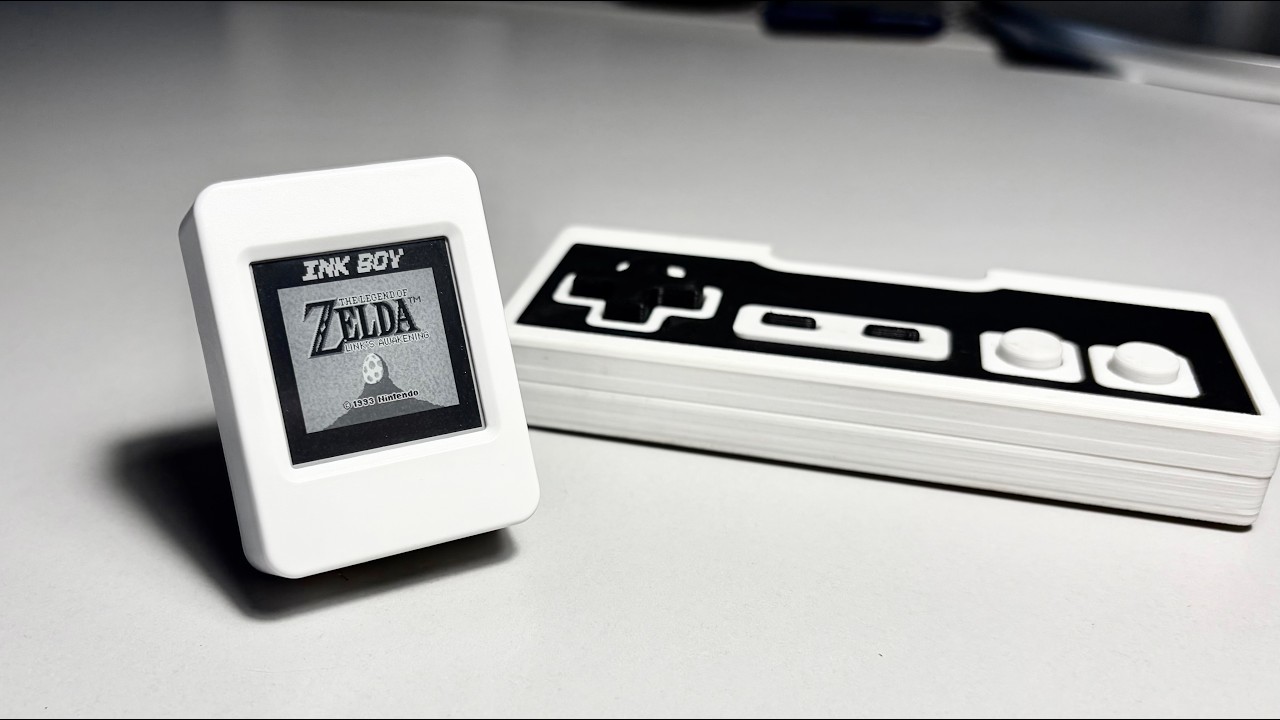
That workaround helps the Ink-Boy dramatically reduce E-Ink symptoms like ghosting and messy visuals, producing more fluid motion that looks closer to an OG DMG Game Boy screen (without the icky green). Of course, since Ninty's old brick uses 2-bit visuals, allowing for four different monochrome shades on screen, it means the paper panel needs a workaround since it defaults to two.
Bo Made It explains that, due to the Ink-Boy's tiny 200 x 200 resolution, that's a challenge compared to the PaperBoy S3 since it can't use several display pixels. It virtually matches the handheld's 160 x 144 pixel capabilities, with the rest being filled by a rather authentic static black bezel. Thankfully, the modder was actually able to spoof additional greyscale pixels using the way E-ink naturally changes pixels, calibrating the transitions to produce 4-bit "color" on demand.
It might feel like the Ink-Boy is late to the party given that the Paperboy already exists, but I actually feel like this tiny handheld could help usher in a new chapter for Game Boy clones (sorry). The paper display in question, the Waveshare ESP32-S3, measures in at just 1.54 inches, and that leaves a lot of room for weird custom designs, with Bo Made It opting for a USB-C NES controller that docks to the bottom.


The modder says the Ink-Boy also supports Bluetooth, so you could use a controller like the CKRD Atom Plus I'm currently testing ($29.99 at Amazon, FYI) and play retro console romps on a stupidly small setup. My plans for this project, should I put together my own, are more cursed than that, as I reckon I could use the E-ink display to give the dreaded 'Game Child' crusty LCD clone a second life as a Game Boy emulator.

Yes, trying to turn the Game Child into a real Game Boy is like a portable Pinocchio horror story, but it does highlight the influence the Ink-Boy could have on modders and handheld lovers alike. I'm well aware the majority of you would rather stick with modern LCD screens, especially since excellent tiny portables like the Anbernic RG28XX exist for $42 at Amazon. Nevertheless, I love the idea of E-ink being used to bring non-backlit displays back in a useful way, and building your own gadgets isn't a bad idea given the current pricing situation.
Swing by the best retro controllers for gamepads that blend authentic designs with modern tricks.

