

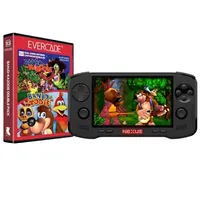
I don't think I have to say that an $1,800 Xbox is not okay, but spending time with the Evercade Nexus has personally compounded the absurdity. I enjoy new-fangled consoles and PCs as much as the next hardware editor, and I wouldn't say Blaze's new portable is a direct competitor. However, we're at a stage where rather than just giving the big dogs of the industry our moolah, even when things soar to used-car prices, I'd rather invest in a handheld that's actively trying to project the art of physical, approachable gaming.
I should note that I don't think the Evercade Next is the absolute best retro handheld out there, but that's only if you ignore its underlying portable premise. Yes, it lacks really simple functions like a sleep mode (although Blaze has confirmed that'll come in a firmware patch), and it's missing some premium touches like an OLED display and hall-effect thumbsticks. Nevertheless, we're talking about a console around the same size as a Nintendo Switch that runs physical cartridges in the year 2026, and I know many of you would take that over whatever Xbox Project Helix will do for upwards of $1,800.
Okay, yes, in an ideal world, Blaze's Evercade ecosystem would exist alongside Xbox Helix and the assumed PS6. The main issue I have is that if Fortune's report that the next-gen console could cost "between $1,200 and $1,800" holds true, then many players won't even have a next generation to consider. Plus, when you consider the likelihood that physical gaming won't be a thing on either Sony or Microsoft's platform, not at least with heavy reliance on internet connectivity, the idea of just sticking with Evercade games makes heaps of sense.

The Evercade is anything but new, but it does feel like yesterday that I reviewed the original handheld for a UK national newspaper. Back then, I was skeptical about whether the cartridge-based ecosystem would continue to grow or break free from its relatively bog-standard portable confines. Over 700 game releases and a staggering number of hardware options later, it genuinely feels like Blaze has stealthily become a fully fledged platform, one that could keep providing you with offline access to classics and indie games while we weather RAMageddon.
I should note that this proposal doesn't solely tie to the new Nexus handheld. You could instead opt for the far cheaper Super Pocket since it will run all the same games for $69.99, or you could even get a bit fancy and invest in an Evercade Alpha, a bartop arcade machine that works as its own standalone console (a bit like a modern-day Vectrex).
The reason I'd consider the Evercade Nexus specifically as your daily driver, though, is that it feels closer to a contempoary handheld, and that matters when running ports like the Banjo-Kazooie collection. I wouldn't say the controls are ideal; I'm not personally a big fan of bottom-placed symmetrical sticks, but beyond that, full 3D controls and a larger 5.98-inch IPS screen help quash the notion that it's a novelty device, so you'll think less about modern alternatives.

Now more than ever, companies that do right by players who just want to buy, own, and play games without egregious price tags or caveats deserve your support. Blaze is absolutely on that list, and the fact it is still making brand-new cart releases with full-color manuals, clamshell cases for your shelf, and games ranging from solid emulation-based classics to ground-up native ports is nothing short of spectacular.
Don't get me wrong, I know many of you looking into how to play N64 games or play PS2 games using original hardware or a handheld will look elsewhere. The Nexus is beholden to licensing its own releases, and while that has its perks, many players will already have stacks of games they want to make use of. My main goal here is to simply signal that if you want to keep buying "new" games, but word of $1,800 consoles makes that sound like an impossibility, grabbing a Nexus could tide you over.
And hey, I'd rather replay Banjo-Kazooie and Legacy of Kain: Soul Reaver for the millionth time than take out a loan for the next Halo anyway.
Swing by the best retro controllers for modern gamepads with an authentic classic console twist.

