


The clipped-wing Dodo aeroplane, sporadically stealable from the rear runway of Francis International Airport, neatly embodies the Rockstar Games of 2001. Although Grand Theft Auto 3 will always be able to stand on its own merits as an uncommonly bleak videogame nasty that also shaped the whole sandbox crime genre, even in its day it felt somehow incomplete, as if its creator was reaching for something just beyond its grasp. Similarly, the Dodo can soar dozens of feet off the ground, but it quickly and inevitably reaches the limit of its engine power and slumps back down to earth. There is a sense of a living, reactive city in GTA 3, but at the same time it feels limited, locked off, as though you're never given full access to the dynamic urban reality it implies. On the scant few occasions that you can enter one of Liberty City's buildings, for example, there isn't anyone or anything in there, and you reach the end of the game with a sense that there is much more in Rockstar's crime series that remains to be explored.
In GTA: Vice City, released a mere 13 months after GTA 3, you are not constrained to the Dodo. From the seat of a helicopter, a seaplane or a fully outfitted Apache attack chopper, you can fly high and free. In just over a year, Rockstar's ability to build sprawling and explorable 3D cities appears to have come on leaps and bounds.

There are other telling mechanical additions. Expanding on the comparatively austere GTA 3, in Vice City you can ride motorbikes, buy property, change your clothes, and discover unmarked ambient side missions such as robbing a pharmacy or beating up gang members to earn the 'good citizen' cash bonus.

This article originally appeared in Edge magazine #424. For more in-depth features and interviews on classic games delivered to your door or digital device, subscribe to Edge or buy an issue!
Rockstar's sunkissed, heat-vapour-saturated pastel caricature of Miami is a sight to behold, but, more importantly, you can explore its interiors too. Between the Malibu Club, the Pole Position, the shopping malls and the Pizza Stack restaurants – not to mention the various hotels, apartments and places of business that you acquire as you progress through the main story – this aptly named metropolis of iniquity is packed with places to go, NPCs to meet, and small but immersion-enhancing interactions. Today, we take all of this for granted. Customisable characters, optional sidequests and small, tertiary mechanics that help to boost verisimilitude have come to be regarded as the mere rudiments of the open-world genre. But way back in 2002 – especially on a console, and outside of the fantasy-RPG realm – a game where this amount of effort was put into pure worldbuilding, and where you could have a perfectly rewarding time simply basking in the atmosphere, still felt exceptional.
Nevertheless, two and a half decades on, some of the changes and enhancements made between GTA 3 and Vice City might sound superficial, or even faintly ridiculous. In the same way that you might chuckle at the size of the earliest mobile phones or recall with a certain irony the 'magic' of wireless Internet, it's funny to imagine a world where the ability to crouch in a Grand Theft Auto game, or to jump out of a moving car if it was on fire, felt like a novelty. Vice City emerged in an era when the conventions of the 3D open-world game – especially the 3D open-world crime game – were still far from codified, when the mechanical language of the subgenre was unfinished. Seen from that perspective, Rockstar's vision for the game starts to feel cavalier, like it's trying to tap X repeatedly to sprint before it can walk. There's no swimming, climbing walls or moving while crouching in Vice City, but there are celebrity voiceovers, a fully licensed soundtrack, and a recognisable representation of the mansion (and climactic shootout) from Scarface.

You might get the sense that presentation was more important to 2002 Rockstar than pragmatism, as though the studio was channelling its creative energy towards superficial goals (aping big-budget movies; showing off a pseudo-cinematic production quality) in lieu of honing or pushing the playing experience. Certainly, the driving, the shooting and the level designs that are supposed to form the game's centre remain largely unchanged from GTA 3. Or you could even go back to Grand Theft Auto, from 1997; the tasks that you receive in the top-down original version of Liberty City almost always involve driving somewhere, killing a bunch of people, picking something up and driving back, and that's also what you do for most of your time in Vice City. It looks gorgeous, and there's plenty to see and explore, but the game can be seen more as an incremental advance than a full-bodied sequel – understandable when you consider that it started life as a GTA 3 add-on.
However, the magic of Vice City – and of videogames in general – lies in more than mechanics, mission design or any other tangibles of the form. Even though Vice City may have fundamentally the same structure and systems as GTA 3, True Crime, Mafia and many comparable crime capers that emerged during the '00s, it nevertheless feels like the standout because of its aesthetic approach. The stinking, smoky, weather-beaten concrete brutalism of Liberty City – and the moral squalor that it symbolises – is replaced wholesale with sunshine, vibrancy and an airier, freer, much more feel-good tone.
Prior to Vice City, the sensory thrills of GTA had been rooted largely in depravity, the transgressive excitement that comes from simulating actions and behaviours that are too dark, immoral and illegal for you ever to consider in reality. They're by no means fully grown up, but in Vice City, Rockstar's virtual fantasies appear more mature. In addition to killing cops with rocket launchers, flinging cars off of ramps and driving a tank through traffic, you're encouraged, surreptitiously or otherwise, towards more plausible and contemplative pleasures. When you reminisce about Vice City today, alongside all the ultraviolence and automotive pyrotechnics, you're also likely to fondly recall the first time you went inside the Malibu Club, or the party mission aboard Colonel Cortez's yacht, or cruising down Ocean Beach in a convertible Stinger while listening to Broken Wings. With GTA 3, Rockstar succeeded in creating a 3D open playground; with Vice City, it started to develop and more finely shape what would eventually become its trademark – a rounded, reactive, and much more enveloping open world.


Can't wait for the new Grand Theft Auto? Join our Countdown to GTA 6 hub for all the latest updates, features, and retrospectives on the series' legendary history.
Vice City's landscape is more than a racing track, and you're invited to regard its citizenry as more than digital toys for you to smash up in variously creative ways. But while it is a broader and deeper game than GTA 3 – and also represents a crucial development in the history of open-world maps, and how they've become progressively larger – it is still very carefully contained. There are exceptions, but in the latter half of the game in particular, when you're set loose to purchase assets and front companies, the majority of the side missions feel as if they are still connected to the central spine of the narrative. It's up to you which businesses you want to buy and which of their accompanying mission chains you want to follow, but all of them are ultimately connected to Tommy Vercetti's core goal of constructing his criminal empire. Even today, this kind of design feels like a rarity. If there is a consistent problem with sandbox and open-world games, it's that they offer too much in the way of meaningless 'content', expecting you to be enthralled by completing banal sidequests in the name of sheer running time. But in Vice City – for the most part, at least – you have a reasonable understanding of why your character is doing the things he's doing. The effect is incomplete, and naturally primitive compared to much later games such as Cyberpunk 2077, but in Vice City you can see that Rockstar is trying to unify the free-flowing, player-driven open world with cogent, coherent storytelling.
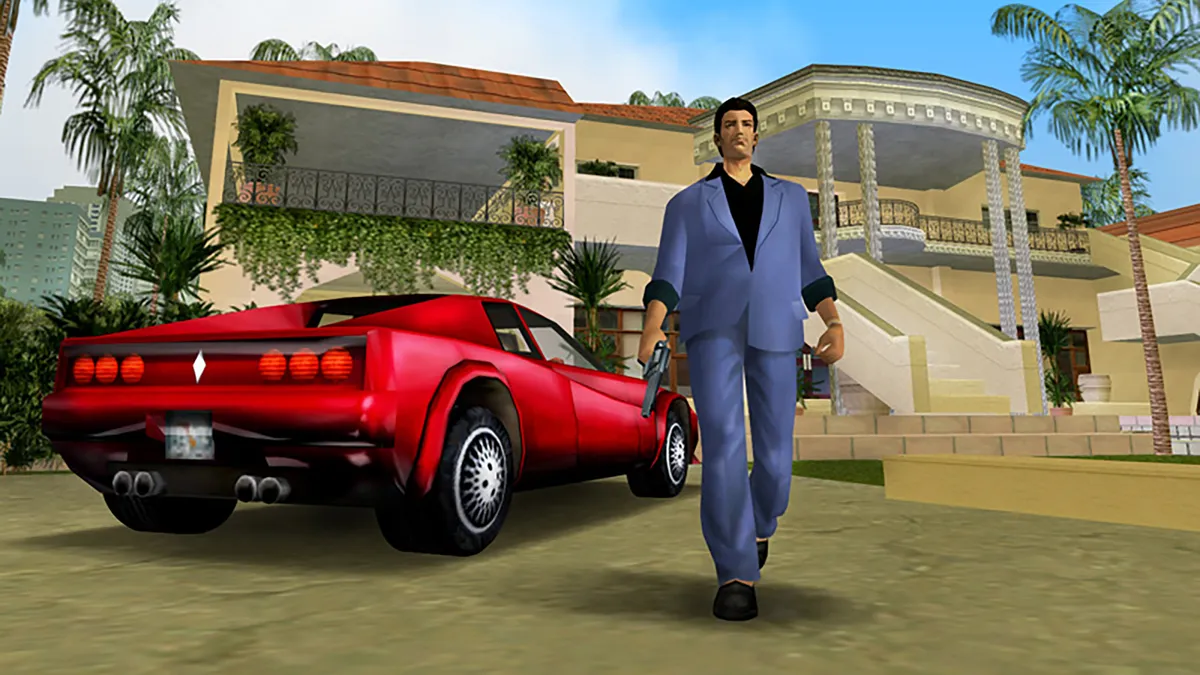
This effort – to make the game feel simultaneously large and comprehensible, reactive to you as a player but nonetheless directed and choreographed by the designers, so that there is dramatic thrust behind everything you do – is ultimately reflected in the map itself, every part of which has its own identifying characteristic: the Ammu-Nation and helipad in Downtown, the multi-storey car park and hotels in Ocean Beach, the airport and the rocket-launcher pickup near Little Havana.
Rather than simply being big, Rockstar's interpretation of Miami is dense. Whether interactive or purely visual, each street contains a point of interest, and the missions are designed so that you're bound to visit every district. Again, it makes the game feel remarkably modern. If the open worlds of today struggle with one particular problem – that there's a lot more map than there are engaging or worthwhile things to do on it – Rockstar, as early as 2002, seems to have appreciated the value of details and meaningful minutiae over size.
Twenty-four years ago, Vice City's appeal might have laid in its new vehicles, its encompassing '80s soundtrack and its enormous cast of celebrity voices. One of the reasons we fell in love with it was because it felt 'bigger' than GTA 3, and perhaps any other game of the era. In hindsight, though, and in the context of more than two decades of sandbox and open-world giants, it's a pleasure to play because of how focused and contained it feels, and how for each inch of the experience there is the detectable authorial hand of its creator steering us along.
Our GTA 6 guide details everything you need to know about the story, gameplay, and world so far! Or, check out our best GTA games list for what to play while you wait!
