


Dreamcast is rarely thought of as the start of anything. It was the full stop on Sega's reign as a hardware company, the console that died as PlayStation 2 thrived. But it was also, Rockstar says, the birthplace of the era's defining PlayStation game. You know, the one your mum heard was about killing prostitutes: Grand Theft Auto 3.
The story goes like this: GTA's developer, DMA Design, had just opened a new office in Edinburgh after a decade in Dundee. Change crackled in the air. The '90s were ending, and all around DMA the game industry was transitioning to three dimensions. The young team behind an early 3D game named Body Harvest believed they were ready to do the same with GTA.

Yet the studio's old guard was unconvinced. The team had already experimented with tilting the camera a little in GTA 2, but weren't sure it was possible to go further. A simulated city, navigated at breakneck speeds in whatever direction the player chose? Surely not in 3D.

This feature first appeared in PLAY Magazine #8, celebrating 20 years of GTA 3.
"We had a bit of pushback from them," recalls Rockstar North co-studio head and art director Aaron Garbut. "So we did a tech demo of a city environment on the Dreamcast with cars driving around and characters walking the streets. We got it working over a period of weeks to the point where you could steal a car and drive it about, then we got it in front of Sam."
Sam Houser was the executive producer of Take-Two's new publishing label in New York, which had rather audaciously named itself Rockstar Games. He'd been a backer of GTA since its earliest days, egging its team on as they embraced player criminality and transgression. Now he was more than keen for the series to take its next revolutionary step.

"Sam has always been the voice of the player," Garbut says. "He has always encouraged us to go further, to take risks, to make every game our best yet and never to settle. He has also given us the support, the room, and the flexibility we've needed over the years to get things where they need to be. He's still that person for the team now."
The GTA 3 team were galvanised by the Dreamcast demo, basic though it was. It became a source of inspiration and a focal point for their ambitions. "We knew what we were doing in 3D and were young, arrogant, and naïve enough to feel like it was easy and exciting," Garbut says. "We just knew how far we could take things. We could see the impact of an urban environment in 3D and were filled with ideas first and foremost about how we could bring it alive. That was our initial focus – building the toys and playset, making a world that functioned as well as we could make it, a living, breathing city."
From the previous games came the premise: the arresting idea of being an antihero, a criminal who worked for even worse criminals. GTA had always had multiple mission-givers, albeit at the other end of a phone. And its developers had already invented Wanted levels, not to mention their antidote, the Pay And Spray shop. The formula was there.
Electric dreams


Can't wait for the new Grand Theft Auto? Join our Countdown to GTA 6 hub for all the latest updates, features, and retrospectives on the series' legendary history.
But the GTA 3 team consciously rejected the arcade-like elements that had come before – in particular, the running point total for destruction that Garbut describes as "pinball scoring". In an immersive 3D world, those abstract touches no longer seemed to fit. Conversely, DMA leaned into the natural sense of cinema and emotional connection that came with a 3D camera. "We didn't really approach it like a sequel," Garbut says. "We weren't slavishly looking at how the earlier GTAs had done things. We worked in broad strokes and without referring too much to them."
Some of GTA 3's greatest development challenges were the fundamentals we take for granted in open worlds today. As Garbut points out, DMA didn't have any contemporaries working with densely populated urban environments.
"We didn't split things into nice manageable, loadable chunks."
"The density was the difference," he says. "There were simpler games – driving games set in urban worlds but without too much interaction – that were designed to traverse at speed." Though Garbut doesn't name any, 1999's Driver springs to mind.
"Then there were denser games like Zelda that did amazing things but spread it out or split it across empty spaces and denser dungeons," he continues. "We didn't split things into nice manageable, loadable chunks, we didn't spread it out with empty areas, we didn't design it to only work at speed or to explore in detail on foot in small areas. We were trying to offer it all in one experience, and to make it feel as alive as possible."
Chop shop


"It’s terrifying, and releasing GTA 3 was cathartic. We were a young team, relatively inexperienced. There’s a lot to carry before a game comes out; experience helps with that."
Players of the time were gobsmacked by the way GTA 3's world was constantly streamed into being, just outside their vision. Well, except for the rare occasions when a wall only appeared in time to tear the bonnet from their Banshee. It's a system that Garbut clearly remains deeply proud of, all these years later.
"The art team broke the world apart by hand in the best way to squeeze all we could into memory while getting it off the drive fast enough," he says. "The code team built an elegant streaming system and we got as granular as writing the files to the DVD in specific orders to keep areas of the world together physically on the disk. It's a testament to the talent and ingenuity of the team that we made this work."
The decision represented a huge risk, but in the end the results spoke for themselves – Liberty City rendered at great distances, across moody bays and packed urban thoroughfares, and did so seamlessly, without long loading screens. "Getting it right effectively removed a lot of limitations for scale and detail," Garbut says. "We could build what we wanted as long as the area around the player would fit in memory and we could get it off the DVD drive fast enough."
If GTA 3 was a living world, then DMA Design was the hospital crash team tasked with keeping it breathing, against the odds. "You have to ensure the system can cope with a random pileup round the corner exploding at the same time you are also trying to run an intense mission," Garbut says. "It's all about managing the chaos and the competing systems rather than just focussing on what you see. Keeping the world alive and allowing real interaction with it is one of the big challenges with open world games."
New car smell

The making of GTA 3 established the methodology that Rockstar North, as the developer is known now, still uses today. The studio always begins with the place and then, once it's fit to live in, moves up one layer to the toys. In GTA 3's case, the toys were the cars – the aspect of the game players would spend more time with than anything else.
"Seeing the world come alive through these vehicles, that's when I remember starting to feel things come together," Garbut says. "Every so often a build comes along with a feature you've been discussing or planning forever – it's normally rough and only there when you squint a bit. But it's there. Everything shifts, the world you had been working in changes and now this new thing has made it better or worse. On some projects at some points, it feels like that happens every day. GTA 3 could be like that."
With the addition of cars, GTA 3 changed overwhelmingly for the better. The team imbued their vehicles with physics that were both buoyant and dramatic, making even downtime in Liberty City gripping.


"Each time you read the first reviews, it’s years of tension and worry, of self-doubt and criticism washing away."
"This was a long time ago so seeing cars behave physically was not the norm," Garbut says. "I remember spending a good few hours skidding the car around and watching its suspension bounce on kerbs. Seeing that in our world, then seeing the variation in tuning with trucks, sports cars, and the like, it was inspiring. We had the toys we needed."
Garbut evidently adores the process of making games, and in particular these moments of punctuation that spark ever more extraordinary feats – the single flaming car which triggers a cascade of explosions that eventually ends in the downing of a police helicopter.
"The work of one team changes, motivates, and pushes the next team to take it and run with it," he says. "It's a lovely whirlwind of creativity."
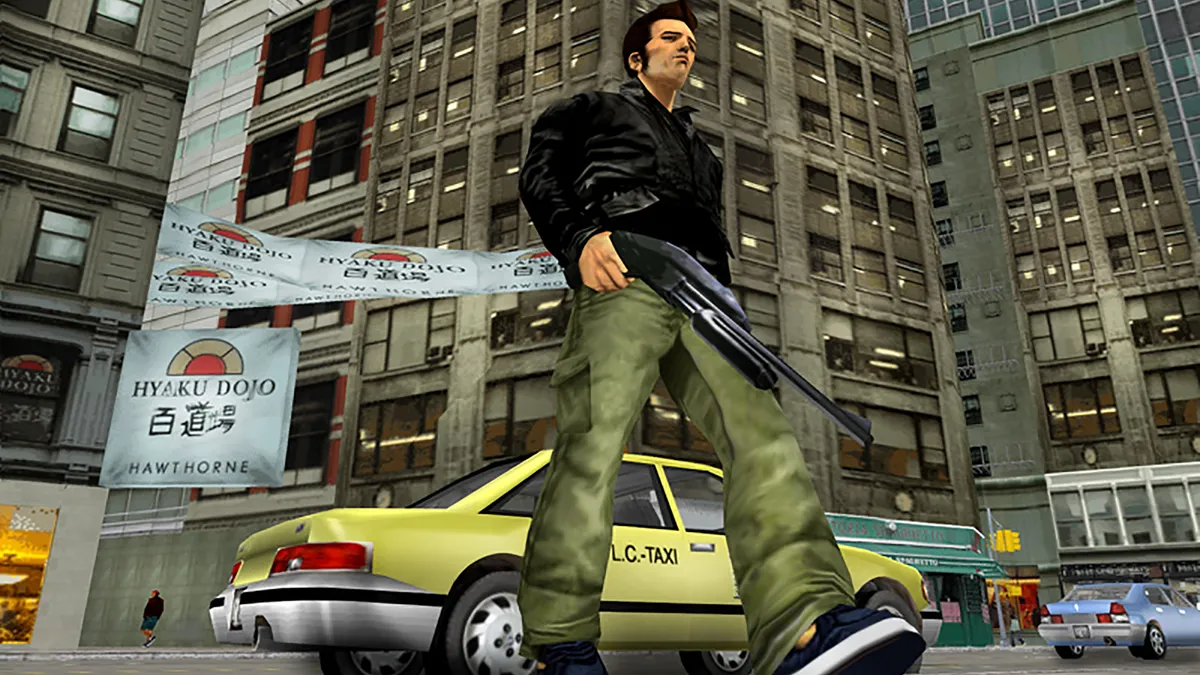
For Garbut's art team, the sprawling 3D city was a canvas on which to paint their vision of New York. This city wasn't the real-life home of Rockstar's producers in the US, but a semi-fictional place pieced together from afar.
"At this point I'd only been there a couple of times," Garbut says. "There was no internet in the studio at first, there was no Google Maps. I just had a little box of 35mm photos a couple of us had taken on a trip there."
Old York

Instead, DMA's reference material came from old films and television. Liberty City mimicked not the glamour but the gloomy mundanity of urban life – soggy streets, grey concrete, dark water, and litter. It was an approach that played to the strengths of PS2's limited fidelity, capturing mood rather than detail.
"We wanted to lean into the grime, the rain, the weather," Garbut says. "We had also made a call to add a dynamic weather system and time of day, and this helped leverage that. It felt right for the kind of story we had, the kind of characters we had, and the way we felt New York had to be from growing up watching it on screen."
It seems very likely that the whole GTA series owes its cartoonish satire – the warped prism through which it has long viewed America – to this literal and critical distance. While success has brought LA and New York within easy reach of Rockstar North's developers, the studio has carefully cultivated its unique perspective in Edinburgh.

"Right from GTA 3 our focus was always on creating the impression of the place we were building over the reality," Garbut says. "Back then there was far less connection in the world digitally – the sheer volume of content and accessibility these days has blurred the line so much that I don't really feel like a cultural outsider in the same way any more, but what it did I think was force us to rely on the US we knew from television and film. It was more about an exaggerated impression, the feeling of the place. It gave us more choices and more control in some ways, and I think it served us well."
Rockstar's storytelling has come a long way since the release of GTA 3, to the point where writer Dan Houser's departure last year felt like a serious blow to the company. But even Liberty City's Scorsese-style drama, while broad and daft, served an important purpose.
"It's quite simple compared to how we work these days," Garbut says. "It's lacking any real refinement, but there's a charm to it and a consistency. I'm proud of what it did. It let us figure out a lot of things, it taught us what we could do better and with Vice City we were already on the path to do that. There were certain choices – a silent main character, for example – that we moved away from quickly, but we have always been good I think at re-evaluating and moving forward."
Concrete tower

"I'm someone who immerses myself in the aftermath, good and bad. Trawling every comment on a video, reading forums and fan sites. It all helps, though, I think. It helps ground things and form an understanding of what worked and what didn’t.”
The story of Claude and Catalina was a blueprint. So, Garbut says, was GTA 3 as a whole. There's little in GTA Online today that can't somehow be traced back to this strange, grey game. Its foundations were so firm, in fact, that its sequel was released to critical acclaim just one year later. You might argue that Vice City is the most successful reskin of all time, though that description does a disservice to the power with which Garbut's art team evoked the '80s, using pitch-perfect costumes and coloured lighting.
"We are building on the path we started on GTA 3," he says. "We are building on that game and evolving it every day, to this day. We carry all that experience and expertise, the stuff that is impossible to replicate that is down to working together forever, to knowing the people you work with and what they know, what each person brings and how to get the best from them."

Long before Rockstar North was a household name, Garbut went to art college. There he studied fine art, and learned that drawing, painting and sculpting was all about 'roughing it in' – getting the basic structure right so that the artist can refine over the top. He sees GTA 3 in those terms.
"The 'squint a bit and it looks kind of finished' sort of idea," he says. "It's how I've always approached both building our game worlds and the games themselves. GTA 3 was as resolved as we could make it at the time, but for today's standards it's simple and rough. Things have come so incredibly far, the detail and depth and sophistication, the interplay of the complex systems we build these days. Squint a bit, though, and it's still the foundation we have built on and I love it for that."
Our GTA 6 guide details everything you need to know about the story, gameplay, and world so far! Or, check out our best GTA games list for what to play while you wait!

