





D&D World of Warcraft isn't trying to be like the MMO.
Alright, so that may sound counterintuitive. After all, the book – which was just announced at Gen Con 2026 – takes us back to Azeroth with all the familiar classes and species you'd expect. But D&D World of Warcraft isn't interested in slavishly recreating the video game. That isn't ever going to work, so principal game designer James Wyatt took a different approach.
"So much of what I love about WoW is really intangible," Wyatt tells me when we sit down for an exclusive deep dive into D&D's trip to Azeroth. "That's very hard to put into a book, and the process of doing something like this is not about translating mechanics on a one-to-one basis. It's about evoking the feel of playing one of these characters of this class and this species, even fighting this boss in a dungeon."
The core D&D World of Warcraft book just went up for pre-order at Amazon, and it hits shelves November 17, 2026. There's an entire slate of content releasing alongside it, from a map pack and Dungeon Master's screen to bespoke miniatures.
The promos we've seen so far are exciting, but avoiding that temptation to simply play the hits is what tips me into 'fully seated.' You're never going to capture everything that makes WoW so beloved on pen and paper, and it's a fool's errand to try. But you can nail how it feels, as well as straying off the beaten path the video game never allowed.
"This is your chance to explore Azeroth as you never have before," Wyatt promises.
From Teldrassil to Darkshore

While the crossover will be launching with 11 new species for us to play, six brand-new subclasses alongside three updated ones, a chance to explore major locations from across Azeroth, and seven dungeons drawn from the video game's most beloved raids, this isn't the best bit for Wyatt.
"It's the stuff you can't do in the MMO that I'm most excited about," he says. "My Night Elf character can have a completely different origin story than any Night Elf character in World of Warcraft, because they all have the same origin story [in the MMO]. I can choose any background from the D&D Player's Handbook. I can be a Night Elf sailor. What does that even mean? Turns out I ran the ferry from Teldrassil to Darkshore until Darkshore blew up. That is my origin story. So, just opening up the possibilities is the most exciting part."
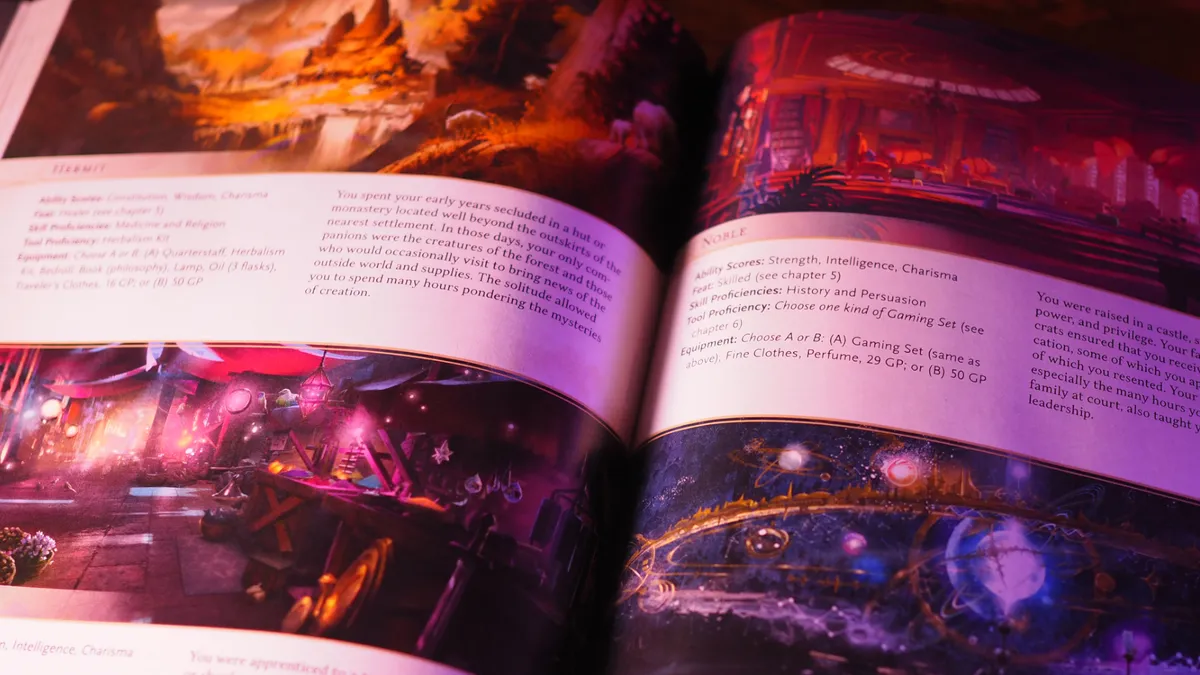
You may have noticed Wyatt referencing the backgrounds in 2024's Player's Handbook, and there's a reason for that. There aren't any bespoke backgrounds in D&D World of Warcraft, and this is simply due to space. "If we ever did a second book, that would be high on my list of things to do," says Wyatt.
Not that revisiting classic dungeons isn't exciting, of course. In terms of size, these are "more than mini and less than maxi." These range from two pages long for Onyxia's Lair to around six pages for the rest, and each one comes armed with everything a Dungeon Master needs to lead their party into the dark – a map, boss stat blocks, encounter tables, treasures, inhabitants, and inspiration for why adventurers might go there in the first place.
Long-time fans won't have any trouble recognizing these famous settings. Aside from Wrath of the Lich King's Azjol Nerub, all of them are classic dungeons – including Blackfathom Deeps and Dead Mines. Actually, the problem was knowing where to stop.
"Our original list was a lot longer, and then we realized that we needed more space for each one than we originally planned," Wyatt admits.
Delving into the past

With all this talk of 'classic' dungeons, will the book take place during a specific time period? No, Wyatt tells me – and that's because it focuses on the themes that define WoW instead. This in turn dictated which dungeons made the cut.
"The adventures chapter starts off by talking about the main conflicts of Azeroth, which are the conflicts that have driven all the expansions of the game," says Wyatt. "In the same way that the Dungeon Master's Guide talks about choosing three conflicts to drive your campaign, that's the way we're presenting these. You could choose to build your campaign around the Burning Legion and the Dragon Flights and the Scourge, and so the dungeons were chosen to have some connection to those major themes."
With that in mind, some dungeons include sidebars that let you tweak its foes based on time period. The book's take on Blackfathom Deeps uses the Naga version, for example, but there's a section detailing how to tweak it for when Twilight's Hammer moves in.
While I'm sure navigating 20 years of in-game history like this was a headache, nothing compares to the tangled knot of jury-rigging D&D classes to fit WoW. This ended up being a unique challenge for Wyatt and the team, because there's no one-size-fits-all solution – some builds could be represented accurately with added Feats, while others required all-new subclasses. This is what made the project "really fun from a design perspective."
Something new, something old

To help you recreate WoW's distinctive classes, the book begins by recommending certain combos to reflect those ideas. (The Mage could be created using D&D's Evoker Wizard with a handful of specific Feats, say.) This isn't always what you might expect; if you want to create a Shaman, for example, you're pointed toward D&D's Barbarian class "which surprises people," Wyatt says with amusement.
New subclasses are then introduced if the build requires more work, like the Oath of the Ebon Blade for Paladins which represents a Death Knight. Some of these update previous ideas, such as the Warrior of Mystic Brews subclass for Monks that tweak the Drunken Master we saw in Xanathar's Guide to Everything. (The Barbarian's Path of the Elements does something similar but on a more radical scale – it's 90% new compared to its inspiration, Path of the Storm Warrior.) Others are entirely new, like the Paladin's Oath of the Holy.

Although D&D World of Warcraft features plenty of original art (particularly in the first chapter which covers the many species on offer), it also makes use of existing work. Wyatt informs me that "there is a lot of of art picked up from Blizzard, not from in-game stills, but actual art, including art done for the WoW trading card game and Hearthstone."
You'll certainly have enough to fight using these builds. Wyatt explains that the bestiary is crammed with foes who fit the book's themes, from demons and dragons to representatives of the Horde and Alliance. That stretches to famous faces like Arthas the Lich King, Anduin, or Thrall.
Crucially, though, these adventures will be distinctly yours. Rather than sticking to the linear path laid out by the MMO, your shackles are off and your leash is cut.
"This is where you can interact with anything you can see, you can talk to anyone you meet, you can learn about the world first person in a whole new way," Wyatt says when I ask what he thinks will tempt WoW fans to try this D&D crossover. "It super excites me. I think it's gonna excite everybody."
D&D World of Warcraft has an early access launch on November 3, 2026. A full retail release follows on November 17.
It's been a busy Gen Con for D&D so far; alongside revealing a long-awaited Dark Sun revamp, a new imprint called D&D Icons resurrects Greyhawk, Dragonlance, and more with new books from legendary creators.
- Check the latest D&D products at Amazon

