




I love Silent Hill. I love the tension of exploring the twisted nightmare forms of real environments, pursued by bizarre creatures eager to make me one more body lost among the fog. Shifting the setting from Americana to Scotland with Silent Hill: Townfall, laden with UK-specific '90s details, made me incredibly excited. Even so, despite holding a candle for Silent Hill, Resident Evil, and more, I'm a scaredy cat at heart. Many horror movies are off the cards for me, and there's one gaming mechanic I struggle to vibe with above all others in horror games: having to hide from patrolling enemies.
Whether that's the gory heights of Outlast or the psychological hauntings in Amnesia: The Dark Descent, I nope out nearly instantly. In our Silent Hill Townfall review, we praised how it's "full of real fear, impeccable atmosphere, and a distressing story of remorse and penance". So, when I found my first cupboard with a 'hide' prompt, foreshadowing the hiding mechanics that loom large from start to finish, I began to get worried. That was until I got used to Simon Ordell's CRTV, the chunky, almost Game Boy-like device he clutches throughout the nightmare trip that is Silent Hill: Townfall.
Screen time

At its core, it functions like the iconic Silent Hill radio, with bursts of static noise alerting you to when enemies are hiding in nearby fog. But, by holding up the screen and tuning it to available signals, you won't just get clues on how to progress, but can pick out the shape of specific monsters.
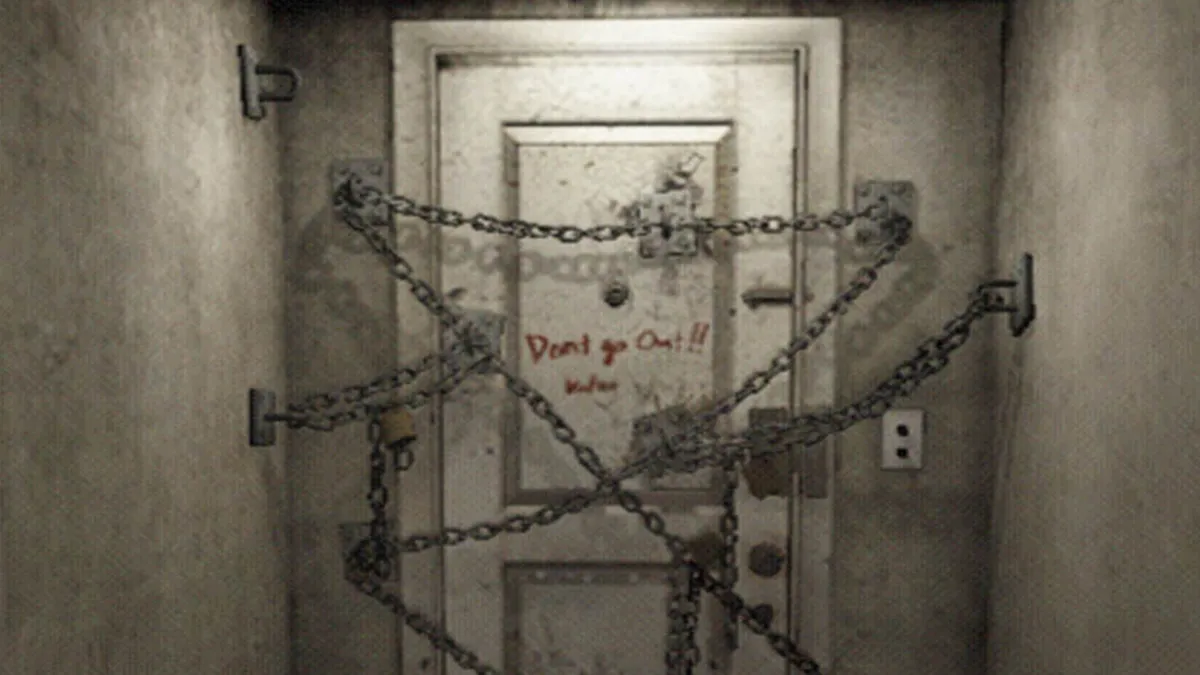
Zeroing in on one, the screen turns red and a darker outline of the creature can be seen through any object. You can keep tabs on a zoomie foe with an axe head running back and forth as you slink through the neighboring alleyway. A maze of gardens and sheds behind blocks of flats could spell doom with one wrong turn, unless I fiddle that dial enough to get an early look at the crouched shapes of enemies writhing on the ground.
Even with the guidance, enemies in Silent Hill: Townfall patrol enough around relatively tight spaces that I still have to put effort into avoiding detection. Sometimes I can use the cover mechanic to anchor myself to the spot and peek around corners, abandoned three-door cars, or the waist-high stone wall of a bungalow front garden. Holding down while peeking allows Simon to flatten himself even further. All the while, I'm clutching my CRTV to add a clearer silhouette to supplement the edge of the enemy I can otherwise barely see. It's the kind of tension I've not felt since Alien: Isolation, where I'm likewise moments away from death at any time.

Often, that can also mean tracking their movements until they look like they're about to double-back, then quickly dipping into the half-open door of a nearby house to 'hide', able to peer through only a small slit with my normal vision.
It's hard to outrun enemies, but Townfall's St Amelia is so full of hiding places that you can usually take a corner and find a spot to duck into. Early on, a monster chases me and continues just beyond where I'm cowered in the dark, instead knocking its head repeatedly on a nearby locked gate, the clanging constantly making me afraid it's about to turn its attention to the doors I'm right behind (make no mistake, they can pull you out if they see you). I soon learn there's an achievement – Isolating Experience – for staying in one hiding spot for at least 60 seconds.
As well as the CRTV you have a map, which roots you to the space – vulnerable – while you peruse it. It's telling, though, that the CRTV can be gripped while still walking around, and, also unlike the map, can be pulled out while in a hiding space. This is the stronger navigational tool you should be relying upon rather than burying your head in a map. The whole world is tinted red, haunted by ghost-like visions of your regret no matter where you are. Can you turn your inner eye away from what you have done before it consumes you? Certainly not. If you do, you're already dead.

Silent Hill Townfall's CRTV is empowering in that it allows you to see your doom coming. In theory, it's not that much more useful than peeking around walls, but it does keep the action pacier, and even encourages moments where I feel like I can step up and bring the danger rather than be hunted.
The whole world is tinted red, haunted by ghost-like visions of your regret no matter where you are.
By tuning into each enemy in a zone one at a time, I can sometimes tell when outlines are trapped behind walls that can't reach me, leaving another vulnerable and alone, its back turned. I could hide, but why not take this destructible plank of wood and get the jump on them?
Sure, in a fair match-up, I'm likely to get my weapon smashed and take deadly hits, but just maybe the screen in my hands can tempt me to be successful with my violence. I'm not always sure the CRTV is a good thing. But this is Silent Hill. What good is left? Here in the fog, we take what we can get.


In my Silent Hill f review I said it has "the legendary horror series' most unsettling atmosphere and writing to date". Between this and Townfall, Silent Hill has made a terrific comeback.
I'm reminded of another horror game that plays with giving the player some slack in the pursuer-pursued relationship – Forbidden Siren. There, Sightjacking can be used to see through the eyes of enemies as you can see yourself illuminated at a distance. Here, the benefit of knowing exactly where an enemy is off-set by the disorientation of the perspective shift. The vulnerability that comes from losing sight of your own body creates an ethereal feeling to the folkloric horror, while also giving me just a touch more control to staying one step ahead of death.
There's a scene in Jane Schoenbrun's Teenage Sex and Death at Camp Miasma – a satirical, tongue-in-cheek deconstruction of slasher movies, which is more along the lines of what I can handle when it comes to horror cinema – where a character describes an out-of-body, disassociative experience that walks a line between terror and reclamation of power, control by way of a lack of control. It's a part of how audiences can enjoy horror movies, but becomes part of Camp Miasma's own text – uncomfortable and validating in equal measure.

In gaming, we're always at a remove. We might be immersed, but we always control a character. It's a framing trick; thinking about Camp Miasma while playing Townfall, I'm conscious that I'm watching through a screen as someone else watches a screen displaying their impending doom. By their nature, games have a lot more room to play with this feeling of distance, to shrug off cinematic ambitions that lock us to one viewpoint, and instead take these complete digital spaces and allow us to look within. A gaming character peering out of reality is, in a way, no different than the player experience often is. Townfall's CRTV outlines are, in a way, an underpowered form of Detective Vision common in the likes of Batman: Arkham Knight or even The Witcher 3.
Yet, conjured and grounded in the reality of this Scottish town that seems completely normal until the nightmare becomes apparent, the simple shorthand of an enhanced vision mechanic is rendered hellish, wrong, yet still no less valuable and necessary for survival. This is the kind of playful horror that reminds me why I always felt so drawn to Silent Hill in the first place. Between Townfall and Silent Hill f, these recent years of genuine reinvention for the series has me incredibly excited for its future, and the horror games it'll inspire.
Shrug off the silence and check out our best Silent Hill games and best Japanese horror games rankings for more!

