





Capcom spent the early part of the current console generation mired in something of an identity crisis. Like much of Japan’s game industry, it spent the Xbox 360 and PlayStation 3 era trying to make games that appealed to the West, mostly unsuccessfully. It began the PlayStation 4 era with some of its most famous series in difficult places. What was Resident Evil after 5 and 6? What was Devil May Cry after DMC4 and Ninja Theory’s own DmC: Devil May Cry? A few short years later, those questions have been answered in style.

This feature first appeared in Edge Magazine. If you want more like it every month, delivered straight to your doorstop or your inbox, why not subscribe to Edge here.
And as so many of its Japanese peers have found, the answer has lain in a return to basic principles: to make games that are true to their host series, rather than titles that seek to appeal to some imagined global audience. And, in so doing, worldwide success has followed. Well, largely. Street Fighter 5 remains the exception that proves the rule, a game built for the masses that ignored it, since refashioned into something its hardened players have learned to accept, if never quite love. Yet in Resident Evil 7: Biohazard, Monster Hunter World and now Devil May Cry 5, Capcom has shown the benefits of staying true to your roots.
The devil is in the detail

In DMC 5’s case, the result is a game that feels like a breath of fresh air despite how clearly it is rooted in its own past. It largely follows the shape and structure of the 15-year-old Devil May Cry 3. You kill enemies for red orbs to spend on new moves; you defeat bosses for new weapons to make killing enemies for red orbs feel different and more fun. It is a game about stylish, flexible combat, just like always, that is made immeasurably more stylish and flexible by the advances in video game technology that have occurred since the template was first laid down. This is not rocket science. No, it is something far more magical than that.
It feels all the more so in the context of the contemporary game industry. There was no baffling PowerPoint slide to explain all the special editions and early-access options across different platforms. There is no levelling curve to climb, no endless endgame to keep you coming back day after day; it is a game that can be blitzed through in a weekend and replayed only for the love of it. There is no Season Pass. Following the game’s announcement last summer, there was a brief, worrying spell in the headlines when it emerged that microtransactions would feature. The final game contains a remarkably well-hidden option to speed up the rate at which you unlock new moves. We had to go looking for it, and the game hardly feels balanced towards it. We watch the credits roll with only the most expensive of each of the three characters’ available moves still locked off – and it’s clear these are carrots to simply keep playing the game, something to chase on a second playthrough rather than punishment for not getting our wallets out.
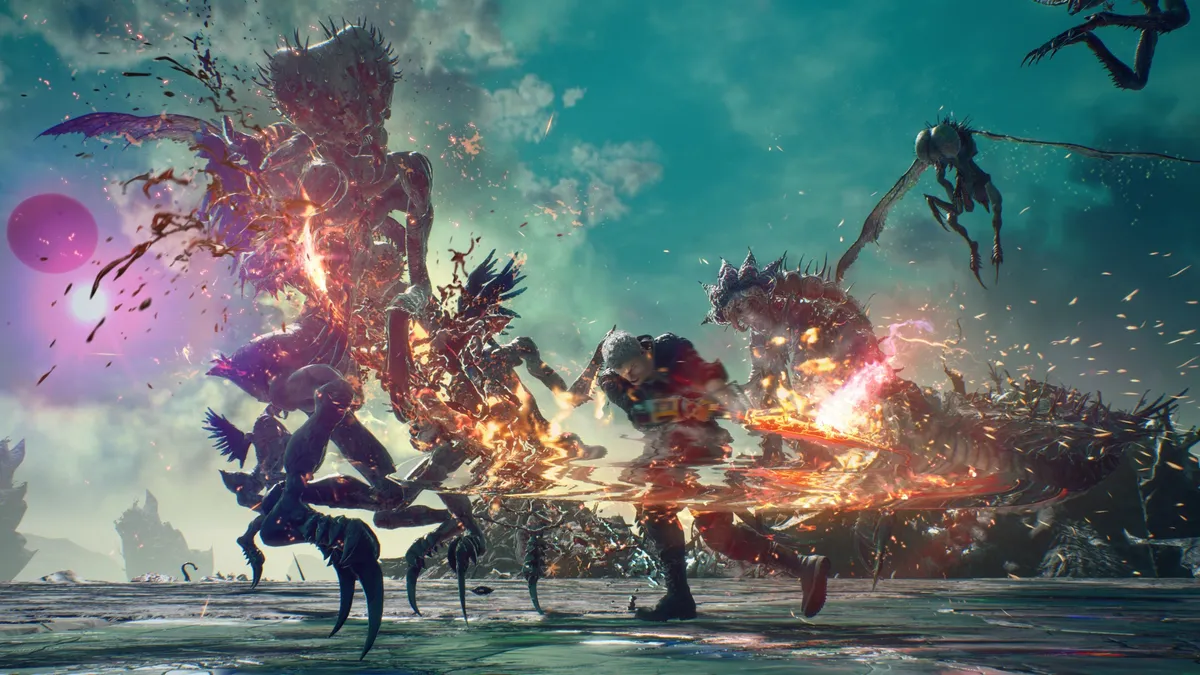
"Street Fighter 5 remains the exception that proves the rule, a game built for the masses that ignored it"
And where there are concessions to modern convention, they do anything but follow the crowd. There is multiplayer here, but it is weird and silly and actually quite easily missed, the game bringing another human in as a character you’re not playing to do battle in an adjacent room. It is not so much multiplayer as it is voyeurism, an incentive to polish off your battle in short order so you can check out the one going on next door, rating them as ‘Stylish!’ – or not; some people are rubbish – at level’s end.
Yes, there are times where the game’s old-fashioned spirit is more blessing than curse. Its women are mere props, there to be gawked, leered or laughed at, as much part of the background furniture as any transit van or Tube sign. And the way it handles loading – into a cutscene then a mission menu, then in and out of customisation screens before finally letting you loose – is old hat in an era of fast texture streaming. But this is Devil May Cry, pure and simple, and its hackneyed missteps are all for the greater good.
Resident Evil 8 is called Resident Evil Village, find out more about it now.

