





Valve finally lifted the lid on its Steam Controller this week, and early reviews on the $99 / £85 gadget scheduled for May are sparking debates. I've yet to try out the accessory, but having just spent the week testing the Retro Fighters StrikerDC, a wireless Sega Dreamcast gamepad that uses the 2000s retro console button layout, I've got a newfound appreciation for Valve's original gamepad vision.
Let me get one thing straight: the Retro Fighters StrikerDC is nothing like the new Steam Controller. I'm not trying to pitch what is essentially a wireless remake of the Dreamcast pad with a single hall-effect joystick and a receiver cradle for Sega's VMU (Visual Memory Unit). What I will say is that it highlights gaming tech history repeating itself, as Valve's accessory is going through the same evolutionary process as Sega's pad before it.
Gamepad designs used to be a by-product of problem-solving. Hell, if you stretch back to the Pong era, some of the first cartridge-based consoles, like the Epoch Cassette Vision, you had to twirl knobs on the system itself. Add a few extra buttons here, a new-fangled 3D "control stick" there to combat the horrors of three dimensions, and you have what looks like a contemporary controller, but today's conventional pads could have taken a very different path.
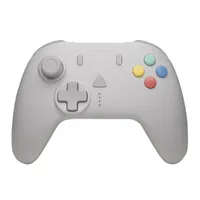
The Dreamcast controller, and by extension its StrikerDC wireless remake, are the blueprint for modern-day Xbox controllers. Yes, the OG version looks like the Millennium Falcon and is missing a stick, but if you draw from Sega's accessories to Microsoft's Duke and beyond, you'll see a gradual evolution that makes complete sense.
Yes, the Dualshock has existed alongside Xbox-flavored designs for decades, but even Nintendo ended up eventually switching to the asymmetrical, dual-stick layout used by most of the best PC controllers today. That's where Valve comes into the picture, as it arguably tried to retreat to the Dreamcast format with its 2015 Steam Controller, and as a result, it's now on a journey that's easier to understand when you've used Sega's old layout.
Ultimately, the problem Valve is looking to solve with its Steam Controller is playing PC games on a console-shaped box. That box will be primarily the Steam Machine, and while conventional controllers work just fine on your rig, the storefront giant is trying to bridge the compatibility gap with touchpads and grip-activated gyro. That's not unlike Sega's original struggle trying to facilitate compatibility with 3D games, a fight it bowed out of early after the Dreamcast's demise.

Just like the Dreamcast pad, the Steam Controller has already had its awkward growth phase with the 2015 version. It also used just a single joystick, going all in on the idea of touchpads instead. Again, similar to Microsoft post-Sega, Valve then course-corrected its approach with the Steam Deck OLED before eventually landing on a new design that is poised for the next age of console gaming.
The reason I'm even taking a step back to look at the evolution of controllers is the Retro Fighters StrikerDC. It's one of many modern pads for your old console today that takes a historic layout and transfers it onto something "Xbox-shaped", which feels a bit like gamepad cross-pollination. That's not remotely a bad thing, as the end result is a wireless accessory that works with Sega's OG system while still retaining the right format for its library.
It's practically the same quest as the new Steam Controller. Valve may have had to concede that its original design was too PC-genre specific, but the new version fuses conventional elements with the same design philosophy. In my mind, the StrikerDC and even other console pads like the 8Bitdo N64 controller highlight paying equal respect to specific layouts while holding onto what players are used to can result in maximum comfort and compatibility.


The question is, will Valve nudge the entire gamepad ecosystem in its chosen direction this time? I could really see that happening since Microsoft's Xbox Project Helix is gunning for the same PC and console game abilities as the Steam Machine. I like to think that will lead to a reality where, just like with the StrikerDC, we'll eventually get "classic" PS5 and Series X controllers that ditch the touchpads and other standardised elements to provide an authentic way to play 2020-era releases, and I genuinely think it takes using pads by the likes of Retro Fighters to illustrate that.
I'm excited for the future of gamepads, but I am still sad no one carried the mantle of Sega's cyberpet-inspired memory card. VMU, I'm dreamin' of you.
Looking for ways to play Dreamcast on the go? Swing by the best retro handhelds for emulation systems and more.

