





GamesRadar+ Verdict
A lean fusion of sci-fi action and eldritch horror that alternates between introspective narrative and madcap combat, Saros is Housemarque's largely successful attempt to broaden the appeal of previous roguelike Returnal without sacrificing anything along the way. The final result is pure atmosphere, and sticks with you in all the right ways.
Pros
- +
An arresting, challenging story
- +
A haunting world that's fiery with atmosphere
- +
Fast-paced gameplay that grabs you by the adrenaline
Cons
- -
Mechanically thin in places
- -
Some plot points are a little too obvious
Why you can trust GamesRadar+ Our experts review games, movies and tech over countless hours, so you can choose the best for you. Find out more about our reviews policy.
Saros comes together with a single line: "How does it endure without entropy?" It's a throwaway comment in reference to alien machinery, but something about that idea permeates through the entirety of Saros, the latest third person bullet-hell shooter and sci-fi roguelike from Housemarque and Sony. How does something important last without breaking down? How does a person cheat death and persevere? And do certain gameplay ideas hold up when revisiting them half a decade after inclusion in your previous work?
The questions will stay with me long after the final credits have rolled, as while Housemarque has duplicated slightly more of their previous game than was probably necessary, the final result is still an excellent example of effort, artistry, and extremely incandescent artillery.
Return, all

Release date: April 30, 2026
Platform(s): PS5
Developer: Housemarque
Publisher: Sony
Sent to investigate a missing mining colony on Carcosa, a planet flush with precious unobtanium, corporate security Arjun Devraj (Rahul Kohli with a perpetually furrowed brow) wakes up to discover he's lost all memory of his arrival, his ship has crashed, half his team has gone murderously bonkers, and the sun-scoured world they've dropped onto is full of twisting roguelike paths through the ruins of a dead civilization.
Well, not so dead that it isn't prowling with weird monsters and still-functional security systems. In the skies above, erratic solar eclipses herald eerie changes in both the native monsters and the visiting humans, infusing events with eldritch horror. And even beyond that, Arjun keeps coming back to life every time he's killed, a fact that frankly nobody on the team seems sufficiently curious about.

The inspirations are as apparent as they are endless. The game is an overt homage to R.W. Chambers' 1895 story collection The King in Yellow, but there's also general Lovecraftian lore in there, as well as elements of Solaris, Danny Boyle's 2009 movie Sunshine, Alien, Dead Space, and the Silent Hill franchise; all mixed with Hindu symbolism and iconography. Yet the one light that shines brightest here is Returnal itself.
Like Returnal, Saros is about a spacefaring explorer with a troubled past, dropped on a hostile planet where linear time is more suggestion than doctrine. The quick bullet-hell combat and platforming-focused exploration is basically the same, the tone is near-identical, the roguelike mechanics are frequently one-to-one translations, and some of the enemies might even be cameos or reused assets, depending on how generous you're feeling. I suspect the only reason this isn't called Returnal 2 is because Returnal's niche appeal couldn't justify the choice.
Bullet points

Whether familiar to you or not, it's Saros' combat that will stick with you. It's a fast-paced experience about snap-decisions and moment-to-moment reactivity based on what the enemy is throwing at you. Blue bullets? Shield! Yellow beams? Dodge! Red balls? Parry! It's appropriate that unbroken kill combos power you up with an "Adrenaline" meter, as twitchy, lower-brain, flow-state thinking overrides all higher functions by the end of a good battle, your heart thundering in your chest after several minutes spent flying purely on instinct.
Still, I'm a bit disappointed by the selection of guns. There are five main weapon types and four flavors of super attacks with variations on each, but that's not enough to stop things from eventually getting repetitive, as when you're vaulting over laser beams, one handgun tends to feel like another. And aside from the standard shooter fare – pistol, shotgun, assault rifle, crossbow – the only conceptually interesting weapon is the blade-shooting Chakram launcher, which ends up being too fiddly to be viable in the frenetic chaos of combat. A couple more wildcards in Saros' arsenal certainly wouldn't have gone amiss.
See the galaxy and meat people
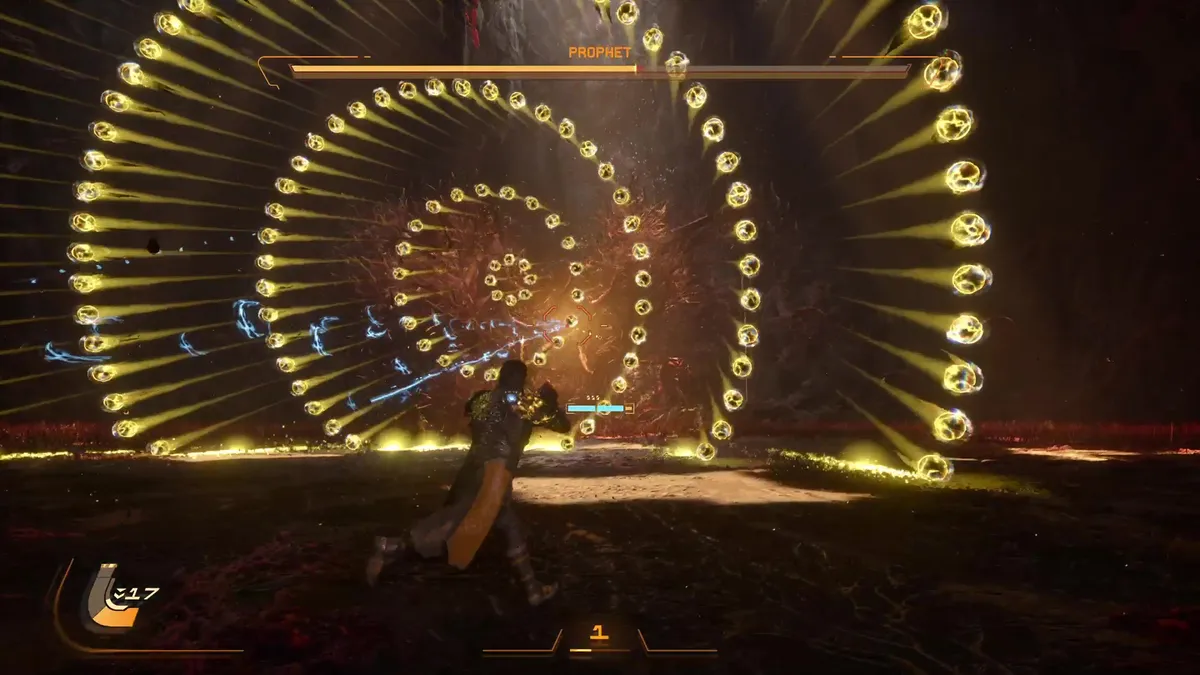
Some of the later boss fights are magnificent in their cinematic splendor.
In Housemarque's effort to make the roguelike experience more accessible, the studio arguably sands down an edge or two more than necessary. An easier start gives way to heftier challenges in the mid-game, but then somehow ends up easier than ever near the finale, which I can't imagine is intentional. This is due to a system of permanent upgrades that allows you to spend resources on better stats and abilities between runs, as well as a system for tweaking difficulty by adding in various gameplay modifiers. It's nice that no run need ever be entirely wasted, as you can spend the cash you earned back at the middle manager vending machine who lives in the hub zone, but a bit more balancing wouldn't have gone amiss.
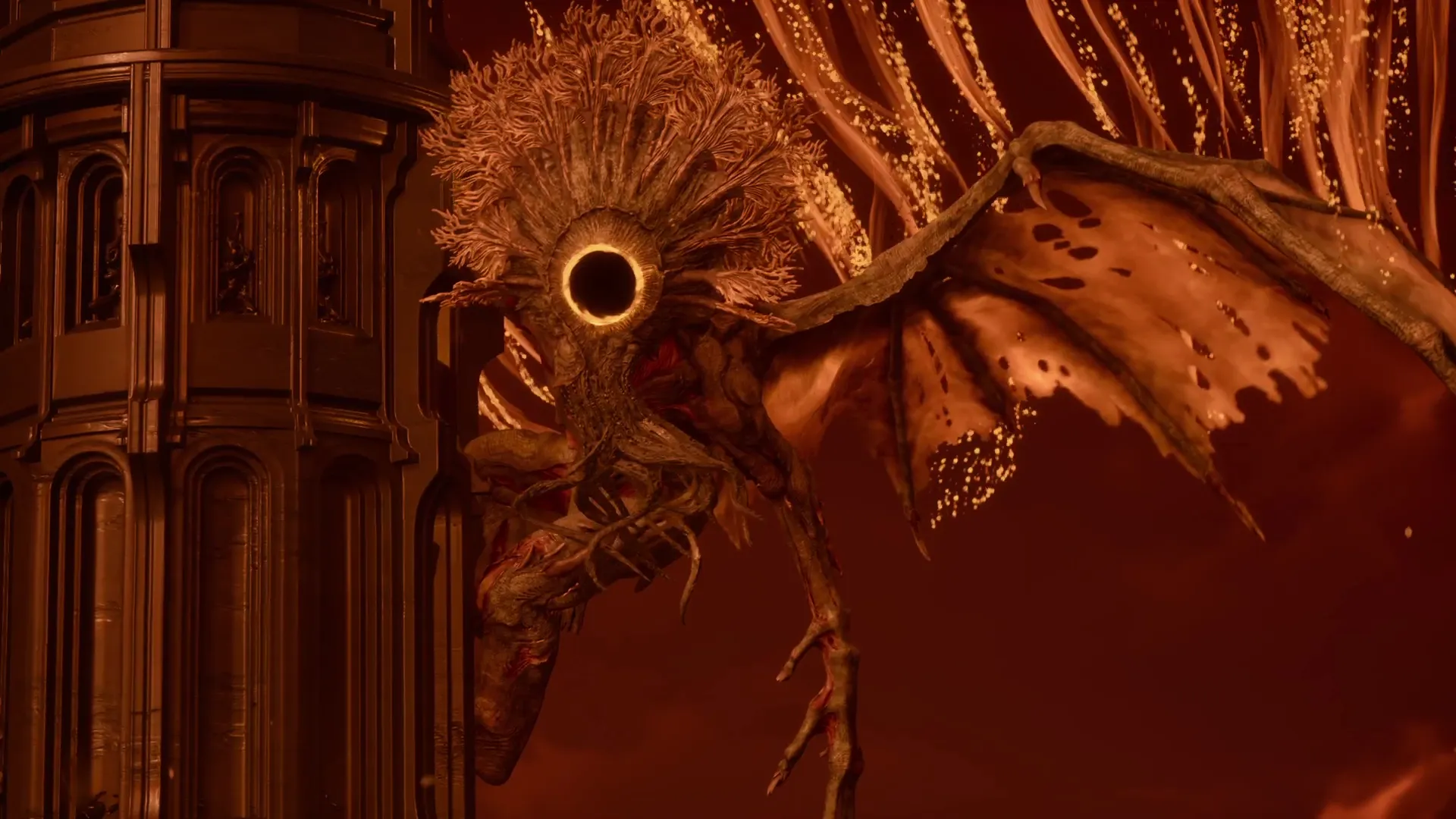
But, there's plenty more factors to elevate the experience again. Some of the later boss fights are magnificent in their cinematic splendor, and there's a strong sense of aesthetic across the board. In Saros, the omnipresent sun stands at the centre of everything, but this isn't a hearty, healing summer warmth. The light from above is terrible and portentous, with a mixture of drone metal and synth-laden electronic music setting a harshly awe-inspiring tone. There's a grim sense that you are being toyed with by higher forces, the eclipsed sun a merciless eye that sees everything. Meanwhile, constant themes of sand and dust give events a literal gritty quality, as is the uncomfortable and loaded image of grasping hands that recurs throughout.
Going rogue
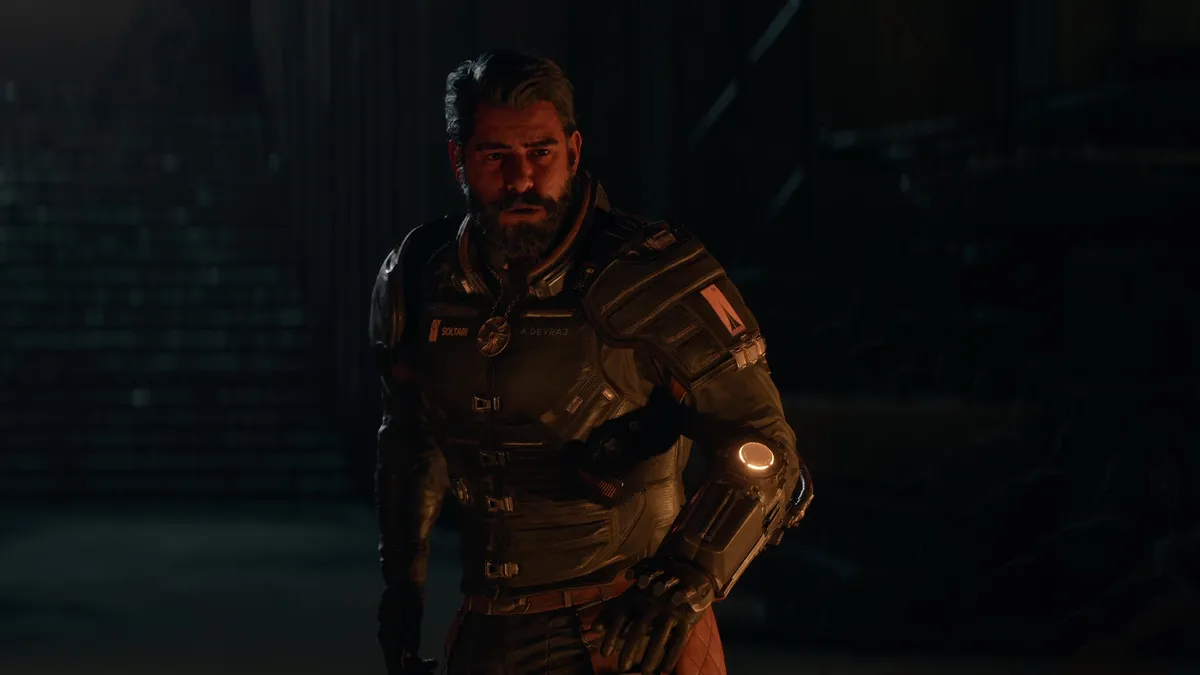
All the theming, of course, centers around our protagonist, and Arjun Devraj is a strong character for all this to hang on. Early on, I worried he was going to be a bit of a generic Joe, but more fool me – that's just Saros playing its cards close to its chest for the first act. His unwavering desire to rescue the lost colony comes across as a blandly heroic motivation until we discover that Devraj has had more going on than he's been willing to admit, adding layers of complexity that gradually turn an off-the-rack protagonist into something much messier and more interesting.
Kohli – a proven actor – isn't always given a huge amount to work with, but things always get interesting when the script allows him to show off his skills. An early flash of rage where he sweeps everything off a table would feel de rigueur in most meathead action protagonists, but Kohli and the scene direction sells it as something more, especially when it flies in the face of the focused, level-headed soldier we've been experiencing until now. As a result, it's a lurch that forces us to reconsider our leading man, especially in the context of a story where characters are becoming violently unstable. A dark sign of things to come, or an understandable outburst in a high-stress situation?

More broadly, the storytelling is decently handled, with some good ideas and creative choices, though I'd say the narrative struggles a little when it comes to plot beats outside of Kohli's core arc. Several characters feel a bit caricatured, there's certain cosmic elements I would have rather remained mysterious instead of being plainly spelled out, and there's a couple of plot twists I'd predicted several hours before their scheduled reveal, which did puncture the "ta-dah" moment slightly. Still, the ending brought me back around, and I walked away from the story with that pleasantly ponderous feeling you get from all good science-fiction, knowing I'd be thinking about it for a while afterwards.
Back to the beginning

By the end of Saros, the answer to "how does it endure without entropy" is clear: it doesn't. Perhaps that's why it's not a hugely long game – a dedicated player can kill it off in a week or two – which is a wise choice for something that doesn't want to overstay its welcome and keep the good bits condensed.
So, while Saros can't help but exist in the shadow of what came before and invite comparisons that aren't always to its benefit, this is still Housemarque doing what it does best, and a strong rebuke to the idea that thoughtful or emotive stories in games always have to be paired with slow or minimalist gameplay. Explosive action and cerebral storytelling – you can have both.
Saros was reviewed on PS5, with a code provided by the publisher.
Not ready to leave the cosmos? Find out all the best sci-fi games out there!

