GamesRadar+ Verdict
I was excited about the Corsair Galleon 100 SD as soon as I saw it at CES, and I'm glad that I've enjoyed my time with the deck as much as I thought I would. Combining both a keyboard and Stream Deck in one has had one of the biggest impacts on my day to day gameplay I've experienced in years of testing. Its price tag runs a little high at launch, and there are alternative ways to get close to full functionality (and sometimes extra features) for less. It's still been a game-changer in my setup, though.
Pros
- +
Excellent additional controls
- +
Super easy setup and full access to Elgato plugins
- +
Smooth, soft typing experience
- +
Vivid lighting
Cons
- -
Encountered some software issues
- -
Value won't make sense for everyone
Why you can trust GamesRadar+ Our experts review games, movies and tech over countless hours, so you can choose the best for you. Find out more about our reviews policy.
Corsair seems to be having a good few months. Out of the dust left behind in the Vanguard Pro's sprint to the top of my best gaming keyboards list emerges a mechanical keyboard that finally blends a gaming-ready deck with the brand's Stream Deck functionality.
The Corsair Galleon 100 SD has a lofty price tag, though comparative Stream Deck functionality will cost you about $200 by itself (looking at the Stream Deck Plus) and the quality of the keyboard part of the equation stands up to the remaining $150. That is, however, presuming you need the dials and display. Problems with those numbers occur if you're just after the buttons themselves.
Price | $349.99 / £309.99 |
Type | Mechanical |
Connection | Wired |
Size | TKL (plus Stream Deck) |
Switches | Corsair MLX Pulse |
Keycaps | PBT Doubleshot |
Media keys | Dedicated Stream Deck panel |
Wrist rest | Detachable |
USB passthrough | Yes |
Design

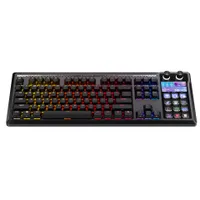
Would you call the Corsair Galleon 100 SD a full sized gaming keyboard or a TKL one? I'm torn. Its form factor on the desk is going to feel like a full-width model, restricting mouse movement slightly. And yet the actual keyboard portion is a TKL design. This is a hybrid of sorts, Corsair continuing to experiment with layouts following the Vanguard Pro 96's squashed shape.
However you choose to see it, the Galleon looks pretty slick on the desk. The shining lights of the Stream Deck on the right, combined with that 'Mood Light' bare along the top and a collection of bold, vibrant RGB LEDs makes for an impressive showpiece.
The Stream Deck portion is fully baked in. Would it have been nice to have the option to swap it to the right-hand side for wider mouse sweeps? Maybe, but I'm just happy it's here in the first place.
You're paying $350 for this deck, and the build quality pulls its weight. While you're not getting the dense block of a Keychron model, the black aluminum chassis feels solid and premium and gasket mounting and sound dampening under the hood keep things echo-free under the fingertips.

There's a very slight wedge shape to the chassis itself, but it's far from enough elevation by itself. Two flip-out feet add extra height for a more comfortable experience, even if the included wrist rest feels just a little too high for me personally. It attaches magnetically and provides a cushioned position for the palms, but my hands feel like they're hanging just a little too far up the deck to feel truly nimble. I generally preferred using the Galleon without the included rest.
Keycaps

Thick PBT keycaps keep the typing experience firm and snappy, while those longer legends do a good job of keeping RGB backlighting uniform and consistent. I can only see one instance where those LEDs aren't making it across the full text, on the Enter key, elsewhere everything else looks super tight.
The caps themselves are curved nicely to provide extra precision support while still offering a satisfying grippy texture up top. That means no slipping, less chance of shine build up, and a tactile grainy feel under the fingertips. It's my preferred style of keycap, but those who like to keep things smooth may want to swap these toppers.
Switches

Under the hood we've got a full set of Corsair's MLX Pulse switches. I first took these purple snappers out for a spin in the ill-fated Corsair MAKR 75, and fell in love with them there. Without that FR4 plate in action there's a little less snap to the overall experience, but they're still smooth, thocky, and rattle-free.
With 45g of actuation force they're not the lightest on the market, but hold up particularly well for accuracy. A 2.0mm actuation distance avoids accidental presses as well. They're not for skating across the top of a deck, but they resist fatigue particularly well. All that, with a nice crisp auditory response - excellent.
The entire deck is also fully hot-swappable with three and five pin switches to boot.
If you've been following gaming keyboards closely over the last year you might notice some absences here. The Corsair Galleon 100 SD doesn't use magnetic switches, instead opting for a full mechanical existence. That means you're dropping some core gaming features like rapid trigger for faster repeat presses, customizable actuation points, and multi-step inputs. Considering this is already a $350 deck, though, there's very little room for Hall effect clackers in this price tag - even if Corsair's latest MGX V2 options are some of the best I've tested yet.
Software

The software is a sticking point for me, but I'm hoping it won't be in a few weeks' time. I've been testing the Corsair Galleon 100 SD with a beta version of the Corsair Web Hub and Firmware Tool. I haven't had a great experience with it straight off the bat.
The Web Hub refused to recognize the Galleon as a connected device until I updated the firmware. I couldn't update the firmware until the Web Hub recognized the keyboard. You see my conundrum.
Using a beta build of both allowed me to get in long enough to start a firmware update, at which point I lost connection again and the entire keyboard bricked itself.
I've been assured by Corsair that this is a rare occurrence and considering Web Hub has been running smoothly for all the other gadgets I've tested with it, I expect the issue comes down to pre-release software.
After all, with a full reboot I was able to connect and update the deck and have had a fairly smooth ride ever since. The Web Hub is still a little sticky, often refusing to save RGB lighting tweaks to the actual keyboard but it's got everything you need.
I'll be keeping a close eye, returning to the Galleon regularly, and will update here.
To set up the Stream Deck portion of the Galleon you'll need Elgato's dedicated software. This runs like a dream, dragging and dropping different functions and commands onto the deck to create profiles, pages, and presets galore. It was easily my favorite part of setting up this deck - I could spend hours building and tweaking different setups. You'll also have access to the massive supply of plugins via the marketplace as well.
Controls

This is where things get good again.
By now you know there's a full Stream Deck tacked onto the side of the Galleon, with 12 full-color buttons to play with, two control dials, and a 5-inch display sandwiched between them.
It's an unprecedented amount of control from a single keyboard, removing the need for static dedicated macro buttons, media playback, and system settings. If you do it on your PC, you can build a list of shortcuts for it.
I've got everything from a Spotify command center to all my usual work links and commands set up, alongside dedicated profiles for Planet Coaster, The Sims 4, and Baldur's Gate 3. Keeping all that right next to my keyboard makes for a far more streamlined experience compared to a separate device. I've used the Mountain DisplayPad for similar functions for some time now, but it's never been reachable enough to accommodate many of these controls. Sure, they're rudimentary for now (though you can buy dedicated profiles for a massive range of games that go into more depth), but they keep all my usual commands within closer reach.
The screen up top has space for four zones of control, ranging from swapping between profiles to changing volume to displaying the weather. There's not a lot out there for this setup just yet, so launch options are fairly limited. I'm hopeful more plugins and uses will come to light shortly, though. There's plenty of potential in this element.
Connection

The Corsair Galleon 100 SD does something I haven't seen in a long time. It uses two USB-C connections to hook up to separate USB-A ports on your PC, only to give one of them back to you via a passthrough hookup along the right edge. It's an odd setup, though perhaps helpful if you need a peripheral plugged in closer to your mouse hand than your rig will allow. Still, it's a little strange to keep two cables trailing across the desk.
The best wireless gaming keyboards have their place in portable setups, but they're generally only useful for keeping your setup clutter-free. If that's a priority, the $350 price tag for not one but two wires is going to sting. Still, the deck runs just fine in everyday life with only one cord connected.
If you're a particularly competitive player you'll also be glad to see an 8,000Hz polling rate in here. That's a feature only the top 1% will even notice, though.
Typing
There was a time when I would loathe to write up an article on a Corsair keyboard, but the brand has knuckled down on its build quality in the last couple of years and the Galleon 100 SD is free from any of the echo and ping I used to experience. This is a snappy, well-dampened typing experience with a smooth feel and just the right amount of resistance underneath each cap.
The Asus ROG Azoth is still going to give you a little more spring, there's slightly more depth to each press here making for a slightly heavier feel. It's also lacking a little of the richness you'll find in a more substantial chassis like the MAKR 75 or a Keychron deck. Still, it's satisfying to use and listen to, while remaining light on the fingers and tight in all its lovely mechanical parts.
Gaming

While Corsair has removed magnetic switches from the equation, the Galleon still has plenty in its arsenal for both casual and competitive players. On the fly macro recording, SOCD settings, and space for up to five onboard profiles (not counting the Stream Deck) keeps things up to pace with other mechanical options.
That extra control panel is the main draw here, though. My Planet Coaster building sessions are easier and faster than ever, and I'm only scratching the surface with my initial profile. There are far more in-game controls to explore across a whole range of titles that will make the Corsair Galleon 100 SD a formidable force whether you're going single-player, strategy, simulation, or competitive.
Switching between profiles is easy (I have mine set on a cycling roster via the control dial), buttons are responsive, actions are immediate, and setup is far easier than other similar options I've used. I'd feel the benefit of this extra panel even if I only ever used it as a launcher.
Of course, the benefits for streamers can't be denied either. After all, this is why the Stream Deck was invented in the first place. With all your controls in one place right next to your hands, tapping through different functions is far easier than reaching over to a dedicated device. That said, if you've already got a Deck on desk you won't find much new here to explore.
Should you buy the Corsair Galleon 100 SD?

There's no getting around it, the Corsair Galleon 100 SD is expensive. It's a great keyboard in its own right, though, and the Stream Deck is one of the most feature-rich and intuitive control pads on the market. That $349.99 MSRP means you'll need to really want both a keyboard and a Stream Deck separately, though. The higher price simply doesn't make sense if you weren't already in the market for a control panel or if you already have one on your desk.
The implementation here is closest to the Stream Deck + model, with its display, dials, and ten buttons. That's a gadget that's going to cost you $199.99 by itself, leaving $150 in the final price for a mechanical keyboard - easy enough if you're after a mid-ranger like the Turtle Beach Vulcan II TKL or Keychron V6 Max. The typing experience and extra features in here do have both of those models beat, though.
There is far more room in that price if you were to drop the dials and go for the simplest of Stream Deck options. The Stream Deck Mk. 2 holds a $150 MSRP (but is more often found at around $130). That leaves you $200 to pick up a gaming keyboard at the same time, and with that cash you've got a few Hall effect options open to you. The Logitech G Pro X TKL Rapid and NZXT Function Elite, for example, will get you more switch features with the same macropad functionality when bought alongside the cheaper controls.
That's where the value of the $349.99 Corsair Galleon 100 SD starts to fall a little short. Put simply, if you're not fussed about the screen and dials (and considering I found them to be a little under-utilized in everyday play at launch I wouldn't blame you), it makes more sense to opt for two separate devices.
The benefit of grabbing the all-in-one device is just that; your keypad, display, and control dials are right there. It's not a feature that should be overlooked - actually using these customizable clickers is far easier in this implementation, and I found myself more motivated to create, tweak, and hunt down the profiles and features I need as a result.
It's an expensive luxury, though, and one that might only make sense for the most discerning of streamers among us or those looking willing to invest in hitting their macros a little faster.
Speed | 4/5 |
Customization | 4/5 |
Typing feel | 4/5 |
Portability | 1/5 |
Comfort | 4/5 |
Controls | 5/5 |
How I tested the Corsair Galleon 100 SD
I've been using the Corsair Galleon 100 SD for the last two weeks, swapping between another deck for some of that time. Alongside my Planet Coaster, The Sims, and Baldur's Gate 3 sessions, I've also run the deck in my usual competitive CS2 and Apex Legends testing and enjoyed my time in Clair Obscur Expedition 33 as well. For more information on how we test gaming keyboards, check out the full GamesRadar+ Hardware Policy.
I'm hunting down plenty more of the best hot-swappable keyboards on the market, as well as the best membrane gaming keyboards for something a little cheaper. For more setup inspiration, check out the best gaming mouse models I've tested so far.

You must confirm your public display name before commenting
Please logout and then login again, you will then be prompted to enter your display name.