


At the beginning of an 84-minute video, Slay the Spire 2 YouTuber Jorbs wonders if it is more optimal to play two Strikes and deal 12 damage now, or play Bash on Ironclad to set up for 13 average damage across two turns. Around 75 minutes into that video, with the help of a fight simulator made to help optimize encounters, we finally approach an answer.
Jorbs is known for granular analysis of high-ascension Slay the Spire 2 runs, and his new machine learning-backed fight solver may be his magnum opus. It's excessive, finicky, impractical, and truly glorious.
"The amount of time that I have spent on being able to do stuff like this... it's fortunate that I can say this is my job, because otherwise this would be a concerning amount of commitment to a hobby," Jorbs says.
This Slay the Spire 2 fight solver, made in Sandbox, can theoretically be used to optimize for different outcomes – generally, reducing damage taken. Enter the cards in your hand and deck, tell the simulator what enemies you're facing, and let the computer break down different lines of play. Who needs basic arithmetic when we've got heuristics and probabilities?
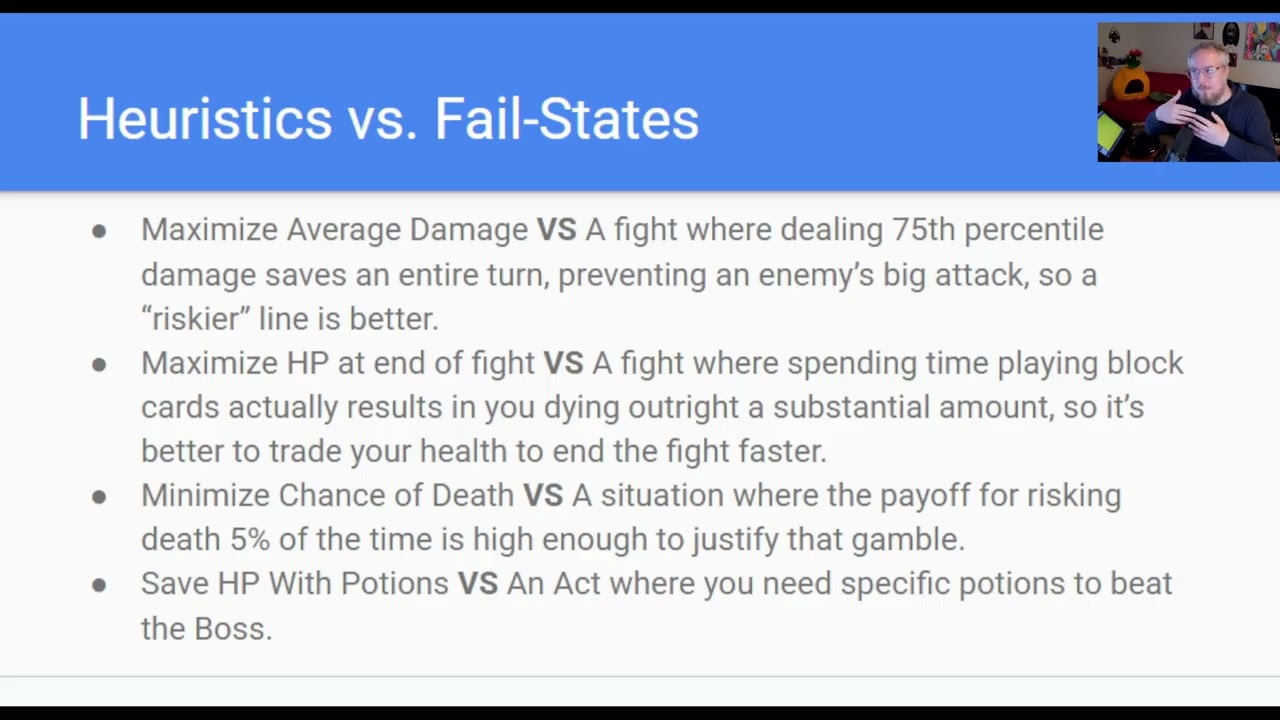
The Strike and Bash example comes from a proof-of-concept fight. In the first encounter of your run, assuming you only have starter cards as Ironclad, do you save health by assuming and playing four Strikes across two turns (24 damage), or a Bash into two Strikes (26 damage), while accounting for draw variance and the possibility of only playing one Strike on turn two after Bash (for 17 total damage), all gauged against the enemy's health?
To answer this, we will drain the Earth's oceans if we must.
This tool, like the video explaining it, is a masterclass in overcomplicating something simple purely and literally for the love of the game. As Jorbs agrees, the moment you apply this simulator to more complex decks and fights – say, a 24-card Ironclad deck versus the Act 2 Decimillipede elite – it explodes like dough in hot oil.
Even a single potion with, in the eyes of machine learning, an arbitrary reward value can throw a wrench in things, to say nothing of the countless permutations of larger decks. Just entering every card and value would become tedious, never mind the calculation time. You could probably complete two A10 Ironclad runs in the runtime of this video alone.
But the human spirit is reflected in the popularity of Slay the Spire and the very existence of this tool, and as someone who's made spreadsheets and written formulas to optimize damage in other games, I respect it. Even if I will just keep playing Bash because Bash goes bash.
"I just kind of like watching numbers go up. That's a lot of why I'm here. It's just kind of a good time," Jorbs concludes.

