





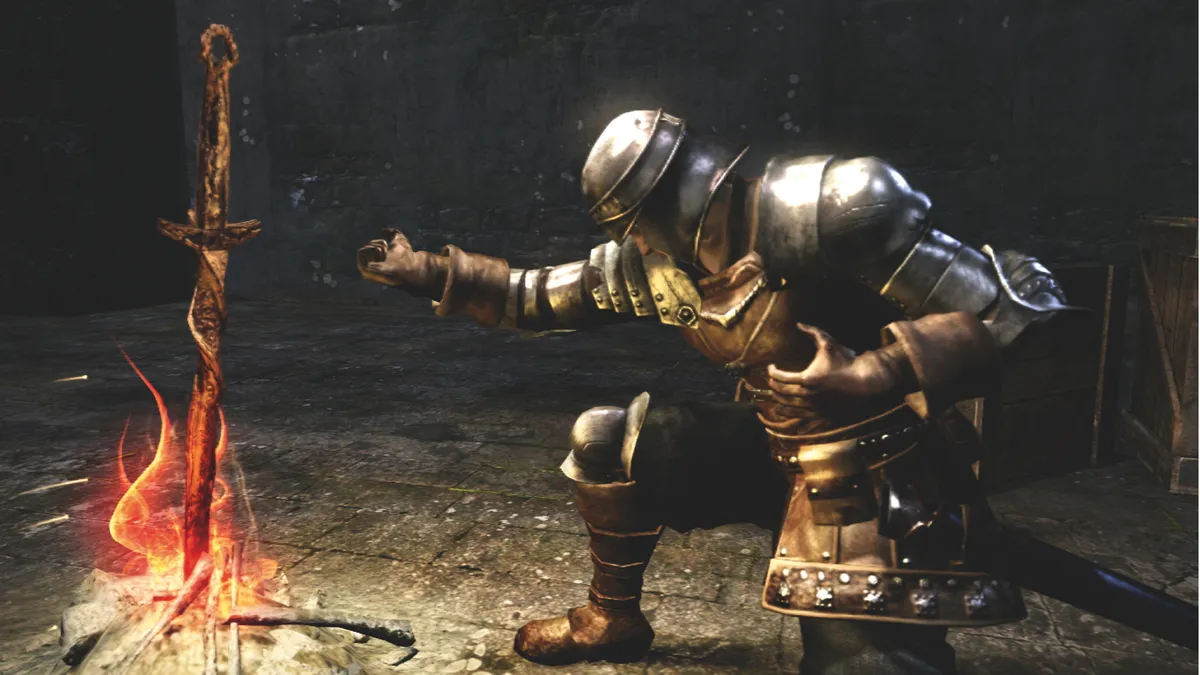
When reviews of the first Dark Souls surfaced, many writers likened their experience to a tour of Hell. The game’s legendary difficulty begs for a metaphor of molar-grinding torment on a sufficiently grand scale, and the Hell allusion is a natural one considering that Dark Souls draws so much inspiration from spiritual iconography, with its demons, cathedrals, curses and souls, liturgical chanting, and kneeling as if praying while kindling bonfires. The idea of a game designer creating a place as baleful as Lordran and sending players there to suffer carries a whiff of damnation. If you spelunk deep enough below ground in Dark Souls, you’ll discover lakes and rivers of molten lava – not exactly subtle.
Dante Alighieri’s 14th century epic poem The Divine Comedy subdivides the expanse between the lowest level of Hell and the highest echelon of Heaven into a series of strata, or circles. Lordran is unique among open-world RPGs in that its progression shares Dante’s vertical journey, as opposed to being a mostly flat two-dimensional sprawl. But what if, instead of clawing your way towards the centre of the earth, you carve an ascending path? It follows that you should expect to arrive at something resembling Heaven. As it happens, this is precisely what you find when you dispatch the Iron Golem atop the roof of Sen’s Fortress. The cutscene that follows shows a pack of winged demons carrying you up the side of a sheer cliff face, over a wall, and then depositing you at the doorstep of the radiant city of Anor Londo.

The way you reach Anor Londo is a departure from the unbroken transitions that typically attend your passage between Lordran’s various provinces, since Dark Souls tends to forgo the expository crutch of cutscenes. In most adventure games, entering an area for the first time sees the camera pull back dramatically and pan across so you can take in your surroundings, similar to how a flyover camera shot might help a person watching a TV broadcast of golf to study the layout and hazards of a particular hole. Dark Souls’ designers understand that there’s more thrill and uncertainty when you’re made to undertake the burden of cartography yourself. Dark Souls never hands you a map, just a quill. There’s a vast emotional difference, after all, between exploring uncharted terrain on foot and by helicopter.
If Anor Londo functions as a kind of heavenly city, it makes sense that it’s the one area in the game you’re incapable of reaching by your own agency. Doesn’t Christianity teach that Heaven is in another dimension and requires the intervention of divine rapture? There’s a wonderful discordance in the fact that, in the place of beatific angels, you have demonic gargoyles hoisting you to Anor Londo’s impossible plateau. The sense of rapture is heightened by a moment in the cutscene where the camera loses sight of your avatar altogether for several moments, soaring up the side of the cliff and over Anor Londo’s battlement. You have the sensation of flight yourself for those moments, as if you’re no longer peering through a camera lens but through your own unblinking eyes.
Those first glimpses of Anor Londo are dazzling. It’s hard to believe how much sunlight there is flooding over the city’s ocean of cathedral spires. Dark Souls can be so bleak at times, so starved of warmth and light, that the beauty seems almost eye-shadingly pornographic – like the point in Cormac McCarthy’s The Road where the starving protagonists stumble upon the untouched bomb shelter with its gratuitous bounty of food and drink.
Dark Souls obsesses over its dualities. In the opening cinematic, the narrator relates Lordran’s genesis story and the point at which fire entered the world. “With fire came disparity,” she says. “Heat and cold, life and death, and of course, light and dark.” If the bonfire checkpoints dotting the world are tiny breadcrumbs of heat and light, the sun is the ultimate cosmic beacon, and Anor Londo seems to be the banquet table on which that feast has been most amply served.

Anor Londo is also one of the only areas of Lordran that doesn’t lie in ruin. It offers a rare peek at a world preserved, a vision that’s even more arresting since you’ve recently traversed the dismal crumbling grey bulwark of Sen’s Fortress. All Anor Londo’s buildings share a cream-coloured exterior, and the game compensates for such uniformity with a sun-baked warmth you can almost feel radiating off the stone’s surface. Interiors are more ornate, with floors covered in a handsome interplay of white and blue marble. There’s an austere quality to these spaces, with no cloth or cushioned furniture to soften the hard surfaces, or dampen the clatter of weapon on shield.
From your first glimpse of Anor Londo, there’s no doubt as to your ultimate destination. Just as a visitor to Disney World instinctively heads for Cinderella Castle, the huge cathedral at the city’s hub grabs your attention with its innumerable spires. Like the game’s boss creatures, its scale is one of the few facets of Dark Souls that betrays its Japanese origins – though perhaps not as much as its most prestigious resident, Gwynevere, Princess Of Sunlight, whose mammaries are large enough to sustain separate gravitational fields.
But you’ll never stand in her presence unless you best Executioner Smough and Dragon Slayer Ornstein. Anor Londo is where Dark Souls casts off restraint. The highest altitude. The brightest sun. The most exuberant architecture. The hardest boss battle. The most maternal figure. Enjoy your stay.
Read more from Edge here. Or take advantage of our subscription offers for print and digital editions.

