





The sun is setting over Paris, and I have a bird's eye view of the city. Climbing one of Assassin's Creed Unity's most challenging vantage points atop the Bastille wasn't easy: diving into a shallow moat is one thing, but scaling the walls of the formidable fortress, clambering through an open window, and silently dispatching the roaming guards is another.
For all the stickier moments of my ascent, where protagonist Arno refused to make a difficult yet certainly achievable wall jump for an assassin of his caliber, this moment of calm is worth it. As is the £6 I spent on the game's 60fps-enabling update, which landed on PS5 last month. But between brooding on rooftops and solving murder mysteries, I'm also mourning something: the loss of the city-set Creed games that could have been, if not for the RPG pivot.
À la volonté du peuple

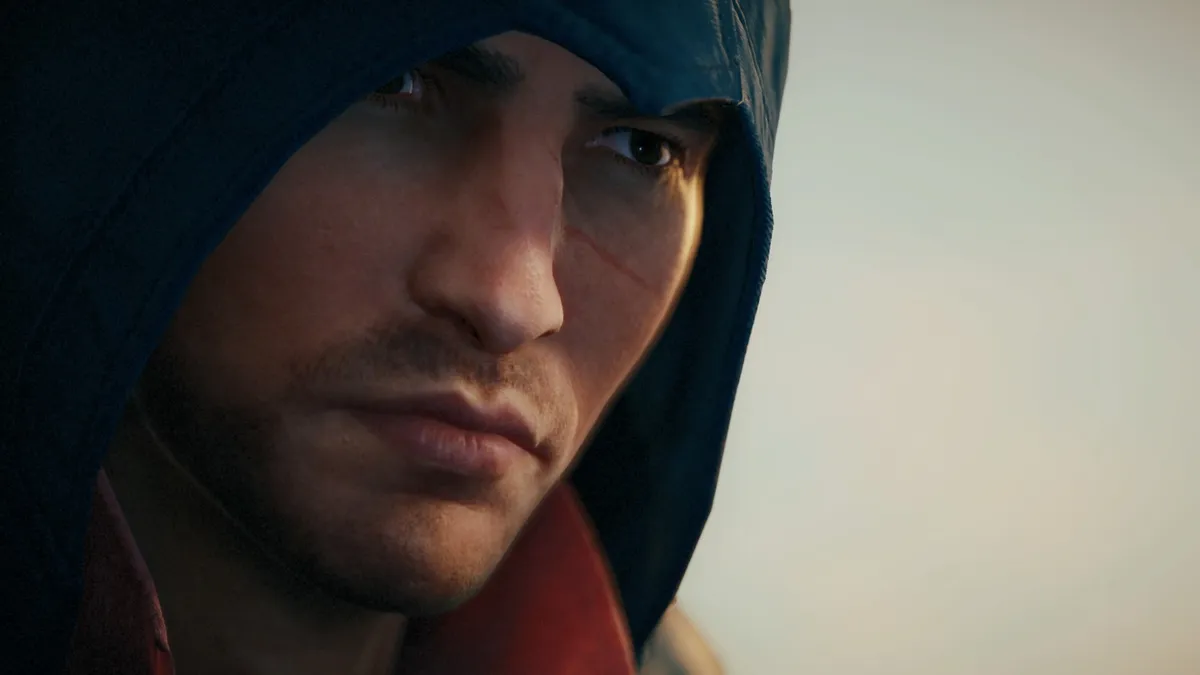
Assassin's Creed Unity review: "So dense and rich you feel like there isn’t enough time to see everything"
The urban density of Assassin's Creed Unity was a pivotal moment for Ubisoft. Providing the building blocks for a city-stealth playground that Victorian era Syndicate ran with a year later, both games revel in the rich, moody atmosphere of the core assassin fantasy by turning chaos into a weapon.
The background of social upheaval in each game's historical setting – Unity's French Revolution, Syndicate's Second Industrial Revolution – is paramount to why the games work at all. The constant commotion draws eyes elsewhere. You become a living shadow, hunting in plain sight, and it's the tangled streets of Paris where that fantasy truly takes root.
Plunging my hidden blade into the ripe jugular of an unsuspecting foe has never felt slicker than it does in Unity. I wind my way through an angry mob to make my escape, silent and undetectable among the faceless masses, and it's as if I was never there. There's a feline grace about Arno's movements in moments like these that truly shines with higher framerates. He places each foot carefully, spine twisting as one shoulder gently eases a path through the crowd.

His fingertips graze yellowed posters, plastered over shop windows like makeshift blinds. When I take a running jump at a wall and watch him glide up it, I half expect Arno to start licking the back of his hand to wash his face.
His sleek assassin moves are part of the assassin fantasy, which brings me back down to earth. This is a work of historical fiction, naturally, so the narrative itself won't mirror facts down to the marrow. But what Ubisoft landed on in Unity is the distinct sense of style, substance, and atmosphere that a Creed game should always have. Unity fully commits to the bit, with Arno feeling as unique as the raucous streets of Paris themselves, and I'm sick of pretending that this game is not a wholly perfect vibe.
Allons-y

Unity is where Ubisoft finally figured out how to make Assassin's Creed feel like its old self again.
Note that I did not say everything about it is perfect. A buggy launch causes many to dismiss Unity outright, promising to return to it whenever the developer got around to patching it up. 12 years later, it's still a little rough around the edges, but the upgraded PS5 version definitely runs smoother than my last foray with it on Xbox Series X some years ago.
Assassin's Creed Mirage was a taste of how fun and fluid a modern old-school Creed game could feel in the 2020s, a feeling only redoubled by how clean Unity feels in 60fps. But Mirage is still too big to capture that feeling of slipping into the background of a thriving, built-up city. After Black Flag's curious pivot to pirate action over sneaky stealth, Unity is where Ubisoft finally figured out how to make Assassin's Creed feel like its old self again. It even seemed to have some very promising ideas in store for what could come next, if the Helix Navigator is any indication.
You only see a glimpse of the Helix Navigator once, the first time the game is booted up and you select the "correct" memory file from the menu to begin your journey in 18th century France. But a quick flick through the other "locked" memory files reveals some truly compelling premises for Assassin's Creed games that don't actually exist, the most interesting to me being something called Jazz Age Assassin.

Immediately, I can picture an Assassin's Creed game set in the city of New Orleans, early 1920s. The mental blueprint I work from borrows heavily from Unity's own design: pacing the cobbled streets of the French Quarter, skirting the Mardi Gras partygoers as I follow the soft drift of saxophone music to a nearby jazz club. This is just one of many time periods suggested in the Helix Navigator, but all of them speak to the kinds of games that would work to the formula devised by Unity and Syndicate but have since been left on ice.
It does, however, give me hope for Assassin's Creed Hexe. While it's no secret that the upcoming RPG will continue the tradition of roleplaying game AC entries as kicked off by Assassin's Creed Origins, the jury's still out on when it will take place - though the latest "witchy German city" setting rumor gives me so much hope. Just please, Ubisoft: no more traipsing across sand dunes. I'll take the filthy alleyways of London or Paris (or the paranoid homesteads of the European witch trials) over a desert oasis any day.
Check out all of the upcoming Assassin's Creed games we know to be in production. Spoiler alert: it's a very short list.

