





Noctua is working on a long-term solution to the annoyances of CPU thermal paste, and it might just be onto something. Although thermal pads and certain graphite pads have been a fringe alternative to thermal paste for the best CPUs, for the most part, we're all stuck with messy and often impractical paste that's wrought with opportunity for human error.
At Computex last week, Noctua shared its vision for the future, which it calls the NT-CP1 Carbice Carbon Nanotube Thermal Pad. That's a bit of a mouthful, and that's because this little workaround takes some explaining. Essentially, instead of squirting out some thermal paste on the face of your CPU to mush down underneath your cooler, you'd instead place down one of Noctua's tiny wafers, and you wouldn't need to touch it ever again if you didn't want to.
Noctua has designed its thermal paste alternative as a long-term solution. Unlike thermal paste, it isn't going to dry, crack, or need replacing over time, so if you're not really interested in upgrading your CPU (ever), then this might actually be a better alternative for you.
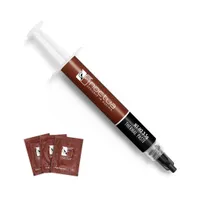

Noctua has tested the Carbon Nanotube Thermal Pad for up to 100K thermal cycles, saying that it'll "outlive your system" without dropping its cooling ability. Where the performance of thermal paste degrades over time, Noctua found that its new solution takes around 2,000 cycles to reach maximum efficiency, but then stays at that level from then on. By comparison, Noctua says 10,000 cycles is when thermal paste typically starts to really see performance drop-offs, but that isn't the case with carbon nanotubes.
The reason the new thermal pad is so long lasting is that it uses the same nanoscale polymer design as the cooling solutions in satellites and other space-grade technology - ie, why it's prepped to outlive your system.

Within the thermal pad (which is very thin; it looked like a small patch of seaweed up-close), there are vertically aligned carbon nanotube "forests". These are supported by an aluminium backbone that makes them more robust than similar graphite alternatives we've seen in the past. A nanoscale polymer coating then makes the pad non-conductive, and also prevents slipping during installation - a constant bugbear with thermal paste when you secure a CPU cooler on top of it.
The only reason the Carbice pad has a "break-in" period is that it takes some time for the polymer layer to activate and wet the contact surfaces on either side. Then, the carbon nanotubes slowly "wick" into the surfaces of your cooler and CPU. Once these are properly activated, they then help to funnel the heat transfer process to keep your processor working efficiently.


As you can imagine, something like this would be far easier to install than thermal paste that can very easily be a messy job that can go wrong. Slip, or somehow drop thermal paste onto your motherboard or into your CPU socket, and you could be looking at some expensive problems. With a pad that you simply peel and stick, you also don't need to enter the ancient debate of how much thermal paste you should use, and in what pattern you should lay it down.
The current ETA for Noctua's new thermal paste alternative is September 2026 and is tailored for AMD's AM4 and AM5 processors; meanwhile, AMD itself also had its own version of a thermal pad like this that it was handing out at its Computex booth, so we could see this as a more commonly used solution in years to come.
For now though, I'd only really recommend certain PC builders look into this type of cooling for their CPU. For starters, if you know you're not going to be upgrading for a long, long time, ie, if you have a top-rate, flagship processor and you don't really have an upgrade path, then look into Noctua's NT-CP1.

On the other hand, my tour guide at the Noctua Computex booth told me one of these will set you back roughly ~£20/$25 (although this is unconfirmed at the time of writing), and you only get one wafer in a package. Moreover, these aren't reusable, so if you do unpeel it from your cooler so you can upgrade something or swap out a motherboard, then you'll need to pay that same amount again.
Meanwhile, thermal paste is a sub-$20 purchase, and even the smaller tubes will give you enough for a couple of CPU upgrades and installations. One thing I like about modern CPU architecure, especially the AMD sockets this cooling solution has been designed for, is that there's more availability for upgrading down the road. AMD has just extended support for the AM5 platform until 2029 at least, so chances are, you're bound to see a processer that could outperform and offer more value for money than your current one before too long.

If you're old school, and you don't want to upgrade your desktop components for as long as possible, or you're just happy with what you've got, a thermal pad like this might be a better option for you. If not, I'd be sticking to traditional paste for any Prime Day PC deals you're hunting for this month.
PC builders should also seek out the best gaming PCs, the best graphics card, and the best RAM for gaming.

