


Seeing a Mass Effect: Andromeda recruit jamming on a bass guitar shaped like the Normandy, with a gas-masked Fallout 4 vault dweller on drums, is a time capsule from a very specific moment in video game history. As, indeed, is their stage of choice. Rock Band 4 is the last survivor from a bygone era of plastic-instrument games, their peripherals now mostly consigned to landfills and charity shops, and a gentle introduction to what would become standard live-service practices across the rest of the industry. But it's a time capsule you can still dig up and experience firsthand, Harmonix's coup de grâce still active and receiving support as it approaches the end of its first decade. Given how quickly the genre had moved – and moved on – in the years prior, that's nothing short of a miracle.
By now, it's surely safe to assume you know the drill, if not of this particular game then certainly one of its many predecessors. You pick an instrument, choose a song (one that, in the latter titles, you most likely bought as an add-on), and start playing along by hitting the plastic buttons in time with the onscreen prompt. It's a simple but marvellous concept that was expanded on enormously over a relatively short span. In the Guitar Hero series, the range of instruments quickly grew from just lead guitar to include bass and rhythm. Rock Band added drums and vocals when it launched in 2007, and then keyboard for its third iteration. Both series also spawned spinoffs, with Rock Band famously tying into The Beatles and even Lego, allowing for reinventions of its visual style along the way.
Controller (r)evolution

To fully understand how we got here, though, we must rewind further still, to the end of the 20th century. In 1999, Konami's GuitarFreaks and DrumMania went beyond 1997's Beatmania by asking players to perform songs on controllers shaped like musical instruments, tapping their buttons to match onscreen patterns. The games failed to earn mainstream notice outside of Japanese arcades, but it was in these places that Harmonix's founders first encountered the concept that would make their name.
Formed in Boston in 1995, the studio made its debut that same year with The Axe, a piece of software in which music could be played with a PC joystick. According to co-founder Alex Rigopulos, it sold all of 300 copies. After a few more lean years, the company's founders decided to try to break into the Japanese karaoke market. While that effort was a failure, visiting Japan introduced them to the local enthusiasm for rhythm games, yet to make a big dent in the US market. The discovery was funnelled into 2001's Frequency and its successor Amplitude, the studio's first actual games, which also established its licensed-music credentials, incorporating tracks by the likes of No Doubt, Orbital and Run-DMC. Neither game was a commercial hit, but – along with a deal with Konami to develop Karaoke Revolution – they were enough to catch the eye of RedOctane, a peripheral manufacturer that had recently decided it would make sense to make music games as well as the accessories for playing them.
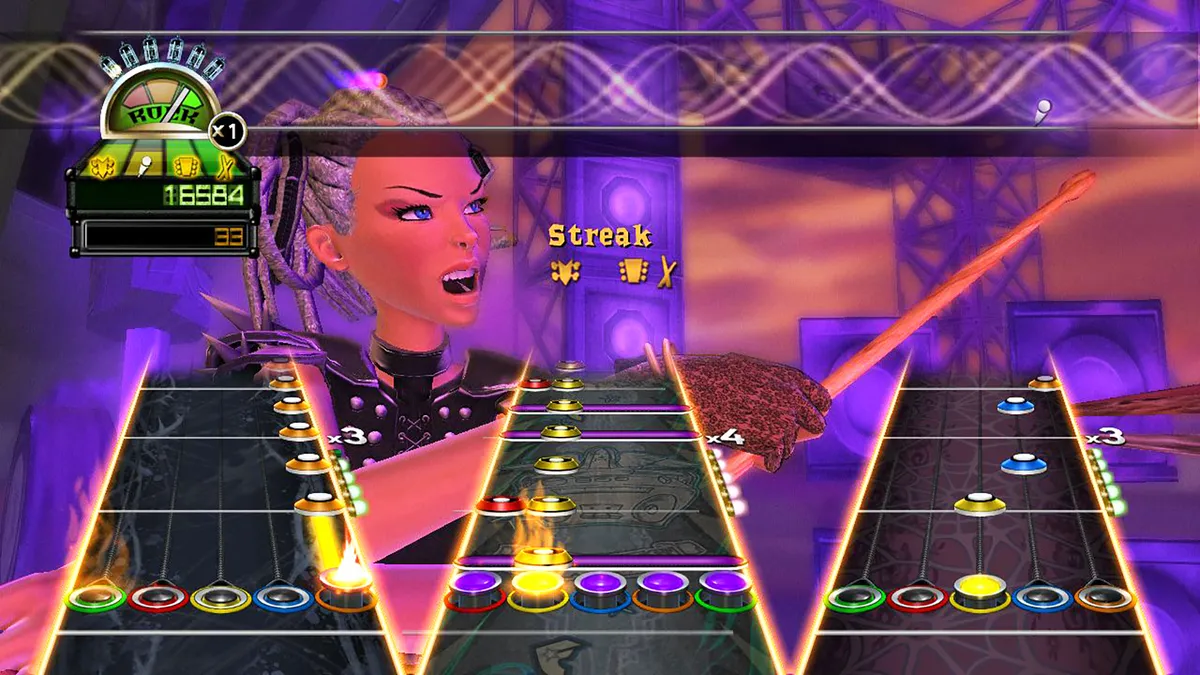
From there, everything took off. Just ten years separate the release of the first Guitar Hero and Rock Band 4 – time enough for a dozen instalments of the former series and nine of the latter (not including portable and mobile spinoffs). At the same time, Harmonix and RedOctane went from collaborators to competitors, after buyouts from MTV and Activision respectively split up the partnership. (Given that, at their peak, individual titles in this lineage broke $1bn in sales, it's not difficult to see why they would have been acquisition targets.)
By 2015, though, the spark was dwindling. RedOctane had released its final game, Guitar Hero World Tour, in 2008, with development duties passing to internal Activision studios; two years later, the company was closed. Fellow series stewards Neversoft and FreeStyle Games were folded into the Call Of Duty machine, the former shutting down in 2014, the latter sold to Ubisoft to become one of its many support studios. Yet, as the 2010s welcomed a new console generation, there was one final attempt at continuing each series' legacy. Rock Band 4 hit the shelves in October 2015, and a few weeks later Activision followed suit with Guitar Hero Live.
On a similar note

While Live bet on an FMV-driven experience that would change depending on your performance, played via a new, more complex guitar peripheral, Rock Band 4 was firmly focused on fine-tuning and unifying what already existed. Even within the context of its own family tree, Rock Band 4's role might be that of the sensible older sibling. Its direct predecessor – the apex of the entire genre – was unafraid to reinvent without compromising its roots, adding to the selection of instruments a keyboard and Pro guitar controller that essentially mimicked its real-life counterpart. Neither is supported in the follow-up.
As a successor, then, Rock Band 4 might initially seem like a step back, with a more standardized visual presentation offering fewer options for character customisation, and a far more rigid career mode. But in 2015 it rekindled a flame that could easily have died out. And there proved to be great value in that sensibility, as the game allowed players to migrate all their previously purchased DLC tracks, and introduced compatibility for other peripherals, including E-Drum kits. It laid a solid foundation that could last the test of time, and one on which Harmonix has continued to build.

Not that it's especially easy to get into nowadays. Mad Catz, which manufactured official guitar and drum controllers for Rock Band 3 and 4, closed in 2017. PDP, which worked with Harmonix for Rock Band Rivals' instruments, ceased production years ago. Second-hand instruments often cost way more than their long-forgotten retail prices. And that's before taking into account how much you're likely to spend on songs. There's also the always-tricky matter of music licensing to consider, with plenty of examples illustrating what can go wrong. When Guitar Hero Live's servers shut in 2018, for instance, 92 per cent of the track catalogue vanished alongside them. In December 2022, a year after Harmonix was acquired by Epic, it delisted the app for tabletop-digital hybrid DropMix and shut down its PC and console successor, Fuser. A year later, Harmonix launched Fortnite Festival, finally making sense of Epic's buyout, but leaving the long-term prospects of Rock Band itself in question.
Today, though, Rock Band 4 stands firm. Since its release, it has added support for asynchronous online multiplayer and competitive band clans, and received over 30 seasons of challenges and cosmetic rewards, not to mention new tracks that continue to roll out on a weekly basis. You can play Rock Band 4 on modern consoles – and, for all the barriers to entry it puts up, people do. Take a glance at the game's subreddit or the official Discord server and you'll still find hundreds of music enthusiasts sharing tips, high scores and celebrating photos from jam sessions with friends in local bars and living rooms. Fire up multiplayer, meanwhile, and you're guaranteed to find somebody failing to get a full combo in Free Bird or singing Mr Brightside at odd times of a weeknight.
Despite its minimal conversational cues – "Let's rock!" or "Sorry, I choked" – playing online feels like a true shared experience, and one that is often enchanting. Sometimes a drummer will show up mid-session then leave after one song, without missing a single beat; at others, you and a stranger might tear through an entire playlist of old standards together before parting ways. Whoever you're playing alongside, it's still impossible to suppress a smile when the band simultaneously activates Overdrive, playing louder and more confidently as a unit. Inter-band banter might be a rockshow standard but these moments are more like those over-the-shoulder smiles you occasionally catch performers sharing, as the crowd picks up their beat. Who needs words when you have music?
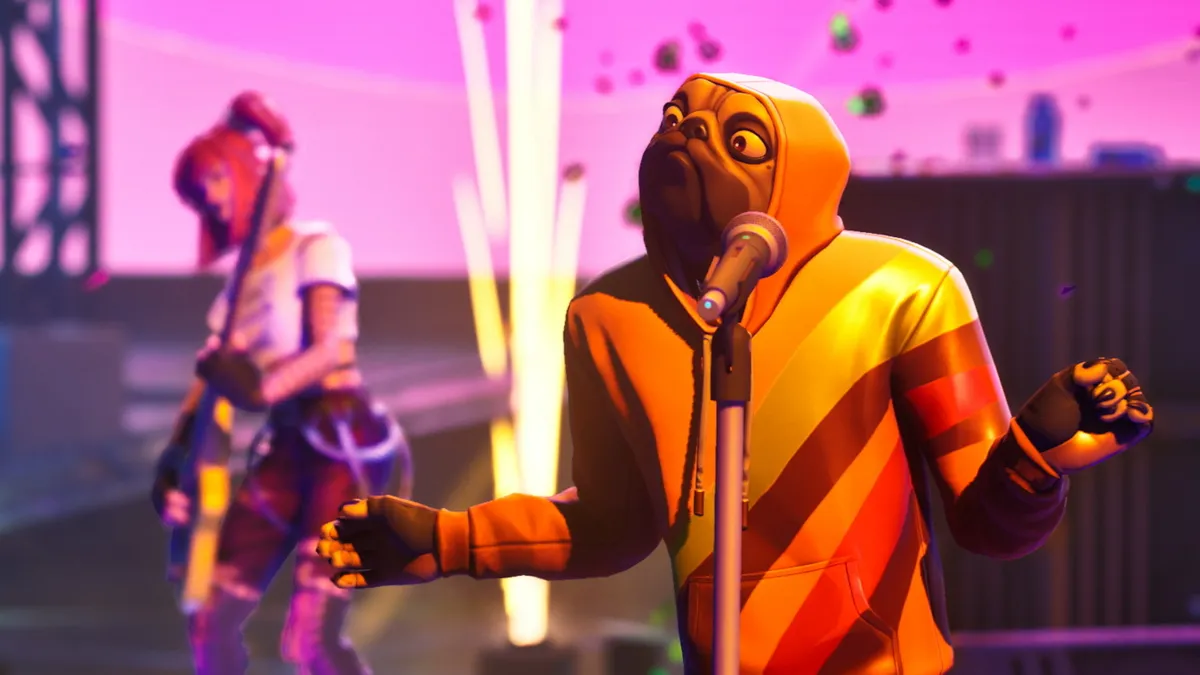
No wonder Epic chose to incorporate Harmonix's work into Fortnite, where dance moves have long rivalled voice comms as the primary mode of communication. Or, viewed more cynically, perhaps it simply saw in Rock Band's spin on the live-service model a way of turning over yet more stacks of V-Bucks. (Here, Festival's shuffling selection of free songs actually borrows a little from Guitar Hero Live, which similarly offered an MTV-style channel schedule for players not willing to splash out with cash.)

Yet Fortnite Festival isn't a true continuation of this legacy. Rock Band players can't import their library of songs, and while Epic is promising instrument support (and PDP teasing a new guitar controller), it's unclear whether this will be compatible with existing peripherals. And those concerns about long-term preservation are only exacerbated by a digital-only game that rarely stays static for long.
In the meantime, Rock Band 4 players continue to strap on their space helmets and tighten their jumpsuits, paying tribute with callused thumbs and broken nails. And at least a small remnant of Harmonix is willing to answer their calls for an encore. Both sides know they're on borrowed time.
There'll come a day – possibly hastened by Epic's recent moves – when developer support finally halts altogether, when older instruments cease to work and the online component becomes inaccessible. But maybe that's appropriate for the artform to which these games were a love letter. Every song is a time capsule, ultimately, as the selective libraries of music-streaming services increasingly decide what is available for listening. Nevertheless, the beat goes on.
This Rock Band 4 retrospective was first published in issue 394 of Edge Magazine. To get more like this delivered straight to your doorstep (or digital device) consider subscribing to Edge.

