





We test a lot of them here at GamesRadar+, so you may be wondering how we test controllers for our reviews and roundups. Controllers are one of the most iconic, beloved, and most frequently used gaming accessories, and as someone who's been an enthusiast in them for close to a decade now, I take testing them very seriously.
Like our full-length GamesRadar+ hardware policy states, we here on the hardware team like to adopt whatever we're reviewing into our setups and "live with it". For me, that's the goal. While I'm reviewing a controller, I'll use it for all of my controller-centric gaming for at least a week, but often more than that, to really get a feel for how it impacts my gameplay and enjoyment across various genres.
There isn't a strict benchmarking process for the best PC controllers like there is with computer components, so it's harder to come up with a scientific test that the everyday gamer would understand and also benefit from. For that reason, I take a holistic approach.
What is the controller I'm reviewing setting out to achieve? Is it trying to be the next competitive Esports multitool? Is it trying to be a comfy, cozy game accessory, or is it trying to be a bit of both? Or, is the controller better at something completely different from what its creators set out to make? I want to find the best uses for each gamepad. I want to figure out who is best served by spending their money on it, and I wanna tell you my honest opinion of it.

My name's Duncan, and I've been the hardware editor in charge of all things controllers here at GamesRadar+ for over three years now. In that time, dozens (probably close to 50) controllers have made their way across my desk. I've been in love with controllers since I started gaming at the age of three, and I've been an in-depth enthusiast for more than 5 years now.
Our standard testing games
Why you can trust GamesRadar+ Our experts review games, movies and tech over countless hours, so you can choose the best for you. Find out more about our reviews policy.
Nine times out of 10, I'll be the one testing and reviewing a controller here at GamesRadar+. The benefit of that is that I'll keep my testing as consistent as possible. That way, it becomes really easy for me to have a birds-eye view of the market, and it means I'm much more capable of comparing one device to another.

For first-person shooters, you'll mainly see me test a controller out with my favorite extraction shooter, Hunt: Showdown. This is the game I play the most, so it makes it easy for me to get a feel for how the controller is aiding my day-to-day gameplay, and it also means I can test as I play the game I personally love. I'm one of those sad people who actually cares about "winning" in this game, so when I'm testing a controller designed for competitive players, I have a down-to-earth perspective with Hunt in tow.
This game is predominantly designed to be played with a mouse and keyboard on PC, so it's actually a really good game to test pro controllers with because it requires a lot of functionality, and I'm always able to find plenty of uses for back buttons. Not only that, but Hunt demands pinpoint precision in its shooting mechanics. With old-west weaponry, you're often at the mercy of your aim, which means it's a fantastic game to test out how a controller's thumbsticks behave under pressure.

For 2D platformers, you'll find a mix of Celeste and Towerfall Ascension used in our reviews. I love both of these games dearly, and in my humble opinion, you'd be hard-pressed to find better-feeling 2D games. They demand precision, but also speed and feel. This is how I'll test if a controller is good in retro-style games and metroidvanias, and it's often where a D-pad will come under heavy scrutiny.
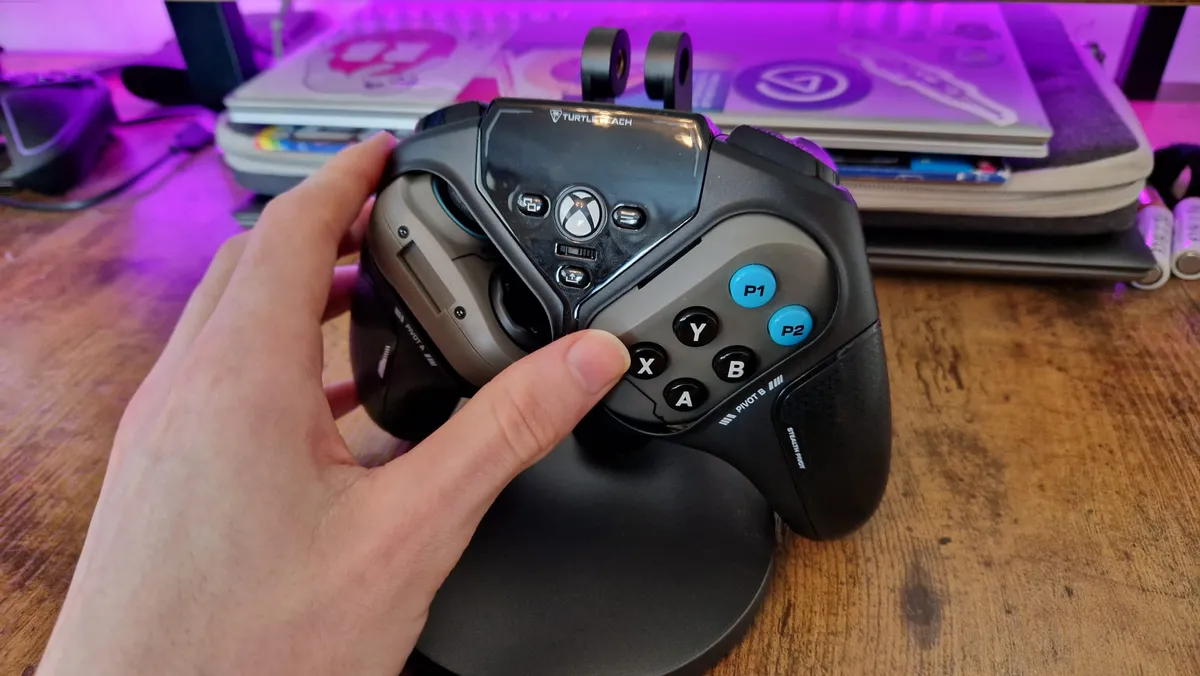
To test out fighting games, I use Dragon Ball: Sparking Zero in my reviews. Now, I can already hear some fighting game fans shouting that that isn't a "real fighting game", but hear me out. Fighting games require speed from a controller, and while Sparking Zero might be a button-mashing fever dream, it's a more extreme version of what you'll need in a fightpad. In our coverage, it's designed more as a benchmark to push a controller to the limit. Button-mashing fight combos as Broly, and spamming dodge wars as Ultra Instinct Goku, aren't a bad test of durability either. I also play the odd round of Tekken, so I may use that on occasion too.
Then, we'll use a few current/evergreen games as well. I try to find at least a few third-person games I'm currently enjoying, so you might have seen Cyberpunk's driving mechanics, Hell is Us and its third-person combat, or Clair Obscur, which needs a little bit of everything. I tend to use an open world game to test comfort during longer sessions, as well as battery life, and good ol' driving mechanics feel.
It's important for our readers to know not just how the latest controllers perform in our tried and tested game choices, but also how they'll serve them in the most contemporary games, so I'm always testing as I go.
We use our expert team

If I'm not the one reviewing a controller, you can trust the fact that whoever I've chosen to test it out and give you their verdict is just as equipped, if not better suited, to reviewing that specific product. There are too many controllers released these days for any one hardware editor to get to them all, so on occasion, you'll see other members of the hardware team, or other members of the editorial staff here at GR+, testing a controller.
Oftentimes, these people will be veterans in a certain niche of gaming, will have a more intriguing perspective on a type of controller, or will just have the platform that's required to do a thorough job of testing something out.
Regardless of who's doing the testing and writing, they'll put a controller through its paces, use it like they would their own gear, and keep value for money as the central guiding focus of their coverage.
Specialist controllers and racing wheels

But we don't just test gamepads here at GamesRadar+, we also test a few niche accessories like guitar controllers, joysticks, and racing wheels. These won't always be reviewed by me, but they'll still undergo strict testing processes so we can evaluate what's worth spending your money on. As with everything, we'll live with the hardware, we'll work it into our own setups, and use it as we would our favorite gear.
From there, it's about assessing how easy it is to use, if it's worth the money compared to what the competition is charging, and whether or not it's designed for beginners in a certain niche, or hardline veterans. Often, software support can play a big role in this type of accessory as well, so companion apps will come into play here.
We take our biases into account

If there's one thing I've learned from over three years of reviewing gaming controllers, it's that no two sets of hands are alike, and no one has exactly the same preferences when it comes to what controller works best for them. Reviewing anything, not least controllers, is an extremely subjective thing, and for that reason, it's important when we test controllers here at GamesRadar+ to address our own preferences.
When I say we have biases, I don't mean toward any one brand of controller, and no review will ever be bought, and no verdict will ever be paid for. If I have a history with one brand's products, I'll likely bring that into play in a review, but only to say that I can either trust or not trust a brand's track record.
My main bias when reviewing controllers, testing them, and recommending their deals is to you, the reader. I'm here to give you my honest opinions as someone who has been lucky enough to test a mountain of controllers over years of hard work covering them. It's my promise that I'll never recommend you something that I don't believe will actually be worth your money.
As always, we judge excellence with value

One of the benefits of covering controllers for so long is that I have a good perspective on how much money you actually need to spend on one these days. I've seen it all, from Razer and PlayStation charging $200 or more for a controller, to brands like GameSir and PowerA charging far less for essentially the same product. I'll always be looking for good value for money, because as you'll know if you shop around, controllers can be way more expensive than they arguably need to be.
When a brand pulls a somewhat shady corporate move with pricing or makes it very difficult for a consumer to make a return, seek support, or otherwise use what they've paid money for, that will undoubtedly come into our testing and our end verdict. That's something I'm committed to in order to safeguard you as a reader and your hard-earned cash that could be going toward something better.
When it comes to deals, I use price history data and my own knowledge of launch prices to judge what qualifies as a "good deal".

