


Sid Meier's Civilization 7 is turning a page. Last year, the strategy game launched with a bold vision – tackling foundational challenges within its genre – but the result proved divisive, creating clearer throughlines for campaigns at the cost of player agency and the sandbox-style freedom that defines the series. The game's latest update, Test of Time, sees developer Firaxis working with its community to answer an important question: what makes a Civilization game?
The list of changes are sweeping. First and foremost: you can now play through campaigns as a single Civilization, rather than the evolving system that Civilization 7 launched with. But equally important is the overhaul to Civilization 7's campaign progression, with the game's initial legacy paths replaced with triumphs – rewards for completing tasks associated with certain victory conditions – and less impactful resets between ages.
Now, Civilization 7 is stickier than ever. I've been playing Test of Time for over a week, finding a fluidity that was missing in the base game's staccato structure. Many of Civilization 7's other changes – like town management and overseas expansion – shine even brighter because of the improved flow, while choosing whether to continue with your Civilization or select another mid-campaign adds a delicious layer of strategy to each age.
Catching up with Ed Beach (creative director) and Matt Schembari (head of product, Civilization) to discuss the update, the pair have learned a great deal about their community since launch.
Next turn?
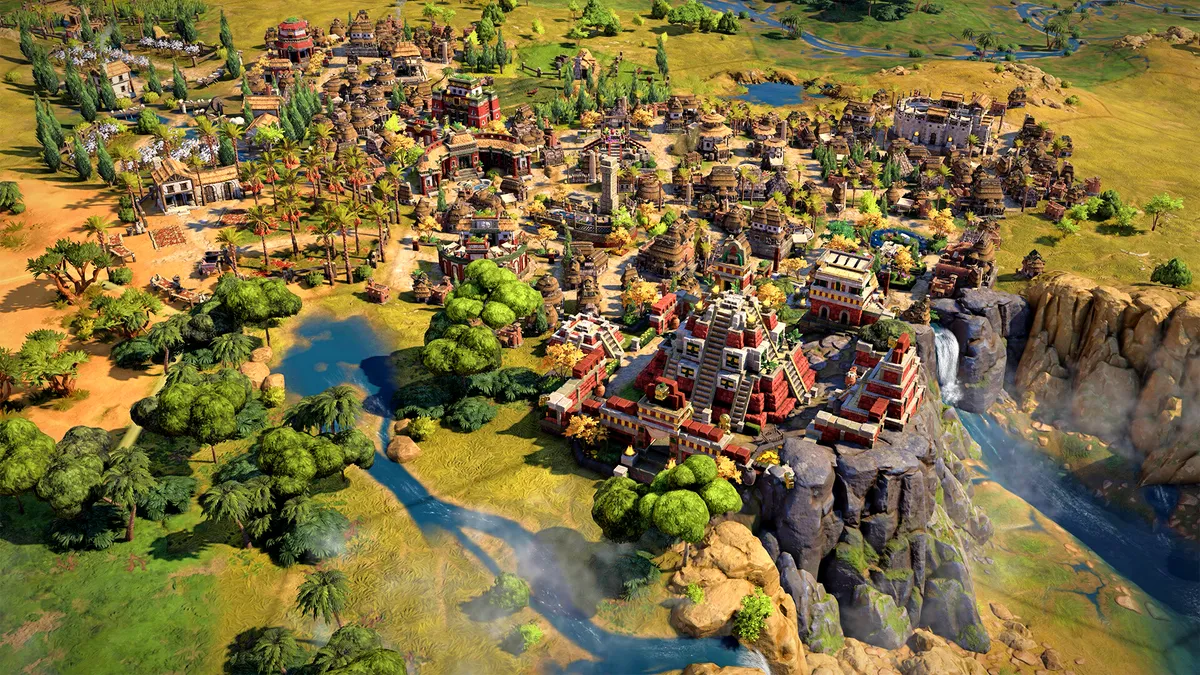

As touched on in my Civilization 7 review, the game's initial emphasis on win conditions within each age felt like being railroaded towards victory; rather than playing reactively in each campaign. These legacy paths have been scrapped, and in their place are triumphs – optional objectives, tucked away in a menu, which reward your chosen playstyle rather than forcing you to choose one plan and stick with it.
"A lot of people who either played the game over and over again, or players who were used to a more open-ended Civ experience, felt constrained by those legacy paths," explains Beach. In my first campaign as Alexander, losing the prescriptivism of legacy paths is a huge win, leaving me free to let my campaign play out reactively, rather than chase the same prescriptive win conditions from turn one.
Similarly, not having to change your civilization between ages means you can stick with the same traits and identity throughout a campaign. Whether you do so is up to you: changing to another civilization may allow your faction to specialize into a certain era, but choosing to carry on as the same civilization unlocks syncretism – the ability to adopt another faction's unique ability or units for an age or double down on your own strengths. I was originally cautious of syncretism, worried it would dilute each civilization's identity or offer too much power, but the nondisruptive system gives the sense that your civilization is adapting to the world around it rather than being gamed like a roguelike build.
"It's integrated so well that you can start a campaign and fully intend to be playing as Rome throughout all three ages, and you get halfway through and you're like, 'oh, I actually want to make a big pivot here, and it's really cool with all the mountains in my empire. If I could switch to Inca right now, I'm going to actually change my plans,'" says Beach. "Those are two different styles of playing the game. You don't have to lock those in the beginning. Those are things that the players can opt into in the middle of the campaign. I feel like that's just the right level of flexibility and open-endedness that we really want to provide the players."

Syncretism was "not unanimously adopted by the design team right out of the gate," says Beach, and Schembari admits to "pushing back" against the proposed feature initially. Debates like this aren't uncommon at Firaxis, and Beach has "lived through a lot" of them over the years.
"Civilization 7 is built by a design team two or three times larger than we've had for earlier Civ titles I worked on," he explains. "On those titles it was more like a single person could try to set the vision and get everyone to come along, but with the larger team, if we're not going to try to establish consensus I just don't think [we could achieve] the unified push we need to be able to make big swings and big updates like this. So we do try to build consensus as much as possible, but there are times where we have to tell the team 'we're just going to try this in the game and see how it feels, and you may be right that this is a really poor idea [...] We always let play testing be the final litmus test to see whether certain ideas are good or certain ideas need to be rethought."
"It's a very Sid Meier-esque philosophy where it doesn't matter if things sound like a good idea, or a bad idea," adds Schembari. "What matters is 'how does it play?', so we try to do that as quickly as possible."

Ultimately, Test of Time is a more hands-off Civilization experience than Firaxis initially set out to offer. The shift poses an interesting question: as designers, when do you have to relinquish control and let players go in their own direction?
"What we've found is we have a lot of different sorts of players. There are players that loved the new Civ 7 ideas right out of the gate, and there are people who couldn't believe what we had done to the Civ experience, and how we had uprooted things," answers Beach, who believes letting fans "lock into what they want" is an integral part of Test of Time. For Schembari, the development process behind Test of Time – communicating and iterating with players significantly more – is a blueprint for Firaxis' future.
"Every time we put a change out there, if the community understands the context behind it better, they can provide even better feedback [and] we can get to an even better place by the end," says Schembari. "The more we openly and authentically talk with the community in both directions, the better off the game will be."
Here are the best strategy games you can play today

