


Ever since the DS and Wii, Nintendo's built its brand on staying out of the AAA graphics race that its competitors have usually pursued. But the seeds of that corporate philosophy were around at least a decade earlier, when games like Super Mario 64 were at the cutting edge of 3D graphics, and RPGs were exploding across new cinematic frontiers. For Shigeru Miyamoto, though? Even in the '90s, he'd rather have just kept launching cannonballs on his OG Macintosh.
In July 1996, Miyamoto was interviewed by Kenji Eno, the developer best known for the cult horror game D. Eno, known for experimental game design, had just played the newly released Super Mario 64, and wasn't nearly as impressed as the rest of the gaming world. He dreamed of something more interactive from the 3D world, where snow would realistically react to Mario's footsteps, kicking up into snowballs as you ran around.
"I would love to do that," Miyamoto responded, according to a newly translated version of the interview on Shmuplations. "However, strategy guides exist now, so the joy of someone discovering something entirely on their own doesn't really translate anymore. Everyone expects to be able to beat the game as a given. There's a massive dilemma there."
Miyamoto's distaste for pre-determined solutions and linear exploration is part of why he decided old-school Zelda dungeons aren't "really that much fun" while making Ocarina of Time a few years later. With Mario 64, he wanted the game to be smaller in scope, but feared the market would reject something that wasn't packed with content and technical wizardry.
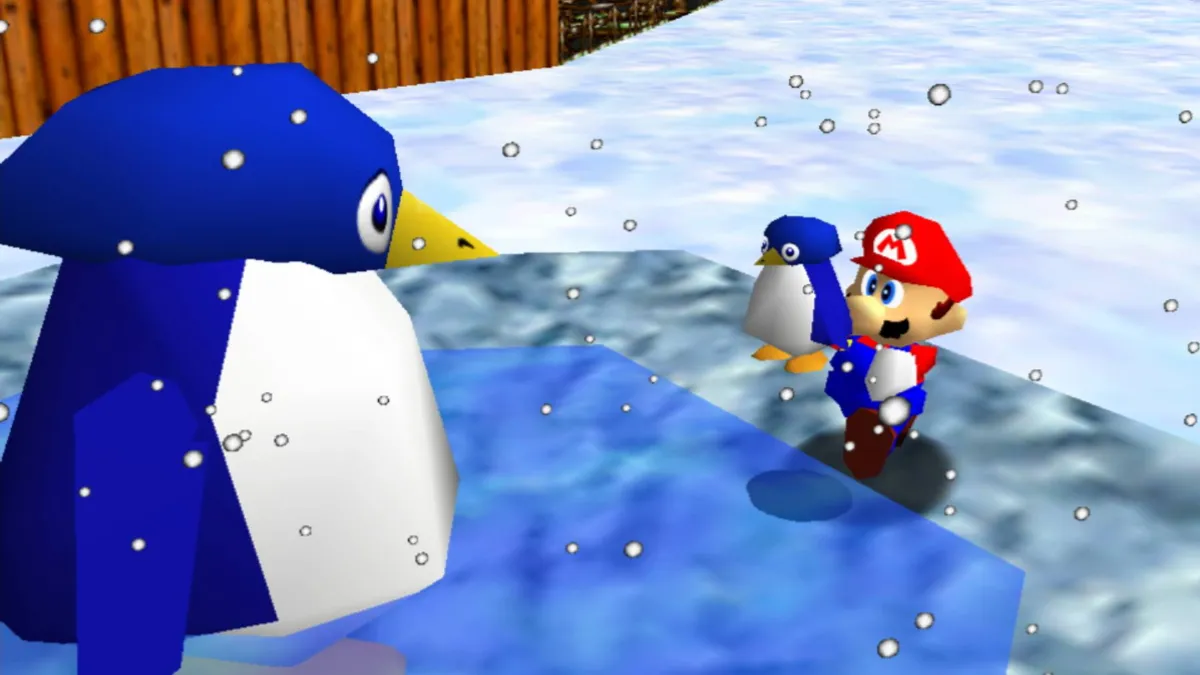
"In reality, instead of having six or seven stars per stage, I only wanted half that number," Miyamoto explained. "But like I said before, the foundation is set now, so we perhaps can start doing stuff like that from here on out. Do you remember that old Mac game where you'd shoot cannons at each other in a windy area? You'd adjust nothing but the launch angle and power to hit the enemy artillery hiding behind rocks. The other side would shoot back at you using the wind too."
Shumplations suggests that Miyamoto is probably talking about Cannon Fodder, not to be confused with the 1993 goofy shoot-'em-up that became a hit on Amiga. This Cannon Fodder is a simple 2D game with purely black and white graphics where your cannon fire can destroy objects in the environment.
"I think that kind of thing is far more interesting than the RPGs we see today," Miyamoto argued. "But you just can't make a game like that when you have to worry about justifying a 9,800 yen price tag. People look at a casual game like that and assume it can be made on a low budget, or that a rookie can handle it, or that if it's that simple, it could just be distributed via the Satellaview."
Satellaview was a satellite-based distribution service for Japan's equivalent to the Super NES which offered downloadable games. The idea that you purchase "big" games with high production values at a store and smaller, more experimental titles digitally would persist for years, even as digital distribution became more prevalent. That line was drawn even more strongly in the '90s.
"Everything gets manufactured based entirely on price," Miyamoto said. "Instead of opening up a playground for people to try out new ideas, everything has just become a conversation about cost. I find that a bit frustrating."
Even here in 2026, as we're being forced to say goodbye to physical games, we're still debating game prices – but it has become much easier for smaller-scale games with fresh ideas to make it to market. Who knows? Maybe Steam's next surprise hit will be all about two players shooting cannons at each other.

