
In GamesRadar+'s From the Vault series, we're bringing you compelling exclusives pulled from our sister magazines' back catalogues to give you a taste of how we were discussing your favorite Fallout games back when they were first introduced.
Today, we've unearthed GamesTM's hands-on experience with Fallout: New Vegas at E3 2010, featuring interviews with Bethesda and Obsidian as they charted the RPG's future.
Fallout: New Vegas hands-on preview
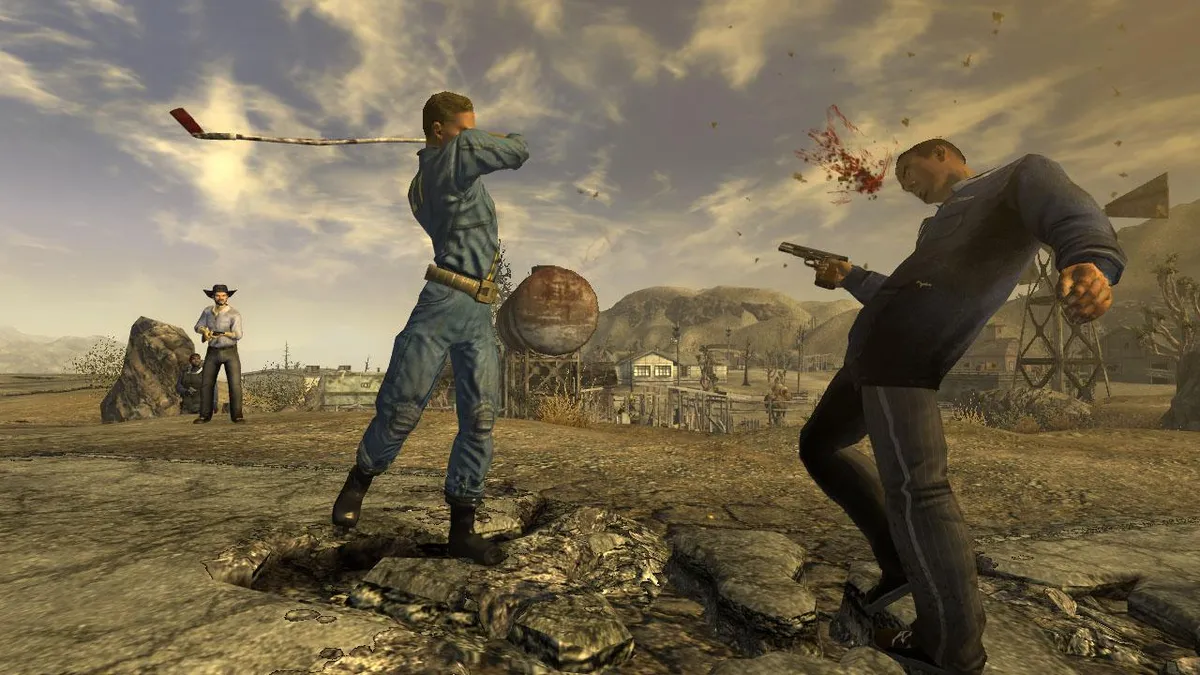
Bethesda’s ambitious reinvention of the Fallout series poses a daunting challenge for game demos. How do you take a vertical slice of a game whose appeal is entirely rooted in its sprawl, the way it tempts you away from defined objectives with the exhilaration of haphazard discovery, and show it off in isolation?
When Fallout 3 was shown at E3 2008, attendees were treated to a 20-minute demo from its very beginning – the most linear section of the game. Becoming excited about what followed your character emerging into the endless wasteland required a leap of faith. Fast forward to 2010, as we pondered our imminent hands-on session with Obsidian Entertainment’s Fallout: New Vegas, it seemed clear that the game could only be effectively demonstrated in two ways: with a small but completely open section of the Vegas wasteland, or the entire game-world with a controlled number of locations to discover.
In both cases, the demo would embrace the qualities that any vertical slice of Fallout should contain: exploration, freedom, and discovery. Fallout is a mosaic in that focusing on any single piece reveals remarkably little. The parts only truly resonate in the context of the whole. Yet while this made our demo an ambiguous representation of just how good New Vegas is likely to be, it also speaks of its major strength.
If it ain't broke...

This feature originally appeared in GamesTM, a sister publication to GamesRadar+ that unfortunately ceased printing in 2018. For more in-depth features and interviews on classic games delivered to your door or digital device, consider subscribing to Edge or Retro Gamer!
Obsidian is wisely sticking with the template established in Oblivion and refined in Fallout 3. As Bethesda’s watching representatives directed us to the next destination, the hollow triangles peppering the on-screen compass sang to us once more, tempting us with the promise of new adventures waiting in the desolation. It’s as fine a basis for role-playing as one could hope for, and the Fallout universe remains pregnant with potential.
Indeed, after the phenomenal success of Fallout 3, it’s hardly surprising that New Vegas is doing so little to alter the basics. With 4.7 million units sold in its first week and Lord knows how many more since, we suggest to Bethesda’s vice president Pete Hines that even he couldn’t have foreseen just how receptive the public would be. Apparently, his confidence in the product was greater than we predicted.

“I don’t think it took me by surprise,” he replies. “Obviously, I had a sense of how good the game was, and I had a sense of how big it could be. It probably out-stripped my expectations by a little, but we put a ton of effort into making that game, and promoting it and marketing it. The goal all along was to make it bigger and take it to a wider audience, and I think we were successful in doing that.”
Even if Fallout 3 hadn’t sold in quite the numbers it did, sequels were inevitable – Bethesda paid $5.75 million for the rights to the entire Fallout brand for a reason. So, the existence of New Vegas is no great surprise. The fact that Bethesda chose to bring in an external developer raised a few eyebrows.
“We talked about a variety of different options,” says Hines. “Near the end of Fallout 3 we talked about what [game director] Todd Howard’s group was going to work on next… was there a good fit for us to work with somebody on Fallout that we felt would do it justice? Obsidian was at the top of the list, and pretty much alone on the list. We talk to a lot of studios just to stay on top of what they’re doing, what they’re up to, and what they’re doing next. It means working with studios we like further down the road, and this happened to be a case where we’d had conversations with Obsidian over a period of time. It was the obvious choice – obvious to us, obvious to them, obvious to everybody. It made total sense.”
Dystopian utopia
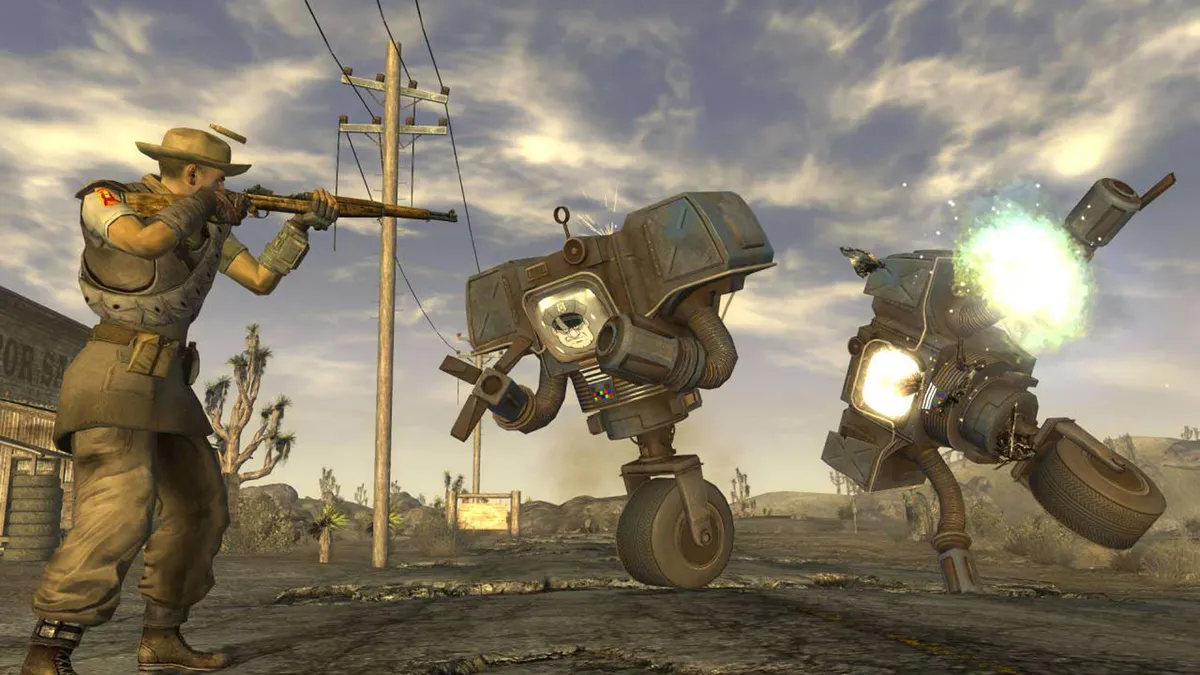
That blue sky alone makes such a difference to how the world feels and looks compared to Fallout 3.
Pete Hines, Bethesda
On that point, there can be no argument. Obsidian was formed by Feargus Urquhart, Chris Avellone, Darren Monahan and Chris Jones after the collapse of Black Isle Studios, Interplay’s RPG division and creator of the Fallout franchise.
In addition, the studio had established itself with a string of well-received and commercially successful sequels to existing Bioware games: Knights Of The Old Republic II and Neverwinter Nights 2. “[Obsidian] obviously knew how to use an existing brand and do something cool and new,” says Hines. “They also have a number of guys on the team with background experience of Fallout, starting with Feargus [Urquhart] himself.”
“The conversation really just started with, ‘Would you guys be interested in making another Fallout game, and if so, what would you do with it, where would you set it?’, and so forth. They came back with something, and we were like, ‘Yeah, that sounds really cool.’ We’re talking about guys who know Fallout, so it’s not like they were going to set it in Kathmandu, or Paris. They stuck with the Fallout universe they know, taking it back to the West coast, and using a really iconic location: Las Vegas.”

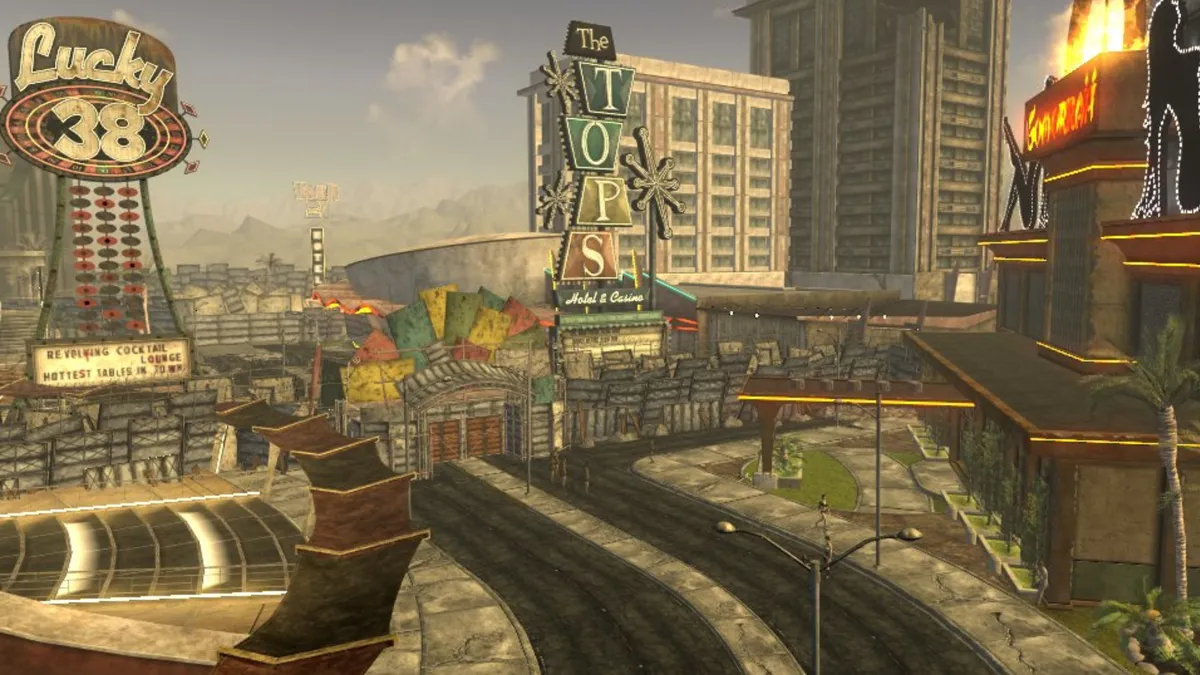
Obsidian’s choice works on several levels. Washington DC is the seat of American politics and institutional power, and one of the country’s few cities with any sense of history. Las Vegas is its mirror opposite: a gaudy monument to greed, vanity and unbridled consumption. Where Fallout 3 allowed Bethesda to create robotic presidents and missions to find the Declaration Of Independence, New Vegas affords Obsidian the opportunity to riff on glamour, vice and, of course, themed casinos.
“Each of the casinos – Topps, Ultralux, Gomorrah – are all themed differently, and run by individual groups that have a distinct personality,” says Hines. “That’s kind of what Vegas is about. Of course, nothing in the game references modern-day Vegas, but it does have that feeling.”
Within moments of starting the demo we saw posters for a lounge act called ‘The Rad Pack,’ inebriated revellers dancing in a fountain, and wandering prostitutes with nothing more than duct-tape to hide what was left of their modesty.
“In addition to that, Washington was highly destroyed and [New Vegas] was virtually untouched. So not only do you get the symbolic differences between the two locations, but then you get the real, tangible differences." says Hines. "It’s a pretty stark contrast. The primary objective of the art team at Obsidian was to use a very different section of the colour palette for New Vegas, so that when you look at it you instantly see things like blues, and reds, and oranges. Fallout 3 was much greyer, greener, and grittier. That blue sky alone makes such a difference to how the world feels and looks compared to Fallout 3.”
By night, the New Vegas strip is awash with neon – it’s one of the few parts of America that still has regular electricity – but even by day, it’s a bright and vivid environment. As Hines indicated, the sky is free from oppressive, grey cloud cover, and plays host to the sort of radiant sunrises and sunsets more commonly associated with Red Dead Redemption and Just Cause 2. The impact on the game’s atmosphere is profound, and we can only hope that this is reflected in the tone of the individual quests and overarching story.
What lies beneath

In Fallout: New Vegas, that’s where the real pleasure will be found: stumbling upon an endearing oddball character only to discover their disturbing secret; finding a bizarre community living in self-imposed isolation and being welcomed into their unhinged microcosm; being presented with three options, each on offering an equally tempting reward, each one demanding an equally troubling sacrifice.
The demo couldn’t be expected to capture whether Obsidian will accomplish this as skilfully as Bethesda, but by deciding against unnecessary reinvention, the team’s effort is certainly being invested in the right areas.
“We’re not worrying about how we’re going to get this to run at so many frames per second,” admits Hines. “Building off of stable technology helps a lot in getting the content creation up-and-running much more quickly, because you’re not spending all that time in pre-production figuring out how things are gonna work. You’re gonna add some new things, tweak stuff, change some things, but you’re not changing how things render, how collision works, how path-finding works. For the most part, all that’s been solved.”
Obsidian is also taking advantage of that sense of familiarity to subtly expand the gameplay, and Hines hopes it will become a more important part of the overall experience.
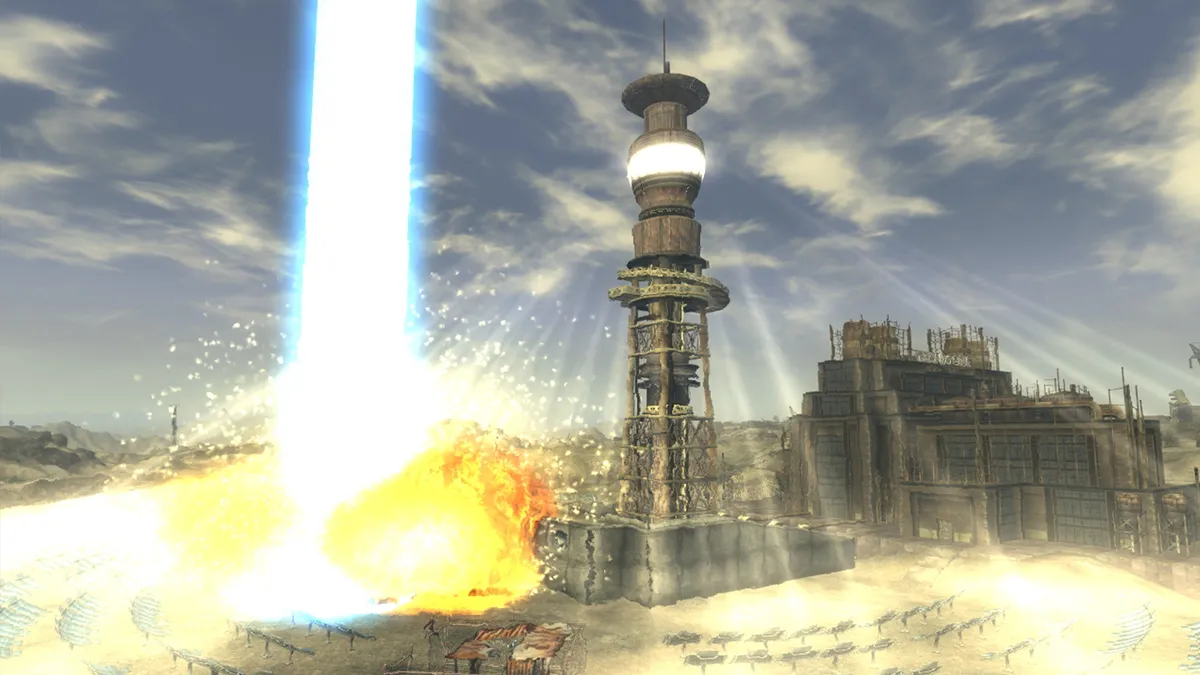
“There are enough new features, new elements, new aspects so that it doesn’t feel derivative, but still feels familiar. We don’t need to teach you how to use VATS, or the Pip-boy… How much time did you spend making items [in Fallout 3]? None. Well, now that can become the focus of the entire experience, like it has in Oblivion with all the players who spend their time picking plants and making potions.”
So is Fallout: New Vegas just ‘more Fallout’, as the more salacious denizens of the online netherworld have suggested? Well, yes, and all the better for it. After all, if you loved the previous game as much as we did, you wouldn’t want it to be anything else.
There are embellishments here, new features to become immersed in, and new weapons to try. But most importantly, there will be a vast landscape full of unknown pleasures, tempting you with the peerless sense of discovery that a vertical slice could never hope to offer.
“The new features aren’t going to be things that appeal to everybody,” Hines admits. “Two thirds of people probably won’t even realise they’re there, but for those that do it’ll add a unique touch, and personalize it a little more. I mean, that’s what Fallout is really all about.”
Q&A with Obsidian Entertainment
Obsidian’s heritage is in Black Isle Studios. Is there any crossover between the New Vegas team and the people that worked on the first two Fallout games?
We have a few of the team members from Fallout and Fallout 2 working in key positions on the project: Scott Everts, who built most of the maps from the first two games, is the head of Team Buffout, our world-building team; Chris Avellone, one of Obsidian’s owners, is a senior designer on the project and is tackling a lot of writing; Brian Menze drew all of the Vault Boys for Fallout 2, and is Fallout: New Vegas’ concept artist and illustrator of all things Vault Boy-related. We also have Aaron Brown, an amazingly talented modeller who worked on Fallout 2, developing characters, environment pieces, and weapons for us. Of course, leading the company is Feargus “Feargusaurus Rex” Urquhart, Obsidian’s CEO and Black Isle’s division director during Fallout and Fallout 2.
Knights Of The Old Republic 2 and Neverwinter Nights 2 must have posed similar challenges to Fallout: New Vegas. What did those experiences teach you?
We learned that we must be very careful about the changes we choose to make and the size of the world we set out to build. Experience has taught us to be more cautious about project scope.
You’re very deliberately sticking to the template from Fallout 3. However, gamers tend to bristle when they feel a sequel isn’t making fundamental changes to a predecessor. Are you concerned about getting this reaction?
We started with the solid foundation that we inherited from Fallout 3. We’re fine-tuning a few core systems: primarily shooting and damage reduction, extending companion functionality with the addition of the Companion Wheel… things like that. We’ve also revamped the way players interact with their companions: the Pip-Boy will now allow players to quickly and easily perform Companion commands. This is most convenient in combat situations, as you’re only two button presses away from checking hit points and administering a Stimpak. There will be numerous other things that should make the experience fresh, such as weapon mods, thrown weapons, and a larger weapon catalogue that supplements what we’ve retained from the Fallout 3 arsenal. Most notably, we’re adding more low-level options to those players that want to focus on explosives.

What attracted you to Las Vegas as a setting?
Las Vegas has a fascinating and very colourful history. In the second half of the 20th century alone, the city has recreated itself repeatedly. Controlling the region the water and power coming through Hoover Dam seemed like it would be of vital importance to expanding post-apocalyptic governments.We also felt that the city of New Vegas itself could provide an interesting counterpoint to what people saw in the ruins of Washington D.C. New Vegas is alive, bustling, and attempting to move forward, to recreate itself yet again. It wasn’t damaged extensively during the Great War, and the Strip is the centre of this activity.
In a sense, what Las Vegas represents in terms of American culture is the mirror opposite of Washington DC.
Very true. Las Vegas is a city of dreams, an escape from the practical realities of daily life. It’s a place where people go to leave things behind and free themselves from the social and emotional constraints they deal with on a day-to-day basis. In Fallout 3, Washington D.C. felt like a war zone. The deeper you moved into the ruins, the more ruinous and volatile it felt. In contrast, New Vegas’ Strip is an enclave, a protected zone surrounded by war. While the world outside burns, people on the Strip fritter away money on gambling. It’s civilization, but consumption at its worst.

In Fallout 3, there were isolated communities all over the Capital Wasteland, with their own rules, social practices and systems of government. Las Vegas is unique in that it comes with prescribed themes in the form of its casinos. Have you made use of that?
When we set out to build New Vegas’ Strip, we knew we didn’t want to directly duplicate any existing casinos or historical casinos. Instead, we looked at historical casinos and thought about how these places created their own identities through their exterior design, lighting, interior design, attractions, employees, and clientele.Each of our major casinos has a distinct look and feel. The most notable example, The Topps, is Rat Pack-themed. Its employees, the ‘Chairmen’, are chain-smoking, boozed-up, swaggering men in late-Fifties styled suits. They even have a variety show in the Aces Theatre. The Ultra-Luxe and Gomorrah casinos have their own flavours and attractions as well.
See where New Vegas ranks in our list of the best Fallout games ever.
You must confirm your public display name before commenting
Please logout and then login again, you will then be prompted to enter your display name.


