


Never underestimate the power of a good demo. When Marc-Alexis Côté, who was then senior producer on Assassin's Creed Odyssey, was told he was going to see Google's new game-streaming tech, he wasn't ready to be impressed. "I was a proud non-believer at the beginning," he tells us. "But my boss forced me to go. He put me into a car to drive me to Montreal. I was like, 'Why are you wasting my time? That stuff will never work.'"
Ubisoft, of course, loves to jump on new platforms with its games. From Wii to Kinect, it's been first to market time and again, and Côté found himself getting swept up in the initial overtures of yet another partnership. "Google demoed it and I was rolling my eyes, wondering when I could go back and work on the game. Then they put the controller in my hand, and oh! I couldn't tell the difference. They were streaming Doom from Toronto, using a connection from a phone, which was pretty remarkable. I couldn't tell the difference. I was like, 'I'm seeing the future now.'"
This demo led to Assassin's Creed Odyssey being the game used in Google's Project Stream, a US-only cloud gaming beta which launched in October 2018, day and date with Assassin's Creed Odyssey's multiplatform launch. Running until January 2019, over 100,000 players tried it, playing for 1.2 million hours combined. This was the first major test phase for Google's entry into traditional gaming, which was finally named Google Stadia during GDC in March. Now Stadia's launching for real, rolling out in 14 countries in November. "Does everyone have the internet connection to be part of the future? We'll know when they launch, I guess," Côté says. "I certainly hope so."

This long-read feature is from the pages of Edge. Find more information on the latest edition of the magazine here.
Around Stadia swirl many such huge questions. Is streaming a practical way to play games? What influence will a company like Google have on the game industry? What happens to ownership when games depend on remote servers to function? How will developers take advantage of its wider features? Is streaming an inevitable future? Is it good for games?
It will take months, if not years, for definitive answers to emerge. But Stadia could absolutely be the future. It could transform the way games are made. It could lead to new categories of design which are only possible when games run in data centres. It could change the way games are discovered and accessed. It could be the most exciting thing that's happened to the industry, and the medium, for years. Or it could flop, leaving Google to abandon it, consigned to the same scrapheap as Google Glass and all its other failed endeavours.
A minor miracle
On a dismal afternoon in early September, we travel to Google's office in central London for our own demo. Apparently, Stadia's engineers aren't happy. The build wasn't designed to be shown off, and in the run-up to launch, they've been making all kinds of changes which might make it more unstable than they'd like. But the choice of game is typical for Stadia. Keen that each demo shows off his confidence in the technology, general manager Phil Harrison stipulates that only fast-moving 60fps games are chosen – the kind in which latency is most obvious. So we play the Gamescom build of Doom Eternal, which is running in a Google data centre in Heathrow, some 14 miles away.
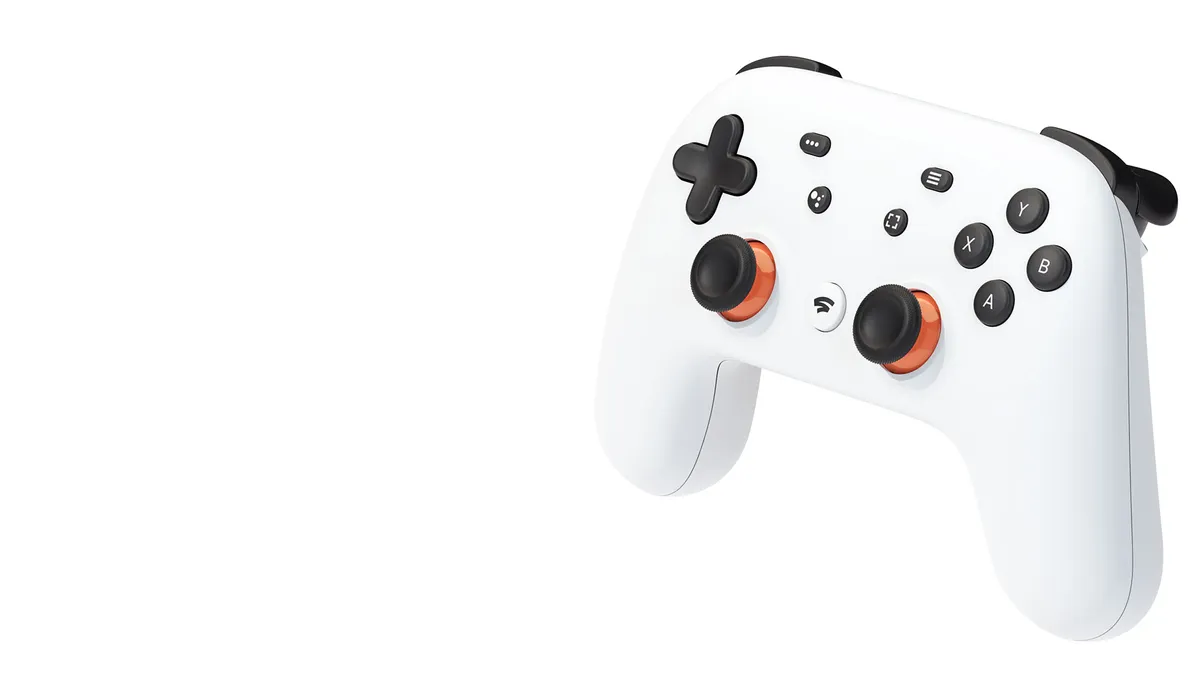
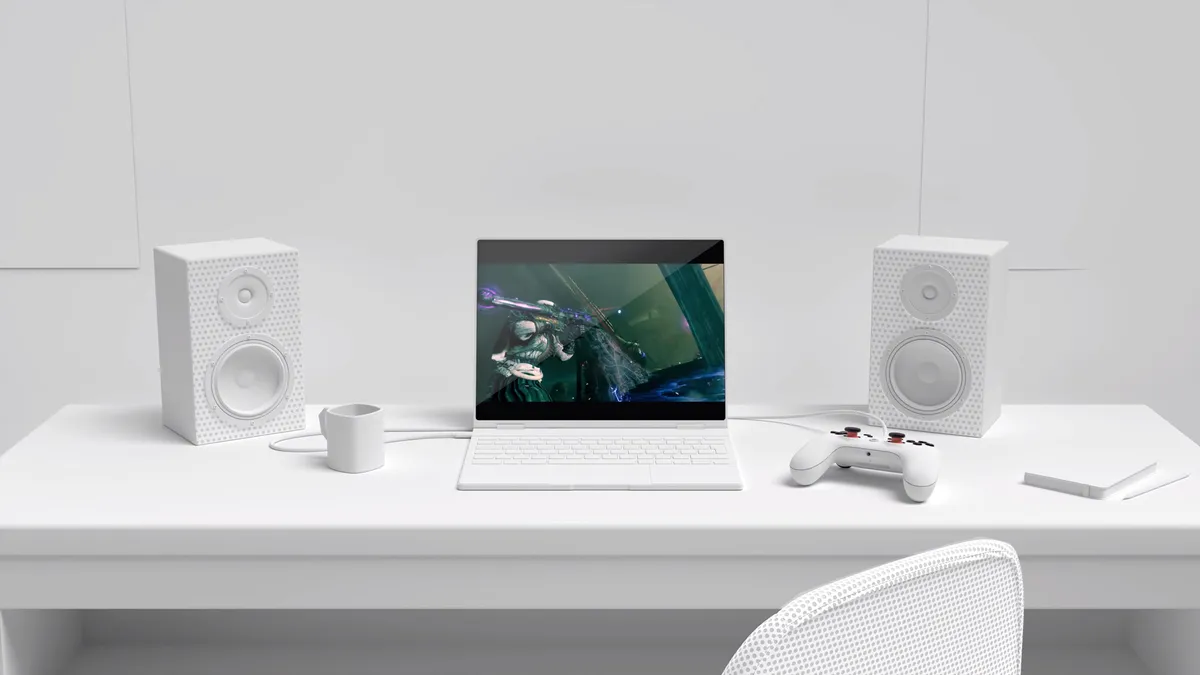
But while the staging for the demonstration is on point, the setup is less comprehensible. In fact, it's either genius or a terrible mistake. Doom Eternal is running in a Chrome tab on elderly Google Pixelbook, hooked up to a similarly dated Samsung 1080p TV. It's the same TV the Google marketing team uses for video conferencing, and it's not running in game mode, and thus all its laggardly attempts at picture improvement are in full effect. The Pixelbook is wired into the office's network, exposing it to all Google's security protocols and whatever else lies between the plug and the outside world. Though high-bandwidth, it's hardly optimised for speed. And the Stadia controller we use to play isn't exploiting its key feature: the ability to independently connect via WiFi to the data centre.
Instead our inputs are instead being sent down a USB cable to the Pixelbook, adding a few more milliseconds of delay and squeezing it among all the other data it's sending and receiving. On a service for which latency is the banner issue, every one of these features adds lag to our experience of Doom Eternal's fluidity. And, it has to be said, we can just about feel it compared to what we're used to on PC. We initially sweep our aim past targets before correcting it, but the sensation is slight – better than we've experienced with both PS4's Remote Play and Steam's In-home Streaming – and soon we're used enough to it that we are simply playing Doom Eternal.
The effect is certainly aided by fantastic picture quality. The few areas of flat colour present in Eternal betray no compression artefacts and HUD details are sharp and clean. Areas of constant movement and violent colour (which is pretty much the rest of the screen) remain similarly clear, and it runs at a constant 60fps. Stopping to steadily pan across a skybox depicting Mars with a massive hole blown in it, there are occasional momentary hitches, but they're impossible to discern through any other means and might even be caused by the game itself. So, even under less than optimal conditions, Stadia's tech works. And that's a minor miracle.
The next evolution of game streaming

Game streaming as a consumer-facing product is nearly a decade old. The first to launch was OnLive in March 2010, followed by Gaikai in February 2011. OnLive collapsed in August 2012, a month after Gaikai was subsumed into Sony, where it eventually became PlayStation Now, which still runs today. Other cloud gaming services, such as GeForce Now and Shadow, have risen in the time since, but none has come close to challenging the dominance of conventional, locally rendered gaming. Google, though, is presenting Stadia as a total replacement – and even more, as a platform that has the potential to reach two billion players across the world.
"Our vision for Stadia is to make gaming, in the broadest sense and at the highest quality, available to everyone, and not to have hardware complexity be a barrier to enjoyment," Harrison tells us. He explains that consoles and high-end PCs have tapped out at around 100 million players, mostly because console and PC hardware is expensive to buy and upgrade, and comes with the frustration of obtaining and updating software. Stadia, because it runs in Google's data centres, offers instant access to the latest games. It's a fundamentally identical pitch to the one OnLive and Gaikai spun in 2010, but now, Google claims, the world is ready.
"I want to give homage to OnLive," Stadia vice president of engineering Majd Bakar says. "They were the first to do this, and they had an amazing idea, and we're following in their footsteps. But they were eight to ten years too early."
Several things, he says, have changed. First, the network infrastructure of the Internet is a lot better. In November 2018, UK government regulator Ofcom found four in five UK households have a broadband connection, and that two-thirds of them are faster than 30 Mbit/s. Only two per cent of connections are under 10 Mbit/s. Stadia, then, with its stated requirement of 20 Mbit/s for a 1080p stream, can reach the majority of UK households. Of course, many areas aren't expecting good wired connections any time soon.
"Our vision for Stadia is to make gaming, in the broadest sense and at the highest quality, available to everyone."
Phil Harrison
For them, Harrison cites the rise of 5G mobile internet. "On paper it has the potential to bridge that last gap for everyone," he says. Theoretically, 5G's specification supports transfer rates into the Gbit/s range and a maximum latency between phone and cell tower of 4ms, but it will very much depend on local traffic and other conditions. And who knows whether Stadia's gigabytes of 5G data will be affordable?
The second thing that's changed is the quality of video codecs (these preserve detail and picture quality at lower rates of data, are much quicker to decode and don't use as much processing power). The third improvement has been to in-home networks, where the shift to 802.11ac WiFi means far greater speed and quality of connection.
But aside from these improvements in general internet infrastructure and technology, Google has also had to solve various challenges to achieve low-latency streaming video to homes from data centres. Bakar cares most about picture quality. "If your connection is 15 Mbit/s, how can we ensure we always send under that while keeping its quality? It took a lot of tuning, a lot of modelling and machine intelligence to drive that design." Google's system constantly adjusts encoding parameters to suit the kind of image being produced by the game. A visually noisy, fast-moving image from Doom Eternal needs very different treatment to the static imagery of Football Manager, or a stark white-and-red Superhot screen.
But latency is the thing that gets the most attention. And while it's already proven to be more than playable, Bakar expects further improvements. "Ultimately, we think, in a year or two, we'll have games that are running faster and feel more responsive in the cloud that they do locally, regardless of how powerful the local machine is," he claims. These improvements will come via a term which sounds rather slippery. 'Negative latency' is a concept by which Stadia can set up a game with a buffer of predicted latency between the server and player, and then use various methods to undercut it. It can run the game at a super-fast framerate so it can act on player inputs earlier, or it can predict a player's button presses. These tricks can help the game feel more responsive, potentially more so than a console game running locally at 30fps with a wireless controller.
Organising the world's entertainment

But while important, latency is really one of Stadia's least significant features. The fact that Stadia is being made by Google has far wider implications for traditional video games. It's necessary to make the distinction that we're talking about traditional games, because as the operator of Google Play, Google is already one of the largest game companies in the world.
"Android is the biggest game platform worldwide by volume – much bigger than iOS," Harrison reminds us. "You'd be surprised to know just how big games are to Google in revenue. We don't share it publicly." He also underlines the part Google plays in game discovery through its all-dominating search and ad networks – and, of course, there's YouTube, too. And he stresses Stadia's importance to the company and how it relates closely to the company's core philosophy. "You look at Google's overall mission statement: to organise the world's information and make it universally accessible and useful. Replace 'information' with 'entertainment', and that's the Stadia mission right there."
For one thing, Google's wider businesses and research efforts contribute to Stadia. For example, Google WiFi has given Bakar's team insight into in-home networks, from coping with a family member downloading a large file to dealing with interference with neighbours' WiFi. Its work in machine learning can play into fine-grained engineering optimisations as well as player-facing creative ones, such as conversational AIs based on the somewhat creepy Duplex, a Google Assistant feature which can call restaurants and make reservations on your behalf.
What Google also brings to traditional games is the fact that it has existed in the cloud since its founding in 1998. Its long-standing network of highly reliable data centres already spans the world (not that Stadia runs on machines developed for search, of course: its hardware is custom-designed for games). And that cloud-based mentality brings fascinating potential for Stadia's impact on games as a whole.

"We can get predictable latency... we're exploring games with thousands and thousands of players at once."
Jade Raymond
Starting with the familiar, cloud-based gaming has profound implications for the practicalities of multiplayer. "The fact you're only streaming video from servers, lag for online games is reduced a lot," says Tequila Works' David Canela, who is currently leading Gylt, a narrative horror game that's exclusive to Stadia. "They have the machines, they're connected and they are very fast. That's a meaningful change for the future."
"We've shown we can get predictable latency," says Jade Raymond, who as Stadia's vice president of content heads up Google Stadia Games And Entertainment, its firstparty game studio. "[We're past] the old limits of 64 players and the difficult problems of replication and keeping what you're seeing in sync with what I'm seeing... that's going to unlock a whole bunch of new games. We're exploring games with thousands and thousands of players at once."
"The other thing I'm excited about is elastic compute," Raymond says. She remembers working on Assassin's Creed, which could support a maximum of 32 AIs at once, and how that limited the "crazy ideas" her team had for the game. Every hardware generation has set limits for what's possible, but a game running on Stadia isn't limited to a single machine. It can dynamically pull in the shared compute power of the data centre to do computationally expensive things, from large-scale physics to big groups of AI, as well as persistently running worlds, similar to the concept behind Improbable's SpatialOS.
"Where I get excited is that you can build worlds that never end and are constantly evolving," Bakar says. "Developers are thinking about this cloud-native development, and we think it's where the future will go. It's running always, it can use as much compute as it needs to, and it retracts depending on the state of the game. You can build these characters and worlds that are always interacting and never have to shut them down."
Embracing creativity

Tequila Works creative director Raúl Rubio Munárriz proposes to us a game based on Roadside Picnic, the book which inspired S.T.A.L.K.E.R. He imagines its Zone, an area mutated by bizarre and dangerous phenomena, being persistently simulated on a server. "What if that world is alive, and you have to build up a mental map of it, keeping up with the way it changes?"
We're already thinking he should definitely make this game. But then Munárriz begins to spitball. "We've all been Sonic, but we've only played an instance of Sonic which is totally unaware of the multiverse of Sonics that are around it. Imagine that you're playing your game, maybe it's a superhero game, and suddenly you jump to another player's universe, and that could have consequences? Maybe there's an NPC who died in your game, and you can kidnap it from their world. Then they react to that in this chain reaction. It's going to be cool shit."
"Stadia is exciting because I can't see in my mind yet what all the ramifications will be," says Gwen Frey, developer of music-puzzle game Kine. As a straight port of a multiplatform game, Kine doesn't take advantage of any of Stadia's special developer-facing features. "I'll see how it takes off," she says. "There's a lot of interesting untapped potential in Stadia and I think a lot of it is going to have to be explored by indies. They've got this chicken-and-egg problem, right? There are a lot of interesting design things you can do with Stadia. You can easily give people the ability to hand off control, so people watching a YouTube video can jump into a game. But if you're making a massive triple-A game, you really can't explore that, because you have to make sure your game will run on other platforms. It's too risky to lean into features that are only available on one platform."
Google knows it. "Uncovering what streaming games unlock in terms of potential for gameplay that wasn't possible before is the main job of firstparty games, and we'll only scratch the surface on it," says Raymond, acknowledging the crucial role external studios will play. But when will the big studios jump in? For Bethesda marketing head Pete Hines, Stadia's big appeal right now is its immediacy. "There are any number of things we're looking at, but the ability to play games in lots of ways and places you couldn't before, and to press a button and be gaming instantly, is certainly a big one." As for supporting its unique features, it's too early to say. Hines says, "You learn a lot about any platform by putting a game out on it, even one you've already released on other platforms. So we're going to continue to look at what features might be a good fit."

"There's a lot of interesting untapped potential in Stadia and I think a lot of it is going to have to be explored by indies."
Gwey Frey
Ever the eager early adopter, Ubisoft is already incorporating some features into its games. Ghost Recon Breakpoint will include Stream Connect, which stitches multiple players' streams together so each player sees feeds from their co-op partners on their screen. It's a simple use of Stream Connect, but smart and entirely fitting for a cooperative tactical shooter, and impossible on any conventional platform. Breakpoint will also support Crowd Play, which lets YouTubers invite viewers into their game (providing they've also signed up for Stadia and bought it). "Twitch often talks about completing the cycle of watch, play, watch, play, and this feature from Stadia lets you do that," says Chris Early, Ubisoft's senior vice president of partnerships and revenue. "That hasn't been this easy or quick ever before."
Of course, for Ubisoft to bring its games to Stadia, it had to port them from DirectX to Vulcan, the open-source graphics API on which Stadia runs. But this is entirely typical for any multiplatform development, and far less onerous than some. "We all had to learn a different way of developing for the PS3," Early recalls, darkly. "When you think of the possibility of cloud compute, that's a different question. Is it more development? Well, of course. You're designing new features. Is it worth it from the player's standpoint? Absolutely. Will there be other cloud-compute platforms in the future? I think so. We've seen Microsoft making some announcements in that space. It doesn't mean they're going to offer the exact same set of services, but nor does it mean we can't bring features like this to other cloud-based platforms."
It certainly helps that Stadia's first slate of developers has found it remarkably positive to use. Over Tequila Works' two-year development of Gylt, Canela says the key specific challenge has been to develop UI that scales from a TV to a phone screen and remains readable throughout. Implementing the technology itself has been smooth. "It's rare that development goes to 30 or 60fps throughout development, but we had a high framerate for most of it," he says.
"You used to have to allocate resources to AI and physics and that's no longer the case," adds Munárriz. "It's like finding yourself suddenly with no body. Power isn't relevant any more. For developers, that's really good." Moreover, a Stadia game doesn't need the raft of testing for different configurations of CPU, GPU and whatever else a standard PC release must endure, and Munárriz likes the way that once new build is deployed it's available immediately from anywhere on anything, so he can test builds on his tablet from home.
Similarly, Frey can simply send a Stadia link to her lead artist, who works remotely (and hasn't played Kine's Switch port because he doesn't have a devkit). "It's the best of PC and the best of console," she says. "One specific set of hardware, but it's not limited by a specific box. Consoles are a pain in the ass."
Can Google change the games industry?
But the wider promises of elastic compute are a way off. So too are Google's firstparty games. While the technology works, the tools are great, the internal infrastructure is in place and the partners are signed, Google is launching without taking any creative lead. Stadia's launch roster sorely lacks the kind of defining – and essential – firstparty games that Microsoft, Nintendo and Sony would make for a new console.
"Making great triple-A games takes time, and we aren't sharing a timeline on when our first Stadia Games And Entertainment game will arrive," says Raymond, who's been in the role for less than a year. "We do have games that we'll be bringing to Stadia that we've partnered with external developers to build," adds Harrison, who only joined Stadia in January 2018. "We haven't announced everything by any means." With such a new team, there's a sense that the platform has been developing more rapidly than Stadia's leadership has had time to fully establish it. Move fast and break things? Perhaps this is an inevitable consequence of Silicon Valley getting into games.
And then there's the challenge of culture. For much of the traditional audience Stadia is seeking to access in its initial phase, there's still a wide expectation for game ownership. When you buy a game in the cloud, how do you really own it? What happens if Google decides to 'sunset' Stadia (Google Reader RIP)? Because if Stadia doesn't exist, your games can't possibly run.
"We're already living in that world for most things," says vice president of product, John Justice, who points out the realities of multiplayer games only functioning while their servers are up. "And anyone buying digitally has to contact digital-licence servers. I see some nervousness from folks, but I also saw that when Sony came out with the first PlayStation, when Microsoft came out with the OG Xbox. When a new player comes in there's always a moment when people say, 'Well you're new, let's see…' The only way for us to respond is to stay committed, and you'll see what we're doing."
"This is a long-term vision for Google, and Stadia is the vanguard of a very long-term strategy for bringing high-end computing to everyone, irrespective of the device they're using," says Harrison, firmly.
"You can build these characters and worlds that are always interacting and never have to shut them down."
Majd Bakar
At the other end of the scale of game ownership, it seems surprising that Google hasn't made Stadia a 'Netflix of games'. Surely Stadia's inherently on-demand nature is ripe for being sold at a low-low monthly fee?
"We talked about this internally when we were putting plans together, and this expression, 'the Netflix of games', was bandied around. I would rather we are the Google for games," says Harrison. Instead, Stadia will support other publishers' subscriptions, including (of course) Ubisoft's Uplay+. "In many ways, what a lot of people want isn't really Netflix," says Justice, pointing towards the fact that most content on Netflix has been through cinema releases and network schedules before it arrived there. "They want a subscription with everything: all the new stuff out there, day one."
"I suspect eventually all games will be in one subscription," adds Harrison. "But not all gamers are ready for that, and not all publishers are ready. We're in a moment of transition in the industry and it'll take a little bit of time to get there."
The effect of all this is a slightly dampened launch for Stadia: it will arrive in November with a roster of games that are all available on other platforms, many of which don't support many of its novel features, and a business model which is, for now, largely based on the traditional model of buying games at full price, or with subscriptions which are available on other platforms. Oh, and until next year sometime, when Stadia's free Base account opens, you'll also need to take out a Pro membership (£8.99 a month) to play. For now, and for many already paid-up gamers, Stadia will seem like a premium option with a single unique selling point – its immediacy – and will remain so for a while.
Then again, Stadia's launch is its least important time. It's what happens afterwards that matters. Wait until developers start realising its real data centre-driven power; wait for Internet infrastructure to further open up across the world; wait for new creators of many cultures to pop up and begin making games that appeal to the next billion players. Then, Stadia might change gaming forever.

This feature first appeared in EDGE. For more excellent articles like the one you've just finished reading, why not subscribe to the magazine at MyFavouriteMagazines.

