
 Join The Community





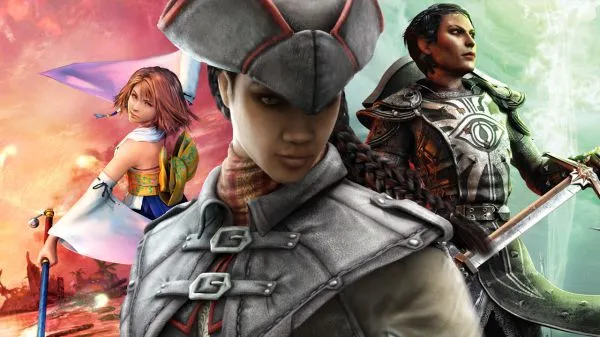
Female game characters have come a long way since the days where Lara Croft and Princess Peach were the only ones flying the feminine flag, and the results are rather awe-inspiring. As developers and the industry as a whole finally realise that girls that play games aren't a myth, there's been a huge shift in female representation in games. Gone are the days where female characters are just glassy-eyed dolls, damsels in distress or mere extensions of the main character. Female heronies and characters have become to be more like, you know, real women.
Some developers struggle to pull it off, some insist curves and personality are too difficult to do at once, and some are too busy tweaking their jiggle physics engines to notice. But others have made serious strides toward creating believable women who are every bit as heroic and inspirational as their male counterparts, and just as we give kudos to Master Chief and Gordon Freeman for inspiring us to be awesome, these ladies deserve to be celebrated too. Here you have the 25 most inspirational female characters in gaming, who push us to be better by being so great themselves. Girl power!
Yuna (Final Fantasy X)

JRPGs love the gentle healer archetype. A quiet and helpful character who lives to support the team, she (and it's almost always 'she') doesn't fare very well on her own, and unfortunately ends up looking weak and useless as a result. Yuna's been slapped with that label before, dubbed a dispassionate damsel with little to offer. Apparently the folks making that claim forget this girl puts the smackdown on anyone who gets in her way, whether it's bands of kidnappers, a diabolical suitor, or a god she's worshiped her entire life. Screw iron, Yuna has a will of diamond, and a desire to achieve her goals no matter what it takes.

Part of her conviction certainly comes from her time as a summoner, when she went through grueling training to make powerful magic beasts appear out of thin air using nothing but her mind. But even when the doctrine she grew up with turns out to be a lie and everyone she's trying to protect turns against her, she chooses to carve her own path and refuses to give up on what she knows is right. As they say, speak softly and carry a big staff, and Yuna does that with flourish. Yes. That's how that saying goes.
Lara Croft (Tomb Raider)

Obvious, right? Well, there's a reason for that. Although Lara started life as a rather generously proportioned Indiana Jones substitute, after her gender was changed part way through development of the original Tomb Raider, she quickly established herself as the go-to female gaming icon. Why? Initially it was simply because of a lack of competition. Back in the 90s, female protagonists were rarer than rocking-horse dung, and seeing a woman capable of doing everything a man could do (and often better) was inspirational to young girls interested in games.
Since then, Lara has gone through several transformations. Some Tomb Raiders miss the point completely, overly sexualising Lara and making her sassy, but the most recent reboot showcases the strongest, most modern Lara Croft. Its this iteration that earns the spot in this feature. Lara's mental toughness and drive stands out most, although her ability to drive an arrow through her enemy's retinas is pretty (straightens tie) eye-catching too.
Cassandra (Dragon Age: Inquisition)

The devout Cassandra takes a serious blow to her faith when she least expects it, and the hits just keep on coming. The death of her dear friend Divine Justinia would've been enough belief-battering for a lifetime, but that catastrophe only sweeps the dust off previously unknown horrors which threaten her very identity as a Templar and Seeker. While the reasonable reaction to that much tragedy would be to abandon one's faith and take up a new career as a bitter mountain hermit, Cassandra doesn't have time for reasonable. She has a Chantry to rebuild, because she's seen the good inside and knows it's worth fighting for.
While Cassandra can often come off as stubborn and unmovable, one of her main strengths is knowing when to hold fast and when to be willing to bend. She's shaken by the rapid decline of the Chantry, but never tries to deny its failings or abandon it, instead seeking to repair what she believes is broken. She's also the first to root out injustice where it lives, and almost single-handedly calls for the Inquisition while everyone else is too dizzy to think. Cassandra's an unstoppable storm, but one with a calm and quiet eye, too.
Ellie (The Last of Us)

Like Lara, Ellie is a survivor; a product of her environment. While she could easily have been designed as a damsel in distress, used to reinforce the surrogate father / daughter relationship in The Last of Us, Naughty Dog was smart enough to dodge such simple stereotyping. Its not Ellies capacity to kill that marks her out as a strong female character, but her ability to accept the world thats falling apart around her.
Ellie is one of the most modern, realistic characters ever designed--regardless of gender. Obviously, theres no telling how humanity would react in the face of a fungal apocalypse, but as with any situation, those who grow up knowing nothing different will normalise the world around them no matter how alien it may seem to everyone else. Ellie does that with aplomb.
Aveline de Grandpre (Assassin's Creed Liberation)

The first lady to bear the title of Main Character in an Assassin's Creed game, Aveline more than lives up to the legacy of the Assassins that came before. A woman of mixed parentage living in New Orleans at a time when that family history could (and almost does) get her sold into slavery, Aveline isn't above putting herself in perilous situations to fight the oppression rotting her city.
One of the ways she accomplishes her goal is through a series of disguises that can get her access to anything she desires, from the holding cells of the downtrodden to the halls of high society. While some players have been quick to point out that this amounts to her playing dress-up, each outfit has strategic advantages and disadvantages, and she uses all three to great effect. While she can easily climb in a target's window and put a knife through their throat, she can also gather information from their household while posing as a slave, or ruin them socially and financially through the family business. She's a triple-threat, and that's before she starts to mix-and-match her skills between personas. You gotta love a lady who can kill someone with a parasol gun without even putting down her drink.
Clementine (The Walking Dead)

It says a lot when an eight-year-old girl is so much more capable than any of the adults in her general vicinity that they all turn to her for leadership. Fighting through every snarling, decomposing obstacle that gets in her way, Clementine never, ever, ever, ever gives up on the fight to survive, and the Ice Bucket Challenge would probably give you fewer chills than hearing her say, "Still. Not. Bitten."
Not that Clementine's some fearless automaton that exists outside the realm of human emotion and struggle. It's immediately clear in season one how defenseless she is, and while she does contribute to the group, she still relies heavily on Lee to defend her and makes some emotionally-charged decisions that threaten her survival. But that just makes her more inspirational, showing her growth into someone strong and capable over the course of season two. No matter the trials or the odds she faces, she fights through the pain and never lets her resolve waver. Man, I wanna be like her when I grow up.
Alyx Vance (Half-Life 2)

If Gordon Freeman is the strong silent type, then Alyx Vance is his perfect--more vocal--female counterpart. Shes an exceptionally well realised character that perfectly dodges the simpering support role, while still retaining emotional depth. Sure, shes seen and done some serious killing, but you never get the feeling that shes lost connection with her own humanity. There are some wonderfully tender scenes between both her and her father, and Gordon himself.
Not only that, but she behaves like a normal human being. Many female characters are just convenient narrative devices used to push the story forward, making their behaviour seem less than natural, but everything Alyx does and says has both context and meaning. More like her, please.
Bayonetta (Bayonetta)

At first glance, youd be forgiven for lumping Bayonetta into the male fantasy group of female video game characters. She is impossibly-well proportioned, overly sexualised, and tends to get naked. A lot. Thing is, all the sexy stuff is played for laughs, and once you strip that away (haha etc) theres a well-rounded character lurking beneath it all.
Then theres the fact that Bayonetta is a begrudging, but caring 'mother' figure. Instead of coddling her offspring, though, she keeps her daughter (well, er, it's not actually her daughter, it's really a younger version of Bayonetta herself, which creates an interesting paradox and oh my I've lost the thread of where I was going with this...) safe without shielding her from the (admittedly bizarre) dangers within the game. Look, no-ones saying Bayonetta is a classic female role model, but she manages to be realistically inspirational in a very unreal game.
Jaina Proudmoore (World of Warcraft)

Jaina Proudmoore is a lot of things: highborne, headstrong, so skilled with magic she can wipe your entire neighborhood off the map if you give her sass. But one thing she's not is particularly lucky. Her childhood love turns out to be kind of a monster (even before he becomes a shell for an undead demon king), her father seems intent on ruining her attempts at diplomacy, and her dead enemies have a nasty habit of climbing out of their graves. But if only one word describes her, its 'determined'.
While Jaina is certainly distraught when Arthas falls under the weight of his own corruption and her father can't see past his own pride, she refuses to let either define her life or hold her back. Instead, as a sorceress of immeasurable power, she directs her talents toward changing the world for the better, creating safe havens for the oppressed and working with Thrall to build trust between the Horde and the Alliance. She is also an incredible badass, and when the Horde turns on her and destroys what she holds dear? They couldn't run fast or far enough to escape to hell she brings down on their heads. No passive princess here.
Celes Chere (Final Fantasy VI)

It's clear that Celes would've been happy with a simple life in service to the Empire, and its hard to blame her. A skilled fighter and decorated general of the Imperial army by age 18, all she had to do was toe the party line, and she'd have nothing but a life of prosperity and esteem ahead of her. She'd have to take part in some incredible human atrocities as the Empire killed its way across the world, but that's a small price to pay for glory. Except she rejects that notion and gives up everything to fight back against the Empire's oppression and protect the people she loves.
Granted, she does retain a degree of loyalty to the Empire even after she's joined the Returners, and does betray her friends on one infamous occasion. But ultimately this just makes her feel more human, and makes her struggle to do what's right even more admirable. How easy would it have been to kill her friends when they're at their weakest and rule the world at the Emperor's right hand? The answer is very, so when Celes turns around and puts a knife in Kefka's chest instead, you know there are no ulterior motives. She just knows it's the right thing to do, and she does it no matter the personal cost.

