GamesRadar+ GamesRadar+
US EditionUS CA EditionCanada UK EditionUK AU EditionAustralia
Sign in
  • View Profile
  • Sign out
  • Games
    • Game Insights
      • Games News
      • Games Features
      • Games Reviews
      • Games Guides
      • Big in 2026
      • The Big Preview
      • On The Radar
      • Indie Spotlight
      • Future Games Show
      • Golden Joystick Awards
    • Genres
      • Action Games
      • RPGs
      • Action RPGs
      • Adventure Games
      • Third Person Shooters
      • FPS Games
    • Platforms
      • PS5
      • Xbox Series X
      • PC
      • Nintendo Switch
      • Nintendo Switch 2
      • Tabletop Gaming
    • Franchises
      • Grand Theft Auto
      • Pokemon
      • Assassin's Creed
      • Monster Hunter
      • Fortnite
      • Cyberpunk
      • Red Dead
      • The Elder Scrolls
      • The Sims
  • Entertainment
    • TV Shows
      • TV News
      • TV Reviews
      • Anime Shows
      • Sci-Fi Shows
      • Superhero Shows
      • Animated Shows
      • Marvel TV Shows
      • Star Wars TV Shows
      • DC TV Shows
    • Movies
      • Movie News
      • Movie Reviews
      • Big Screen Spotlight
      • Superhero Movies
      • Action Movies
      • Anime Movies
      • Sci-Fi Movies
      • Horror Movies
      • Marvel Movies
      • DC Movies
    • Streaming
      • Apple TV Plus
      • Disney Plus
      • Netflix
      • HBO
      • Amazon Prime Video
      • Hulu
    • Comics
      • Marvel Comics
      • DC Comics
    • Toys & Collectibles
    • Lego
    • Dungeons and Dragons
    • Merch
  • Hardware
    • Insights
      • Hardware News
      • Hardware Reviews
      • Hardware Features
    • Computing
      • Desktop PCs
      • Laptops
      • Handhelds
    • Peripherals
      • Headsets & Headphones
      • TVs & Monitors
      • Gaming Mice
      • Gaming Keyboards
      • Gaming Chairs
      • Speakers & Audio
    • Accessories & Tech
      • Gaming Controllers
      • Tech
      • SSDs & Hard Drives
      • VR
      • Accessories
      • Retro
  • Deals
    • Game Deals
    • Tech Deals
    • TV Deals
    • Buying Guides
  • Video
  • Newsletters
    • Quizzes
    • About Us
    • How to pitch to us
    • How we score
    • Newsarama
    • Retro Gamer
    • Total Film
  • home
  • Games
    • View Games
      • Games News
      • Games Features
      • Games Reviews
      • Games Guides
      • Big in 2026
      • The Big Preview
      • On The Radar
      • Indie Spotlight
      • Future Games Show
      • Golden Joystick Awards
      • Action Games
      • RPGs
      • Action RPGs
      • Adventure Games
      • Third Person Shooters
      • FPS Games
    • Platforms
      • View Platforms
      • PS5
      • Xbox Series X
      • PC
      • Nintendo Switch
      • Nintendo Switch 2
      • Tabletop Gaming
      • Grand Theft Auto
      • Pokemon
      • Assassin's Creed
      • Monster Hunter
      • Fortnite
      • Cyberpunk
      • Red Dead
      • The Elder Scrolls
      • The Sims
  • Entertainment
    • View Entertainment
    • TV Shows
      • View TV Shows
      • TV News
      • TV Reviews
      • Anime Shows
      • Sci-Fi Shows
      • Superhero Shows
      • Animated Shows
      • Marvel TV Shows
      • Star Wars TV Shows
      • DC TV Shows
    • Movies
      • View Movies
      • Movie News
      • Movie Reviews
      • Big Screen Spotlight
      • Superhero Movies
      • Action Movies
      • Anime Movies
      • Sci-Fi Movies
      • Horror Movies
      • Marvel Movies
      • DC Movies
    • Streaming
      • View Streaming
      • Apple TV Plus
      • Disney Plus
      • Netflix
      • HBO
      • Amazon Prime Video
      • Hulu
    • Comics
      • View Comics
      • Marvel Comics
      • DC Comics
    • Toys & Collectibles
    • Lego
    • Dungeons and Dragons
    • Merch
  • Hardware
    • View Hardware
      • Hardware News
      • Hardware Reviews
      • Hardware Features
      • Desktop PCs
      • Laptops
      • Handhelds
    • Peripherals
      • View Peripherals
      • Headsets & Headphones
      • TVs & Monitors
      • Gaming Mice
      • Gaming Keyboards
      • Gaming Chairs
      • Speakers & Audio
      • Gaming Controllers
      • Tech
      • SSDs & Hard Drives
      • VR
      • Accessories
      • Retro
  • Deals
    • View Deals
    • Game Deals
    • Tech Deals
    • TV Deals
    • Buying Guides
  • Video
  • Newsletters
    • Quizzes
    • About Us
    • How to pitch to us
    • How we score
    • Newsarama
    • Retro Gamer
    • Total Film
Trending
  • Pokemon Winds and Waves
  • New Games for 2026
  • GamesRadar+ Replay
  • Mario Day deals
Don't miss these
A mind-boggling skeleton stands next to a chest in King's Field
RPGs Dark Souls and Elden Ring studio FromSoftware was "worried" how its OG RPG King's Field would be received
Assassin's Creed Shadows cinematic screenshot
Assassin's Creed Best Assassin's Creed games, ranked from worst to best
James holds the Alice stuffie in concept art by Jean Walter
Adventure Games Alice Madness Returns creator American McGee is making a spiritual successor, and he's not worried about EA
Mass Effect 2 - Garrus
Adventure Games The 25 best video game stories of all-time
Leon Kennedy drives a car at night in Resident Evil Requiem, with the GamesRadar+ On The Radar branding
Resident Evil 14 years later, Resident Evil Requiem achieves what the series' most controversial game couldn't
Dreamcast
Games The 25 best Dreamcast games of all time
Assassin's Creed Mirage mysterious shards Basim looking down at order member dressed in black
Stealth Games The best stealth games you can sneak through in 2026
In Hitman World of Assassination, Agent 47 sits at the departure gate in an airport during the loading screen
Roguelike Games After weeks spent locked into Hitman's Freelancer mode, I realize there's one vital thing 007 First Light needs to learn
The Legend of Zelda: Wind Waker
Games The 25 best GameCube games of all time
A close-up of Styx looking up from under his hood in darkness, one eye glowing amber, and the other light blue
Stealth Games Styx: Blades of Greed review: "What if Metal Gear Solid 5 went goblin mode? This fantasy open-world stealther delights"
Tony Hawk on the cover of the GBA edition of Tony Hawk's Pro Skater 2
Sports Games $1 million in debt, devs on handheld Tony Hawk's Pro Skater saved the company by pitching an impossible port
XCOM 2 screenshot showing an alien brute with a plasma gun
Strategy Games 10 years later and with no XCOM 3 in sight, I'm in love with XCOM 2 now more than ever
A young James Bond smirks in 007 First Light with the GamesRadar+ Big in 2026 branding frame
Action Games 007 First Light will do something no Bond game has done before – slow down: "Players might be surprised"
Rayman PS1 case sitting on top of console next to controller.
Retro The Rayman 30th Anniversary Edition is neat and all, but I'd still recommend playing the PS1 original on original hardware
Two armies clashing on a coastal region in Civilization 7 ahead of its Test of Time update
Strategy Games One year after Civilization 7 tried to fix the strategy genre's biggest problem, Firaxis is meeting fans in the middle
  1. Games
  2. Stealth
  3. Splinter Cell

The making of Splinter Cell – How the decision to "ruthlessly enforce stealth" created a classic

Features
By GamesRadar Staff, Ian Dransfield published 15 December 2021

With Splinter Cell set for a remake, we look back at the game that started it all with the developers that made it happen

When you purchase through links on our site, we may earn an affiliate commission. Here’s how it works.

Splinter Cell
(Image credit: Ubisoft)
  • Facebook
  • X
  • Pinterest
  • Flipboard
  • Email
Share this article
Join the conversation
Follow us
Add us as a preferred source on Google
Get the GamesRadar+ Newsletter

Weekly digests, tales from the communities you love, and more


By submitting your information you agree to the Terms & Conditions and Privacy Policy and are aged 16 or over.

You are now subscribed

Your newsletter sign-up was successful


Want to add more newsletters?

GamesRadar+

Every Friday

GamesRadar+

Your weekly update on everything you could ever want to know about the games you already love, games we know you're going to love in the near future, and tales from the communities that surround them.

GTA 6 O'clock

Every Thursday

GTA 6 O'clock

Our special GTA 6 newsletter, with breaking news, insider info, and rumor analysis from the award-winning GTA 6 O'clock experts.

Knowledge

Every Friday

Knowledge

From the creators of Edge: A weekly videogame industry newsletter with analysis from expert writers, guidance from professionals, and insight into what's on the horizon.

The Setup

Every Thursday

The Setup

Hardware nerds unite, sign up to our free tech newsletter for a weekly digest of the hottest new tech, the latest gadgets on the test bench, and much more.

Switch 2 Spotlight

Every Wednesday

Switch 2 Spotlight

Sign up to our new Switch 2 newsletter, where we bring you the latest talking points on Nintendo's new console each week, bring you up to date on the news, and recommend what games to play.

The Watchlist

Every Saturday

The Watchlist

Subscribe for a weekly digest of the movie and TV news that matters, direct to your inbox. From first-look trailers, interviews, reviews and explainers, we've got you covered.

SFX

Once a month

SFX

Get sneak previews, exclusive competitions and details of special events each month!


An account already exists for this email address, please log in.
Subscribe to our newsletter

By 2002, we had seen Tom Clancy's name on plenty of games – Ghost Recon, Rainbow Six, Red Storm Rising, and many more. It was already a mark of quality and reason enough to get excited about a game. The world was excited for a hardcore, thinking person's take on the then-underpopulated stealth genre – and almost 20 years later we're still feeling the effects of Tom Clancy's Splinter Cell. 

"The moment we all understood we had something," says Hugo Landreville-Potvin, level designer on Splinter Cell, "was when we realised the Metal Gear team was in the crowd [at E3 2002], pen and paper in hands, carefully taking notes. Splinter Cell was not just another game; it was a challenger." Splinter Cell had been bubbling away under the surface for years, but it took a long time to be recognised. Initially it was a retro sci-fi shooter called The Drift featuring flying vehicles, floating island settings and – tellingly – spy gadgets like a grappling hook and the ability to shoot cameras into walls. 

Development on The Drift didn't get much further than a demo stage before the idea segued into something more familiar – a James Bond-style spy game. But that project didn't move much and was shelved – until Ubisoft acquired Red Storm and the Tom Clancy back catalogue. With this new licence to hand, the studio figured it could make something with the idea that had been put on hold. The team was tasked with making 'a Metal Gear Solid 2 killer'. Martin Caya, lead character artist on what became Splinter Cell, said: "After Ubisoft acquired Red Storm back in 2000, the company wanted to create a new action game based on the universe found within the Tom Clancy novels, more specifically the Op-Center book. 

You may like
  • Rayman 2: The Great Escape main character smiling and running How Rayman 2 "offered 2D gameplay situations in a 3D environment" to get the best of both worlds
  • Dead Space "We want you to feel like it's the game you remember playing": System Shock and Dead Space devs on the art of the remake
  • Destroy All Humans! "Instead of being 80% UFO and 20% on foot, we flipped it": How Destroy All Humans' sci-fi action oddity conquered all
Splinter Cell returns

Splinter Cell

(Image credit: Ubisoft)

A Splinter Cell remake has been greenlit by Ubisoft, here's everything we know about it so far.

"So our game started out focusing on a character named Brett August. But it was soon decided that our game, although still set in the Clancy-verse, would centre around a new protagonist." With a bit of back-story written by JT Petty, it was left to Caya to come up with an idea on just who those picking up Splinter Cell would be playing as. 

"I was pretty much on my own when I first started designing Sam," he said. "I was coming up with ideas I thought were cool. But the more I was progressing on the design the more opposition I was encountering from some of the higher-ups. I remember some really long meetings where every aspect of Sam's design was being questioned. 

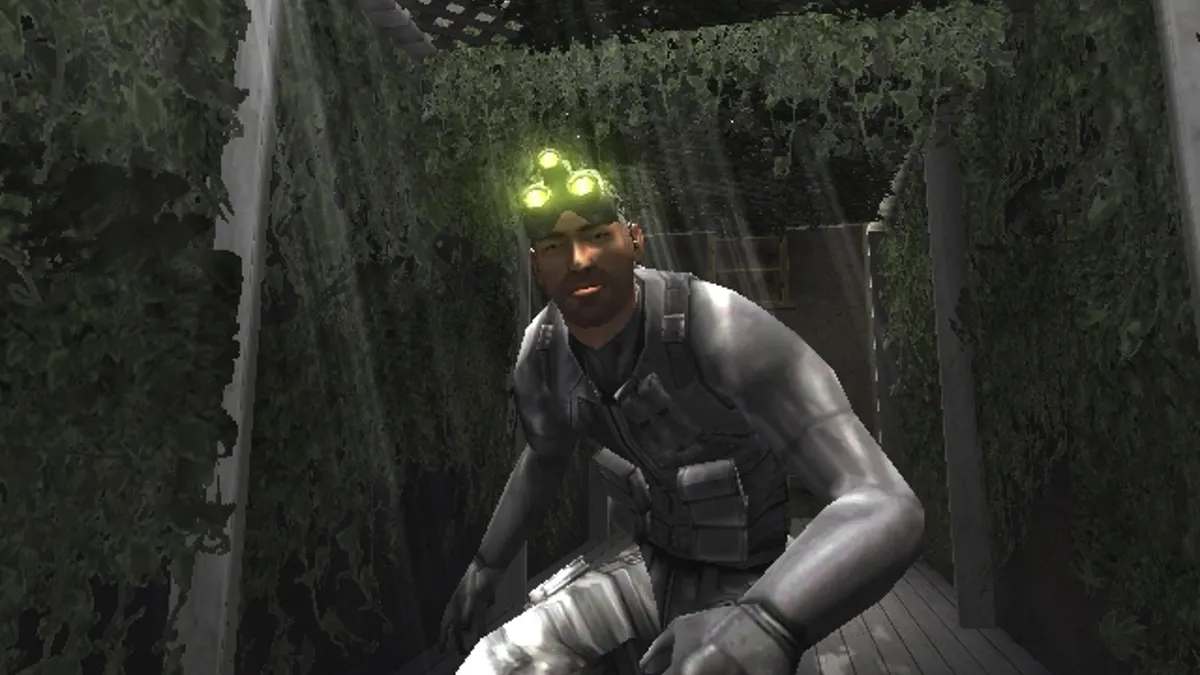
"For instance, when I originally pitched the idea that we needed a strong visual gimmick for our game, something as recognisable as Batman's silhouette is in pop culture, I presented the now famous 'three green dots'. That idea was almost instantly shot down."

Building an icon
Splinter Cell

(Image credit: Ubisoft)

One of modern gaming's most iconic elements of design, Sam Fisher's night vision goggles weren't just an element that affected how you played, allowing you to cycle between heat and night vision modes – they defined the character. 

Sign up to the GamesRadar+ Newsletter

Weekly digests, tales from the communities you love, and more

By submitting your information you agree to the Terms & Conditions and Privacy Policy and are aged 16 or over.

"Looking back now," Caya continued, "it wasn't really professional on my part – but I just didn't care about office politics. I still fought tooth and nail for that concept simply because I believed in it. That is probably one of the things I am the most proud of, the idea that when you see those green dots, you know right away that it's Sam." 

Roxane Gosselin, associate producer on the first game, agreed: "The Sam Fisher character took more than two years of research and improvements to finalise. We worked so hard to find a really identifiable element – I remember wishing that the three dots could be alone on a box and people would be able to recognise it." 

And, of course, there was the Ironside element – something Neil Alphonso, level designer on the game, is still a big fan of to this day: "Apart from being a badass tech ninja, I always liked that Sam was older than the typical video game protagonist. That was always the vision for him, and then getting Michael Ironside to be his voice just totally nailed it." 

You may like
  • Rayman 2: The Great Escape main character smiling and running How Rayman 2 "offered 2D gameplay situations in a 3D environment" to get the best of both worlds
  • Dead Space "We want you to feel like it's the game you remember playing": System Shock and Dead Space devs on the art of the remake
  • Destroy All Humans! "Instead of being 80% UFO and 20% on foot, we flipped it": How Destroy All Humans' sci-fi action oddity conquered all

Splinter Cell

(Image credit: Ubisoft)

This sort of enthusiastic creativity wasn't just limited to the design of Sam Fisher – Splinter Cell had a small team working on the game and didn't see much interference from the powers that be. Alphonso said the game was unlike anything Ubisoft had done before. "The corporate structure was fairly hands-off when it came to the actual design," he told us, "but they provided some great guidance to keep a semblance of accessibility as the game got more and more difficult." 

Caya corroborated this stay-away management aspect, saying: "From what I can remember, upper management wasn't particularly present early on. For the prototyping phase, we were pretty much left to our own devices. Everyone would participate in establishing what the different aspects of the game would be. It really was a team effort and an exciting time for a 25-year-old new to the industry. On the other hand, after the game was showcased at E3 in 2002, all eyes were on us." 

Being worked on by a small, nimble team meant things would always be progressing, changing and moving forwards, as Landreville-Potvin explained: "The team for the original Splinter Cell was a small one. Design and level design totalled seven people – leading to easy interactions between us. Each level would have a defined location with specific main story events and goals, but we were left with lots of creative freedom for secondary goals and design throughout our levels."

Working in the shadows

Splinter Cell

(Image credit: Ubisoft)

Compared to the modern, gigantic productions of the series, the original game's creation was unique in a number of ways. "We didn't really have a creative director," Gosselin explained. "Creative direction was led by a creative team, which I was part of. At the time Ubisoft Montreal was a pretty new studio and we didn't really have any 'mentors' besides the editorial team. All the work on Splinter Cell was intuitive but we always took the time to analyse properly – and we did a lot of research." 

This new-ish studio and brand new concept resulted in a few other elements that we – these days – take for granted. As Gosselin told us, Splinter Cell was one of the first games Ubisoft worked on to include extensive playtesting as a part of its design. "Our goal was really to make a game that people would enjoy," she told us, "and we spent a lot of time polishing and improving the fun factor and playability."

There is one question that often comes up with the mention of these particular branded games: how much involvement, if any, did Tom Clancy actually have? "I can honestly say that I never saw the man on the studio floor," Caya told us, "but I believe JT Petty, the game's writer, was in contact with him – though I wasn't privy to those types of meetings myself."

Gosselin, on the other hand, was more certain of the big man's influence over Splinter Cell: "Tom Clancy was really involved in the story – he reviewed the script and gave us a lot of good advice."

With or without Clancy 's involvement though, Splinter Cell saw a quick-footed process of design, implementation and testing. This meant that changes could be brainstormed, put in the game and tried out in an active setting before ultimately being kept or killed. Landreville-Potvin explained: "Basic creation of the levels was relatively quick to do. Most of our time was spent perfecting each gameplay section, like making sure all the patrolling guards always ended up at the right place at the right time, and endlessly testing to be certain all paths were achievable."

Splinter Cell

(Image credit: Ubisoft)

"The first levels we made were never completed. We made mistakes"

But just because you can be quick and change things in a nimble fashion doesn't mean you're always going to get it right: "The first levels we made were never completed. We made mistakes. But in the long run they served the purpose of focusing the level design direction. And I believe they were reworked as bonus levels later on anyway."

Beyond that particular learning process, Splinter Cell saw other big changes through its development process. As Landreville-Potvin pointed out, there were two big, important changes carried out during Splinter Cell's development. "The first one was the level design direction," he said. "In Splinter Cell, the player can go through an area using different approaches of stealth, gadgets and combat. But ultimately, the progression through a level is linear.

"The original level design direction was more of an open one with multiple interconnecting areas, closer to the Thief series. Unfortunately, for the relatively inexperienced team we were at the time, this was a sure-fire way to do the number one junior level designer mistake: we ended up creating levels that were too big, which resulted in badly paced gameplay. As a result, the first round of levels were never completed. Afterwards, the level design direction was refocused for the better."

The second change was another big one, Landreville-Potvin told us: "The second change was part of the core design. As we went through development, one problem became clear: Sam Fisher was too powerful. For instance, originally the player could grab any enemy weapon as a secondary gun. In a game that is supposed to focus on stealth, unlimited ammo simply was not fun. Removing this option was a trade-off: realism versus tension and stealth. The choice was obvious."

Alphonso agreed – this modification was a big one: "The single biggest change from my point of view was dropping the ability for Sam to pick up weapons in the field. This basically made running and gunning far more viable than we'd wanted." But it wasn't the strangest thing to be dropped: "We very briefly had floating collectibles that you had to do split-jumps to collect, but it didn't really fit the tone of the game and fortunately was dropped."

Embracing challenge

Splinter Cell

(Image credit: Ubisoft)

The race to make Splinter cell a very difficult game didn't stop with a lack of collectible weapons and ammo, though: "The other big design change was the addition of the 'three alarms' mechanic," Landreville-Potvin said. "Each time an alarm would go off, all enemies would get tougher. After three alarms, the mission would be failed. It was a much-debated change that ruthlessly enforced stealth and made the game much harder." 

But they were changes – whether ruthless or not – for the better: "Ultimately, those changes made the original Splinter cell a good game, although a hard game... maybe too hard... but that's one reason, I believe, it is remembered." 

Other cuts to the game were less important, but have still been revisited or riffed on in later iterations, as Caya told us: "I remember that Steve (Dupont, lead animation director) and I would riff on ideas like Sam using a knife for hand-to-hand combat, or the ability to open doors while carrying a body. Also, I always thought the player should experience the insertion and extraction phase of every operation." 

Good ideas. So why drop them in a project so creatively free? "Like any cool sounding ideas, coming up with them isn't nearly as difficult as implementing them in the game without sabotaging the flow of any existing mechanics." 

Though Caya made sure to point out one thing did make it into the game from these idea-riffs – the split-jump. "We never actually used it extensively," he told us. "That was something I had suggested to Steve who went on to create the split animation, but I think there were only two instances in-game where Sam could actually do that." 

A legend is born

Splinter Cell

(Image credit: Ubisoft)

Splinter cell was, back in 2002, one of the most technically-accomplished games available. It has aged, but there are certain screens you can still look at and be impressed by. As Alphonso told us, some parts of the game had to be cut because of time constraints: "A big chunk of the game set in snowy Russia was cut in order to get it out in time and at high quality; the only remnant was my nuclear plant level for the PS2 version." 

But generally speaking this was a game Microsoft was very helpful with – it was the original Xbox's biggest third-party release and a timed exclusive on the format. The eventual PS2 and Gamecube ports were technically lacking compared to the format it was built for, and with good reason. "The dynamic lighting model in the game relied heavily on the console's architecture," Alphonso explained, "and we had some additional help from Microsoft to eke out every extra bit of polish and performance." 

It was a game sent out to win hearts and minds and convert gamers to the cause of Microsoft's gigantic gaming console. While halo is recognised as the defining game of the original Xbox, Splinter Cell wasn't far behind. But it wasn't until that showing at E3 2002 that the world really began to take notice. Splinter Cell drew elements from elsewhere – it was recognisable and somehow familiar, but it was a unique type of game. The Metal Gear developers were in the crowd taking notes for a reason.

Splinter Cell

(Image credit: Ubisoft)

"While halo is recognised as the defining game of the original Xbox, Splinter Cell wasn't far behind"

Nevertheless, those involved in what ended up being one of the most critically acclaimed games with Tom Clancy's name attached remain humble. "I don't think anyone on team set out with the idea that we were creating a classic," Caya said. "In all honesty, we just wanted to create a really fun game. Although looking back on the excited reactions from people trying out our demo, we were starting to see we had something special." 

Landreville-Potvin felt similarly: "I don't think any of us could foresee Splinter Cell becoming a classic. Sure, after E3 it was clear we had something. It was also clear that it had the buzz to be big at release. But you never know if it's going to meet the expectations for the press and gamers." 

But it worked. It was well received, and it started a series that is still running. But where will the future take Sam Fisher? Caya is optimistic: "I think that as long as there are creative people involved in Splinter Cell games the series will remain vital. The series still manages to introduce a lot of innovative ideas with every new outing." 

Gosselin, meanwhile, prefers to simply look back on Splinter Cell with fondness: "It was one of my best experiences. We didn't have many constraints; Ubisoft almost gave us carte blanche on everything. It was a big risk for the company, but a good one. I'm not surprised to see where Ubisoft is now – it's one of the biggest game studios in the world, and it deserves it."


This feature was first published in issue 150 of gamesTM Magazine. For more great writing on classic games from the past, subscribe to Retro Gamer magazine. 

Ian Dransfield
Ian Dransfield
Social Links Navigation
Freelance Writer

Ian Dransfield is an experienced writer and editor, having contributed to a wide variety of Future Plc publications like 3D Artist, games™, PC Gamer, Retro Gamer, and more. With a career spanning more than a decade, Ian has done everything from work as a freelance consultant for the Guinness World Records to putting in the time as features editor of Raspberry Pi's Wireframe magazine. Ian Dransfield is currently the games editor for Media Foundry.

Read more
Rayman 2: The Great Escape main character smiling and running
How Rayman 2 "offered 2D gameplay situations in a 3D environment" to get the best of both worlds
 
 
Dead Space
"We want you to feel like it's the game you remember playing": System Shock and Dead Space devs on the art of the remake
 
 
Destroy All Humans!
"Instead of being 80% UFO and 20% on foot, we flipped it": How Destroy All Humans' sci-fi action oddity conquered all
 
 
"It felt like a great, natural fit, it was just a matter of tuning the gameplay": How Shogun: Total War marched into new territory and laid the foundations for a strategy game empire
 
 
Grim Fandango
"The physical world gave us possibilities we didn't have before": How Grim Fandango's 3D world revolutionized PC gaming
 
 
Bully
"Bully was chaotic from the day I started": Inside the making of Rockstar's 'GTA in boarding school'
 
 
Latest in Stealth
A brightened screenshot from Metal Gear Solid 5: Ground Zeroes.
Modders achieve Kojima's original vision for Metal Gear Solid 5: The Phantom Pain by fully integrating Ground Zeroes
 
 
Galeb Bazory, a vampire in a crisp blue suit, draws a blade, in key art for Vampire: The Masquerade - Swansong
I'm craving a Vampire Hitman thanks to this underrated RPG series that almost cracked the supernatural stealth code
 
 
Snake and Gray Fox in Smash Bros Brawl
After Smash Bros and Fortnite nerfed him, Rainbow Six Siege has finally returned Solid Snake's big butt
 
 
Splinter Cell
Splinter Cell remake still happening, Ubisoft insists as it lays off 40 developers at the studio developing it
 
 
Metal Gear Solid
Hideo Kojima flexes as he shares Metal Gear Solid 3 collector's edition book featuring "legendary" contributors
 
 
Metal Gear Solid: Peace Walker
Metal Gear Solid Master Collection Vol. 2's included games disappear from storefronts without warning
 
 
Latest in Features
BG3
The future of RPGs is isometric
 
 
Photo of a Mario nendoroid figure holding a microSD Express card with a Turtle Beach Switch 2 case in the background.
These Mario Day-inspired Switch 2 accessories will power up your console more than a super star
 
 
Underside of Alienware 16 Area-51 gaming laptop with glass viewing window and RGB fans
We could get a shock when 2026 gaming laptop prices are unveiled, here's what you need to know about buying this year
 
 
Emily Rudd as Nami and Iñaki Godoy as Monkey D. Luffy in Netflix's One Piece
One Piece season 2 ending explained: Who is Mr. Zero? Who dies? Will there be a season 3?
 
 
In Hitman World of Assassination, Agent 47 sits at the departure gate in an airport during the loading screen
After weeks spent locked into Hitman's Freelancer mode, I realize there's one vital thing 007 First Light needs to learn
 
 
Mario gadgets, accessories, and games on a blue background
The ultimate Mario Day starter pack, kit up for the plumber's big day
 
 
LATEST ARTICLES
  1. One Piece
    1
    One Piece season 2 is a live-action adaptation to treasure as it debuts to perfect Rotten Tomatoes score
  2. 2
    Overwatch lead says using Steam player counts to dunk on multi-platform releases like Marathon is "big unemployed, maidenless behavior"
  3. 3
    Nier: Automata creator Yoko Taro sees it "as a form of respect" when devs "say outright that they copied" his action RPG, but he's not sure "how Square Enix would feel about that"
  4. 4
    D&D's most annoying rule helped Fallout co-creator Tim Cain get his big break at legendary RPG studio Interplay after he flexed on the job interview
  5. 5
    Resident Evil Requiem director acknowledges the Leon thirst and marriage debate all in one as he jokingly lets slip a mock-up of the hot unc starring in The Bachelor: "Whoops..."

GamesRadar+ is part of Future US Inc, an international media group and leading digital publisher. Visit our corporate site.

Add as a preferred source on Google Add as a preferred source on Google
  • Terms and conditions
  • Contact Future's experts
  • Privacy policy
  • Cookies policy
  • Accessibility statement
  • Careers
  • About us
  • Advertise with us
  • Review guidelines
  • Write for us
  • Accessibility Statement

© Future US, Inc. Full 7th Floor, 130 West 42nd Street, New York, NY 10036.

Please login or signup to comment

Please wait...