GamesRadar+ Verdict
The Turtle Beach VelocityOne Race KD3 should be a compelling mid-range direct drive racing wheel. It certainly has the hardware to impress, but poor console compatibility and middling force feedback performance hold it back.
Pros
- +
Direct drive at an accessible price
- +
Reasonable force feedback feel off-track
- +
Full bundle with pedals and desk clamp
- +
Swappable wheels
- +
F-RX wheel is a delight
Cons
- -
Major console game compatibility issues
- -
Some funky force feedback performance
- -
Included wheel is disappointing
- -
Pedals are cramped and lack real adjustment
Why you can trust GamesRadar+ Our experts review games, movies and tech over countless hours, so you can choose the best for you. Find out more about our reviews policy.
Forget squad shooters, it’s sim racing hardware that seems to be the most active battleground in gaming over the past year or two. Not only are more brands dropping in with new hardware, they’re fighting each other particularly hard when it comes to price. There’s been a noticeable shift in the market as it’s rapidly become more mainstream; it’s no longer a choice between budget or performance, genuine mid-range racing wheels for PC are now a reality.
Turtle Beach is one of the more recent additions to the grid. It may be best known for headsets, but in recent times it’s shifted focus to an expanding range of VelocityOne simulation gear too. It came out swinging with the VelocityOne Race in mid-2024, a punchy 7Nm direct drive debut, and now it’s adding to the team with a gentler, cheaper model. The Turtle Beach VelocityOne Race KD3 halves the torque but basically halves the price at the same time.
It has competition in this race though. MOZA was the first off the line with the R3; Logitech’s RS50 is leading the championship, and old-school options like the Logitech G923 will still get the job done. At £329.99/$449.99, the KD3 looks like a very accessible direct drive option, but has Turtle Beach had to pick up too many corner-cutting warnings to make it possible?
Design

Early credit to the Turtle Beach design team here, because the VelocityOne Race KD3 is one of the most unique-looking wheelbases you’ll find. When everyone else is copying each other’s homework with basic black cubes, Turtle Beach has gone anti-corner with a striking cylindrical design. It’s still matte black, but there are a couple of striking neon yellow logos to break things up. I like it, though it does mean you’re reliant on a separate, though included, mounting bracket to stop this thing from rolling away.
Build quality on the wheelbase is strong, with a textured metal body capped off by plastic ends. It feels a little more hollow than rivals, but not in a concerning way, and on the whole, it all feels more premium than the price tag would have you expecting. It’s impressively compact too, just 15cm long and 13cm wide, allow a couple of cm on the bottom of the clamp and you’re still looking at a very small-space-friendly footprint. That included mounting bracket is all metal with a clever integrated tilt adjustment offering up to 20 degrees of angle choice.

The VelocityOne Race KD3 includes a 30cm round wheel as standard, but this is Turtle Beach’s first track limits violation. It’s nowhere near as premium as the wheelbase, and it’s being shown up by its teammate.
The Turtle Beach KD3 is an entry-level direct-drive wheel, so raw torque numbers from the wheelbase are a little lacking on paper. 3.2Nm of force isn’t nothing though, particularly if you’re new to sim racing or looking to step up from a gear or belt-driven option like the Logitech G923.
The wheel rim features a textured rubber coating that’s not bad, but a joining seam running right the way around not only looks cheap but is noticeable and uncomfortable to hold. Things get worse heading into the middle of the wheel, where it’s plastic galore. Everything from the frame itself to the buttons and selection rollers is hard plastic and not pleasant to touch and use, though the layout is tidy and all inputs are within reach of a thumbsweep without adjusting your grip. Around the back, the paddle shifters are a highlight; they’re metal, magnetic, a great size, and in a great position.
This isn’t your only option, however. Turtle Beach has introduced the VelocityOne F-RX Formula Wheel alongside the KD3, and it could not be more different in terms of build quality. It’s phenomenally good in design and execution to the point it really makes me question what went wrong with the default option. The rubber grips are soft and luscious, and while they too have a joining seam, it’s much less noticeable. There’s a huge array of customizable inputs littering the (unfortunately still plastic) face. The buttons are mechanical with just the right amount of resistance, though the three central rotary encoders are too stiff for my liking. If it wasn’t for the little palm tree in the middle of it I wouldn’t have believed this wheel was from the same brand, let alone the same range. You’ll pay for the privilege, mind you, £189.99/$249.99 for the wheel alone, but it is an absolute delight.

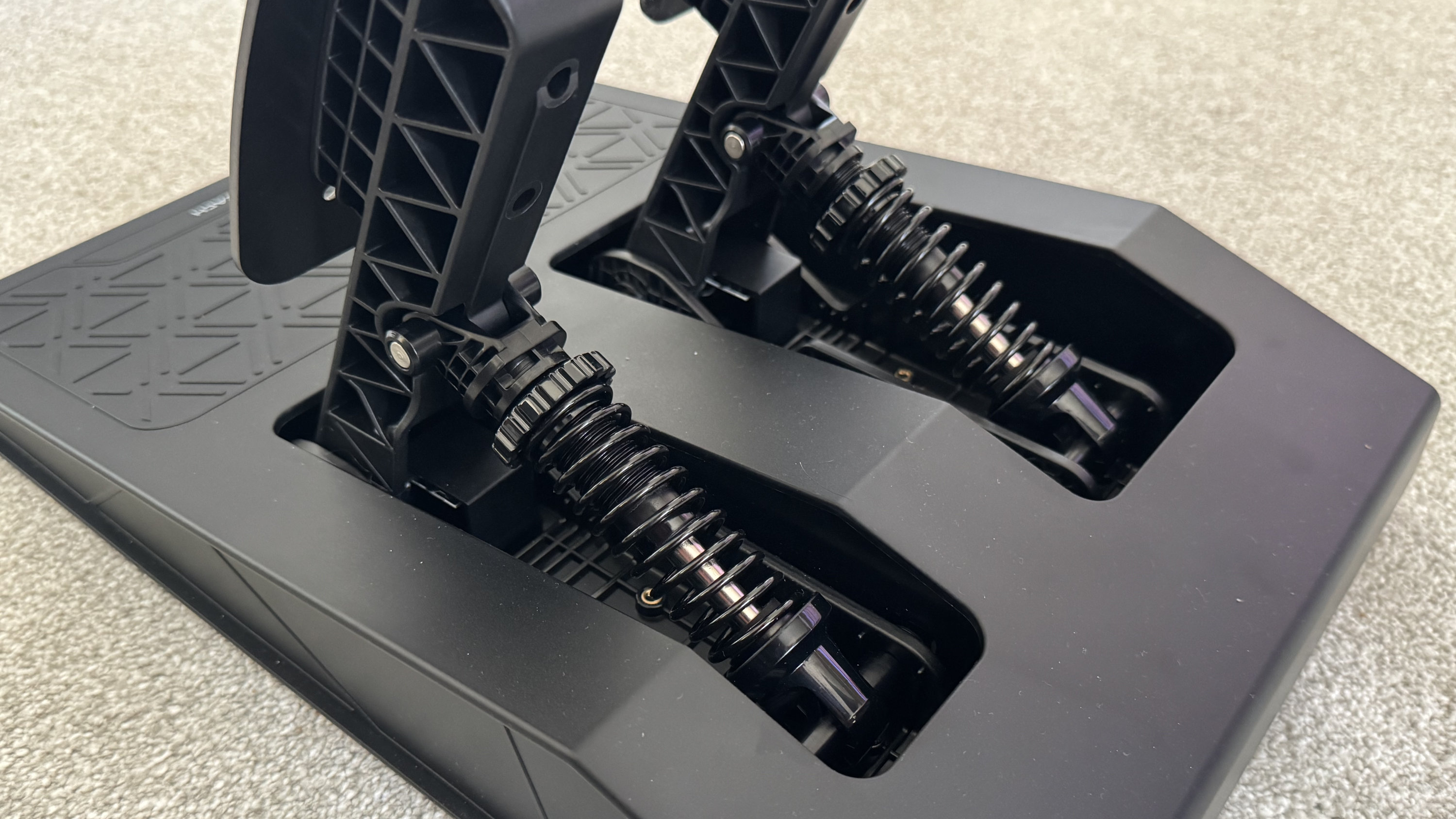
The pedals are almost a hybrid of the wheel and wheelbase in terms of quality. There are pros and cons to them. Turtle Beach has stuck with a large, all-in-one tray, which I don’t mind as a concept, though the execution relies heavily on plastic and doesn’t feel great as a result. The texturing on the heel plate is welcome, and there are non-slip pads on the bottom, though I didn’t find them particularly effective on either carpet or a hard floor so you’ll probably want to butt the KD3 pedals up against something.
Thankfully, this is now possible as Turtle Beach has learned from the original VelocityOne Race and has moved the USB connection from the back to the side, a very welcome and logical change.
The pedals themselves are again largely plastic, although they feel sturdy with generously-sized metal faceplates. There’s loads of adjustment potential here too with no less than 21 holes drilled into the accelerator and 15 in the brake. There’s no actual lateral movement to the accelerator though, and a negligible amount to the brake - bizarre given the inch-wide bezels on the outer side of both. I found they felt a touch cramped as a result, not enough that I was actually clipping my feet together, but tight enough that it wasn’t comfortable or natural.
Features and Compatibility

The Turtle Beach KD3 is an entry-level direct-drive wheel, so raw torque numbers from the wheelbase are a little lacking on paper. 3.2Nm of force isn’t nothing though, particularly if you’re new to sim racing or looking to step up from a gear or belt-driven option like the Logitech G923.
With 3.2Nm of torque at its disposal, I wasn’t expecting the KD3 to wrestle me around corners but resistance did feel light around high-speed bends.
It’s fully compatible as an Xbox steering wheel, which gives it natural affiliation with PC, though there’s no love for PlayStation racers, unfortunately. The little OLED display on the wheelbase is a nice touch and allows for onboard tuning of settings, though it’s certainly fiddlier than making those adjustments in the supporting app.
The included wheel is particularly light on inclusions. There are no additional programmable buttons here, just the standard array carried over from an Xbox controller. The F-RX Formula Wheel, on the other hand, offers 10 mechanical buttons spread across the face with RGB backlights, three rotary and two thumb dials, two thumbsticks, onboard RPM lights, Hall effect clutch paddles, tunable clutch paddles—the works. The pedals rely on traditional spring resistance and have quite a large travel distance. There’s no load cell brake here, which is a shame, but both the throttle and brake use contactless Hall effect sensors for accuracy and longevity.
Performance

Most of my sim racing is done on PC, so that’s where I started with the Turtle Beach VelocityOne Race KD3. I bolted it to the Playseat Trophy Logitech G Edition, connected the F-RX wheel, and jumped straight into F1 25. I was pleased to see the KD3 was fully button-mapped out of the box, which meant I was able to go straight out on track with no additional config. With 3.2Nm of torque at its disposal, I wasn’t expecting the KD3 to wrestle me around corners but resistance did feel light around high-speed bends. Where I am able to lean into the torque for control on strong wheels, with the KD3, my car felt much more floaty, and I didn’t have that same level of physical connection. That said, after adjusting I was able to bang in consistently quick lap times, so while it’s a compromise on a more powerful wheel, I still enjoyed whipping around Circuit de Barcelona-Catalunya.

Compatibility on Xbox is a major issue with the Turtle Beach VelocityOne Race KD3, just like it was with the original VelocityOne Race 18 months ago.
Curiously however, there’s next to no feedback from the track surface itself, not even a gentle buzz to let me know I still had tyres on, it was like driving on ice down the straights. This wasn’t limited to F1 25 either, Forza Motorsport (which required full button mapping) had the same sensation. Kerbs, bumps, and gravel were a different story altogether in both titles, and the KD3 was excellent when I strayed off-line. Riding over kerbs gave a proper jolt and shudder through the wheel; it was obvious when I dipped a wheel in the gravel and I had to correct for it. It’s proof the K: Drive motor is capable of some grunt, it’s just not being overly well implemented at present. Buoyed on by this off-track performance, I swapped over to EA WRC and was much more impressed. It really seems like the VelocityOne Race KD3 was born to rally because when you take it away from tarmac, it comes into its own. Sliding around gravel-covered hairpins was wonderful with a rich amount of detail, plenty of wrestling, and a great amount of control.

Things aren’t quite so straightforward when it comes to playing on console. Not because there are quirks in game performance (though there are), but because there are quirks in what games you can actually play. Compatibility on Xbox is a major issue with the Turtle Beach VelocityOne Race KD3, just like it was with the original VelocityOne Race 18 months ago. There’s a list of the games that are supposed to be compatible on the Turtle Beach website, but surely I shouldn’t have to dig out a spreadsheet to find out what games I can play with my jazzy new wheel?
I’d love to go into deep detail about how the KD3 performs on Xbox, but as it stands, I couldn’t play much from my library to actually be able to tell you. Forza Horizon 5 and Forza Motorsport are both on the compatibility list and do actually work, so we’re off to a good start, but the experience is middling. Everything was button-mapped and force feedback worked well moving between surfaces, but there was a strange inner deadzone issue in both games that felt like the wheel was on top of a pyramid and was determined to pull left or right down straights.

I tried jumping over to F1 24, another game on the list with claimed full compatibility, though I failed at the game’s simple request to “Press Any Button” to start. Nothing, dead. Might as well be turned off. The same was true of Burnout Paradise, though admittedly that wasn’t on the compatibility list. Wreckfest was, yet while the buttons worked and I could navigate menus, neither pedals or steering registered anything. I’m not sure if you’ve tried to compete in a demolition derby without being able to move or turn, but it doesn’t end well.
With game compatibility being a persistent gripe with this brand’s sim gear, it makes the rivals look even better.
I’m just glad the force feedback that’s meant to work in that game didn’t, or I’d have been sore in the morning. Farming Simulator 22 is on the list, but curiously, 25 is absent. I tried the latter anyway and while the pedals, steering, and some buttons work, there’s no way to look around or move outside of vehicles. I’m not sure if you’ve tried to harvest wheat without being able to see where you’re going, but it doesn’t end well.
I’d be inclined to say that this could change as time goes on, but that’s what I told you about the original VelocityOne Race. With game compatibility being a persistent gripe with this brand’s sim gear, it makes the rivals look even better. The Logitech G RS50 doesn’t have immediate compatibility with every game out there, but it has a clever mode that tricks games into thinking you’re using the widely compatible Logitech G Pro wheel. Even worse for Turtle Beach, Nacon has come straight out of the gate with its first-ever sim racing system in 2025, the Revosim RS Pure bundle, and while its game support might not be perfect, you can tell it’s been something the product designers have put thought into.
Should you buy the Turtle Beach VelocityOne Race KD3?

What makes the KD3 so frustrating is that, on the hardware front at least, Turtle Beach has a competitor with genuine potential. This could be a perfect step-up wheel for maturing young gamers or a logical entry point for new racers wanting more than a toy wheel. Even tuned down to 3.2Nm, the K: Drive motor has enough punch for most people, and it can deliver smooth and precise sensations when you venture off of smooth tarmac. Connect it to a PC and pair it with that scrumptious F-RX wheel and it’s a compelling bundle (albeit less compellingly priced by that point).
But console compatibility just isn’t up to standard. I shouldn’t need to cross every finger when booting up a game from my library in the hopes that my wheel works, I shouldn’t have to check a spreadsheet to know if I can go racing, and I definitely shouldn’t have to question my sanity when a game I was told will work, doesn’t.
I have a strange sense of déjà vu with the KD3 because I feel like I could copy and paste a lot of my top-level thoughts from my review of the original VelocityOne Race a year and a half ago. The same pros are still pros, and the cons are still prohibitive cons. I’m sure there are intricacies in game compatibility and I’m not expecting every single game since the console’s release to work perfectly. But there’s no excuse for titles released in the last two or three years to simply not work, and there are more misses that hits here.
How we tested the Turtle Beach VelocityOne Race KD3
I tried the Turtle Beach VelocityOne Race KD3 on both Xbox Series X and PC, mounted to either a Playseat Trophy Logitech G Edition racing seat or bolted to a coffee table using the included clamp and supplied tools in both cases. I tried a range of games on both platforms, focusing on titles included in the official compatibility list while also trying my luck on others that weren’t. In each game, I used both the included standard wheel and the F-RX wheel, which is a paid add-on to the bundle.
For more on how we test controllers, take a casual gander through our Hardware Policy.
Looking for something more PlayStation-compatible? Check out the best PS5 steering wheels. For more on controllers, take a look at the best PC controller, and the best Xbox Series X controller.

You must confirm your public display name before commenting
Please logout and then login again, you will then be prompted to enter your display name.