
"We've been asked a lot: what else from the show can we put into Fallout 76? And it's not much," says creative director Jon Rush. "We can't put Lucy in there, because she's not even born yet."
As we speak, Rush and his team have just launched Burning Springs, a huge expansion to Fallout 76's map. With the end of the year in sight, his characteristic buoyancy seems tempered by a certain amount of palpable exhaustion.
Springs eternal


Bethesda reflects on 10 years of Fallout 4: "You have to accept the creative choices you make on every game, even in retrospect"
In Ohio, the backdrop for Burning Springs, they've found a winning compromise: a cameo from The Ghoul. Located in the saloon of Highway Town - a colossal chunk of motor bridge repurposed as a settlement, like a concrete treehouse - he doles out bounties and desert-dried wisdom in the drawl of Walton Goggins.
"The Ghoul made sense," Rush says. By which he means, Goggins' alter ego is one of the few characters to have survived the span of almost 200 years that separates Fallout 76 from the setting of the Amazon production. "We wanted players to depend on him to act as The Ghoul that they know from the show."
That said, Fallout 76 finds our crumbly cowboy only partway through his character development. Or perhaps you could call it character dishevelment - the moral and physical deterioration that takes him from upstanding Hollywood has-been Cooper Howard to the noseless ranger we first meet in bombed-out LA.
"Players can infer what they will from his dialogue or how he acts," Rush says. "Perhaps he's not as wasteland-hardened as he is in the show. He certainly hasn't had as many experiences as when we're introduced to him in season one. But it's fun and interesting to look back and see him in Appalachia and realize, 'This is part of what made him what he was when I initially saw him'.
As for what The Ghoul's doing so far from California? "We give little hints, but not going into a lot of detail," Rush says. "Not laying out the exact time sequence of why he's there. Perhaps that comes out over time, or perhaps not."
Childhood of steel
There's some level of secrecy there that's also very intriguing as well.
Bill LaCoste
Gradually, Fallout 76 has become the place where the many identities of the series intersect. Its position at the earliest point in Fallout's timeline connects it closely to the original 1997 game, and the beginnings of perennial factions like the Super Mutants and Brotherhood of Steel.
"Being set the furthest back actually affords us the opportunity to lend a bit of exposition to existing stories, or touch on existing themes that players are familiar with," Rush says. "But the biggest challenge is, when weaving those stories together, not to step on already established lore."
Trudge over to Camp Venture, a survival training facility at the edge of the Mire, and you'll find the most tentative steps of the Brotherhood recorded in notes, terminals and holotapes. Hear about the morale crisis that saw them lose early recruits to depression and desertion, and consequently develop the quasi-religious language and traditions that kept them going.
"Words have power," the Brotherhood's founder, Roger Maxson, tells an unconvinced lieutenant. "They build identity. They take on a meaning if you keep using them, even if it didn't exist to begin with. It was the Knights and Scribes after the fall of Rome that protected what was left of Western civilization. People have a hunger to believe in something. Just let them work their way to it."
Rush points to last year's Gleaming Depths raid as another area where Bethesda has referenced the lore of Fallout's earliest entries. "There's even a nod to Fallout 2 in there," he says. "The power armor trio look kind of like [Enclave final boss] Frank Horrigan. So maybe it was a prototype. Maybe not. It's fun to lightly touch on those things."
Lore to the fore

I've always viewed our Appalachia as the main character of the game
Jon Rush
Of course, at some point there'll be a Fallout 5. And Todd Howard has told IGN that, even as Bethesda beavers away on The Elder Scrolls 6, his company is doing more work in the Fallout franchise than any other. Given that the series is expanding on multiple fronts, how does its lore retain internal consistency?
"We're a very organic studio, and as such we keep communication flowing in all directions, constantly," Rush says. "So I guess it's just not developing in a vacuum. It's including others, like [Fallout 4 lead designer and writer] Emil Pagliarulo, to weigh in on lore or any inconsistencies."
Right now, the Amazon TV show is pulling on Fallout: New Vegas for its depiction of the Strip and the NCR. Which factions from the history of the series would Rush and his team like to bring into 76 in more prominent form?
"Well, I know players would love to hear me say Enclave," Rush says. "And you know, I'm an Enclave fan too, but I can recognize that their coolness is really represented by their mystique. Which is supported by not giving away too much at any one time. I am really interested in that group."
"I think people really do dig the Enclave quite a bit," adds production director Bill LaCoste. "But there's some level of secrecy there that's also very intriguing as well. And to keep that a little bit under the rug is always a nice thing to keep people guessing about what's happening and when things are happening."
What about more niche groups, like the humanitarian Followers of the Apocalypse who cropped up in 1997's Fallout and New Vegas? Rush suggests that particular example may not be distinct enough to merit inclusion in the MMO. "I think that there's qualities of that kind of group that exist across a few of the factions across Appalachia, where it may not necessitate having to bring them back in," he says.
Massively multiplayer matcha
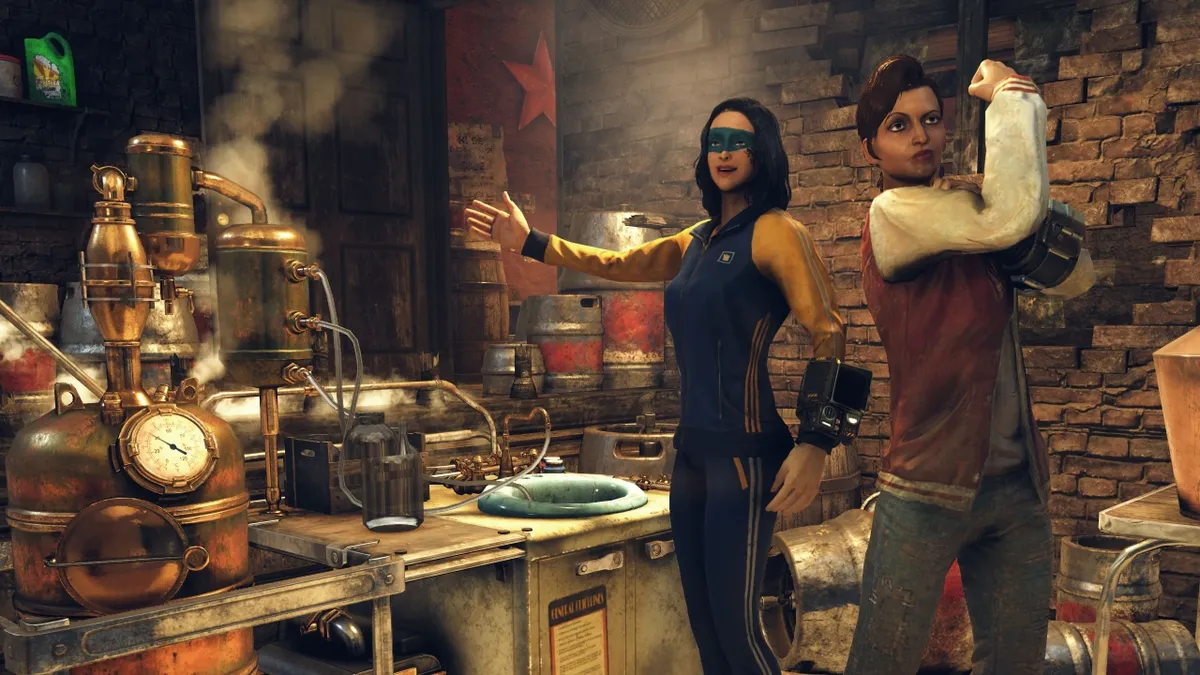
Meanwhile, as LaCoste points out, there's a lot of enthusiasm for the Free States - the prepper collective whose story is told in the bunkers of the Mire. "Players always ask for more Free States content," he says. "So that's certainly one to keep expanding."
It's important to remember that, as much as Fallout 76 is a gathering point for Fallout of all flavours, it has a character and story all of its own. One with a murky, earthen palate befitting a mutated West Virginia.
"The thing I'm most proud of is, I've always viewed our Appalachia as the main character of the game," Rush says. "And what the players experience as they traverse their Appalachia is how they become acquainted with that character. I'm most excited about the evolution of our Appalachia."
We've ranked the best Fallout games to play (or replay) right now.

You must confirm your public display name before commenting
Please logout and then login again, you will then be prompted to enter your display name.


