





We're celebrating the end of an incredible decade for games, movies, and TV shows. Breath of the Wild is one of the games that defined the last 10 years of play, placing 5th in our 100 best games of the decade rankings.

Spare a thought for Horizon Zero Dawn. Yes, Sony's glossy, absurdly pretty open-worlder may have comfortably topped the charts on launch week. Yet it wasn't state-of-the-art for long. Guerrilla had made something pretty special – something close to the apex of the sandbox genre as was. But all of a sudden it felt like the past, as Nintendo brought us a glimpse of the future.
Here was a daringly wide-ranging overhaul of one of the most beloved game series ever. And yet it was also a return to first principles: a Zelda game set in a world in which your next destination isn't set by a cheerful quest-giver or a cosseting AI companion, but entirely by you. This is a Hyrule in which it's possible to lose yourself, and yet you never feel lost. It's a vast place, but there are landmarks aplenty, with hills and towers from which to gaze out and locate new places to visit.
It can sometimes seem as though Nintendo develops its games in a bubble, but this was clear proof the company had been looking beyond Kyoto – leaning upon ideas from western open-world games but remixing them so they felt new and fresh once more. Take those towers: they reveal more of the map, but rather than offer a jumble of icons to clean up, they simply give you more potential destinations, extending your to-go rather than your to-do list. (Indeed, your 'reward' for collecting all Korok seeds lets you know Nintendo hasn't made this for achievement-hunting completists.)
Freedom to play
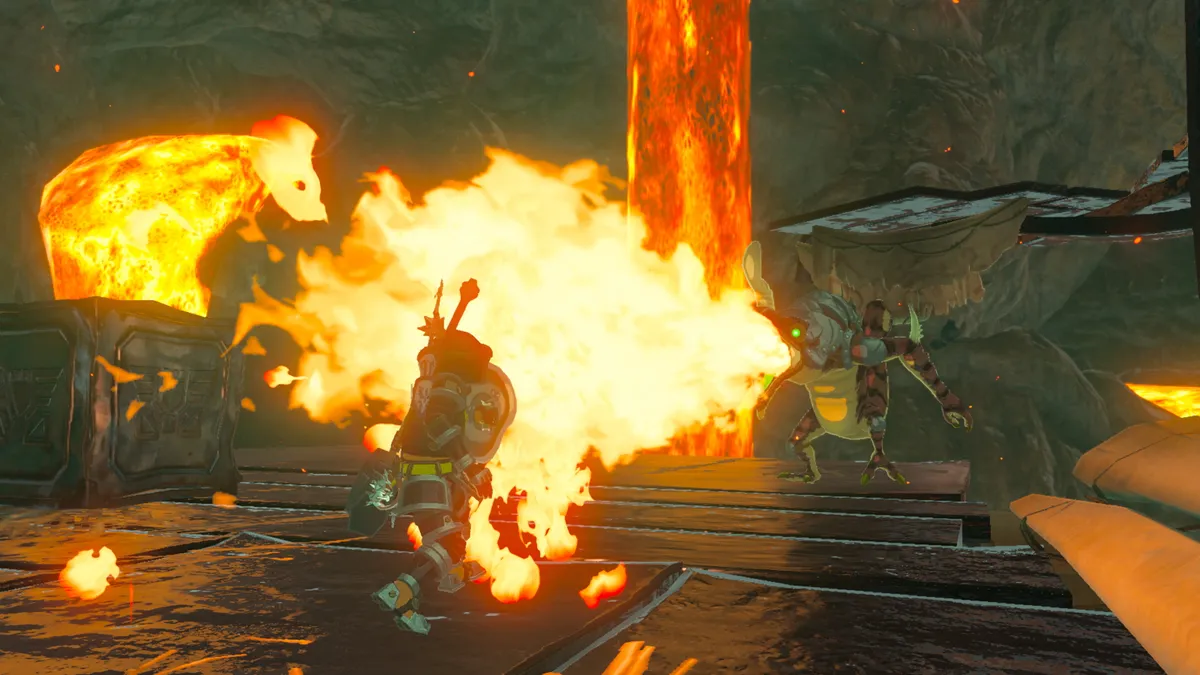
Some sneered that this was nothing more than Nintendo discovering physics, or belatedly realising the emergent joys of the immersive sim. Nonsense. There's plenty of physics-powered fun here, but Breath of the Wild is often more like a chemistry set, prompting dozens of playful experiments. Throwing metal objects at enemies during a storm to shock them with a bolt of lightning. Shooting flaming arrows into long grass and opening your glider to ride the resulting updraught. Creating an airship with a boat and several Octo Balloons, or using two minecarts and Link's magnesis ability to make a flying machine. Its anything-goes approach extends to its puzzle shrines: if the intended solution seems beyond you, there's almost always an alternative. If you can’t get hold of the orb you need to complete an electrical circuit, for example, why not dump a chain of metal weapons on the floor instead?
This player-led sandbox doesn't arbitrarily withhold its toys either. By the time you've finished exploring the Great Plateau – the whole map in glorious microcosm – you technically have everything you need. It's another reminder that Breath of the Wild trusts its players to find their own fun, confident that it has provided the tools (and the spaces) to do just that. It may be a little while before its impact is truly felt, but be in no doubt that developers across the world have been studying Breath of the Wild since launch, learning from a game that has so much design wisdom to impart.
This feature first appeared in Edge magazine issue 339, as part of its celebration of the defining games of the decade. For more industry-beating access to the very best that the video game industry has to offer, why not subscribe to Edge?

