
 Join The Community





I have a big spot for budget retro handhelds, but I wasn't initially sold on the Atari Pocket Player Pro. My doubts weren't sparked by its design, its ability to emulate the original VCS, or its hearty selection of 100 games. Instead, I'm ashamed to admit that I pre-judged the portable due to its similarities with the first console I ever owned, which happens to be a crusty Atari clone that hits many of the same notes despite a 30-year age gap.
Just so we're clear, I now feel silly for doubting the Atari Pocket Player Pro, especially since it's basically a comprehensive and compact time capsule for playing the console's greatest hits. Yes, it's potentially missing your favorite Atari game since it doesn't include third-party releases for licensing reasons, but for under $40, you're getting a handheld with respectable buttons, a decent 2.75-inch screen, and the option to play with AA batteries or USB-C power.
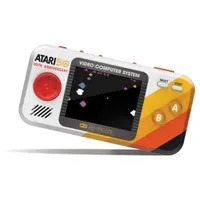
Before getting the Atari Pocket Player Pro out of the box, something about the tiny gadget reminded me of the Systema TV Boy. Anyone familiar with that plug-and-play system from 1992 might think I'm particularly bananas since it doesn't even have a screen. But, just like My Arcade's modern device, that console uses AA batteries and features a bunch of classics built in, albeit with an obscure twist to avoid licensing.

You see, unlike the Pocket Player Pro, which includes fully licensed ports of 100 Atari classics that run pretty well, the TV Boy opted for 127 ROM hacks with swapped palette colors and tweaks. Basically, the console makers fiddled with a bunch of real games to pass them off as originals, with games like Frogs and Flies (Frog Bog if you've got an Intellivision Sprint) becoming "The Frogs" and Defender disguising itself as "Protector."
I hate to admit it, but the TV Boy is the reason I'm in the world of video games today. I'd love to say the Sega Master System or Mega Drive was my first console, but Systema's crusty clone reached my tiny digits when I was just three years old. Atari's back catalogue was considered retro even back then, yet my undeveloped brain thought the mysterious list of 127 outings felt like entering a bunch of doors leading to random, exciting worlds.
You could say that by automatically comparing the Atari pocket Player Pro to the TV Boy in my head, I was actually paying My Arcade a backhanded compliment. Having now spent some time with the mini portable, though, I now realise it deserves better than to be lumped in with a cheap '90s clone. It's still what I'd call a casual option rather than a definitive way to experience the '70s console's back catalogue, but for the money, it really holds up as a collectible handheld.

For starters, the desk-shaped 8-directional d-pad is actually pretty servicable, as while it's slightly mushy, it's nice and responsive across the Pocket Player Pro's 100 games. The chunky dome A and B buttons also feel pretty tactile, and I actually think I prefer the feel compared to even the Super Pocket, but that's probably since the Evercade console features four smaller buttons.
I don't want to suggest I'd necessarily buy the Pocket Player Pro over the Super Pocket, especially since the latter is a proper retro platform that supports cartridges. But, My Arcade has squeezed a few features in that Blaze's budget contender skips on, like a brightness toggle and a difficulty button on top. Small touches like that make it evident that the Atari handheld is made with respect.


At the same time, this is a cheap and cheerful handheld, and that means going back to the good old days of using AA batteries. Having the option to use your own cells does come with perks, as you'll technically never have to wait for a charge, but it's still annoying having to rummage around for spare bats. The fact that you can just feed the little guy 5V 1A via USB-C makes up for that, though, and it means you'll always have a way to power on if you're in your car or near a power outlet.
Let's be real, if you're a serious Atari nerd, you've probably still got your OG console or something like the Atari 2600+ that will run your real cartridges using HDMI. The Pocket Player Pro is more or less like a quick reference handheld for trying out games with a bunch of history behind them, and if you get bored with those, there are 23 outings from 8 and 16-bit consoles, although NES ports like Stanley: The Search for Dr. Livingston seem to suffer from flicker tied to the screen's refresh rate.
Even if you don't sink hours into actual gameplay with the Pocket Player Pro, the handheld's Earth Tones yellow, orange, and black getup will look pretty next to your other portables. If you're into collecting handhelds, grabbing My Arcade's smol Atari for under $40 makes sense just for the vibes.
Looking for more ways to revisit the classics? Swing by the best retro consoles for plug-and-play systems and proper remakes.

