Join The Community





Bookending the first three decades of a survival horror legacy is no easy task, but Resident Evil Requiem bears that cross like a badge of honor. It's been a wild ride getting here from the halcyon days of 1996. Look to the Resident Evil timeline, and you'll find it peppered with all manner of grisly delights, from instant classics to diamonds in the rough and console exclusive spin-offs destined to be enshrined in the eternal halls of infamy instead. But, my Resident Evil Requiem review concurs with the Metacritic zeitgeist: Capcom's latest has earned its place as the highest user-rated entry in the franchise to date, and I'm utterly enthralled by it.
Contrary to its fastidious loose-end-tying duties, Resident Evil Requiem is more than a full-stop to cap off 30 years of terror. Rather, it's a semi-colon that proves how the franchise is constantly evolving along with the genre itself – and that it has no intention of stopping.
Nostalgia neuralgia
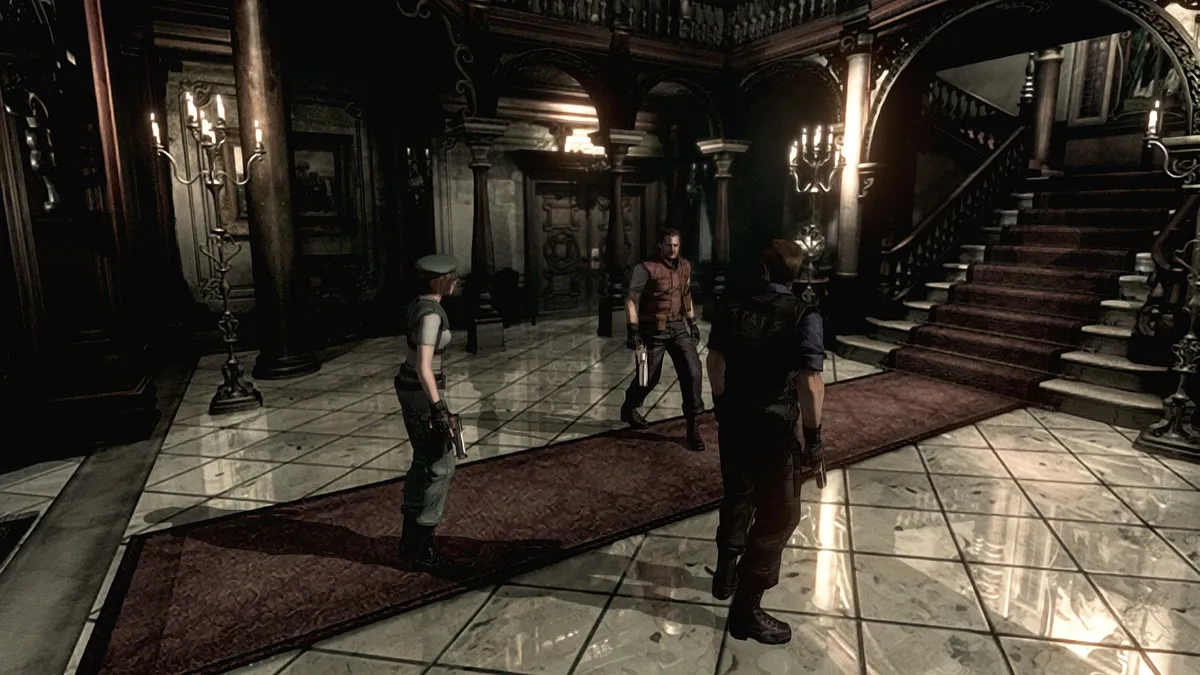

I see that no plainer than when I put it side-by-side with 2002's Resident Evil remake. Picking through the labyrinthine halls of Spencer Mansion is still one of the hardest things to do while replaying the best Resident Evil games. Truth be told, fixed camera angles were never my thing. Call it jumpy nerves or the fact that I was six or seven when I first held a sweaty PS1 controller in my hand, but I prefer my frights where I can see them: over my player character's shoulder.
Somehow, even with its dual perspectives, Resident Evil Requiem recaptures that feeling of dreading the unknown. Grace Ashcroft's limited field of vision is as terrifying as any cleverly-placed fixed camera in classic Resident Evil, and it's something I only appreciated when I swapped between the two while playing through the game's later sections within the ARK complex.
Hiding in a storage container with lickers patrolling in blind, voracious hunger all around Grace, I had to rely on my sense of hearing to maneuver to the next container, praying that I wouldn't run headfirst into disaster. But, when I swapped from first to third-person mode, suddenly able to see beyond Grace's choked periphery, that fear of the unknown was instantly erased.

There's no shortage of more blatant Resident Evil Requiem Easter eggs throughout the game, but moments like these remind me how far Resident Evil has come in 30 years. By holding fast to its roots and finding unique ways of demonstrating that without dating itself, Capcom manages to weave flavors of classic Resident Evil into Requiem's DNA with the effortless panache of Leon S. Kennedy's finisher moves.
But those are noteworthy, too. Perhaps the biggest change in terms of how Resident Evil Requiem plays compared to Resident Evil remake is the combat itself. Gone are the days of stationary shooting or on-rails mayhem; Requiem elevates the sharpness of Resident Evil 2 remake's over-the-shoulder stylings and brings it into harmony with its more classical aspects.
Things like tight, claustrophobic spaces, dark corners, item rationing, inventory management… it's all still here. Only this time, modern action mechanics are celebrated alongside them to deliver a refined experience that brings all of Capcom's biggest developments into focus.
Event horizon

Behind the big brash monsters and undead hordes, the world of Resident Evil is still a human one.
If the game is an homage to all that came before, a rapturous moment of no return that ushers in a new future for Resident Evil by wiping the slate clean, where does Requiem leave us?
It's somehow poetic that a prospective Resident Evil 10 (or, given Village's roman numerals styling, Resident Evil X) would signpost the franchise's fourth decade. But that means it would have a greater responsibility than simply carrying the torch: it would be charged with continuing Capcom's trend of reshaping survival horror as a genre, too.
For a subgenre composed of so many distinct parts, it still seems always in flux. Capcom has been lucky to be at the forefront of the genre so far, very much spearheading the surging popularity of the modern survival horror game. I've spoken in the past about how the genre's tendency to cannibalize itself is actually one of its secret weapons – a survival horror without its specifics is just another horror game, after all – but that doesn't mean innovation stops altogether.

Imagining a post-Requiem Resident Evil is thrilling in its uncertainty. Grace and Leon's journey sets the stage for a whole new world, a cure to the horrors unleashed by the Umbrella Corporation, and what sounds like a happily ever after for the human race.
The glint of gold around Leon's ring finger in the final cinematic is a subtle reminder that behind the big brash monsters and undead hordes, the world of Resident Evil is still a human one. How Capcom grapples with a rescued humanity as it recovers from extensive bioterrorist trauma is compelling on its own, but I'm even more keen to see how it feeds into a new kind of terror.
The tenth mainline game, whatever it ends up being, is Capcom's moment to divine a new future for its beloved franchise. It's a chance few developers get without a full and total reboot, like Playground's revived Fable, and even with the remake series destined to carry on alongside mainline titles, I don't think Resident Evil has finished its lifelong mission of pushing survival horror to soaring new heights.
We probably wouldn't have any of the best survival horror games if not for Resident Evil 1996, and the subgenre is still kicking today!

You must confirm your public display name before commenting
Please logout and then login again, you will then be prompted to enter your display name.