


Grand Theft Auto 3 was not the first open-world game, but it laid a blueprint that the industry is, in many ways, still following to this day. Urban environments at the scale of Liberty City were practically unheard of when GTA 3 hit PS2, but Rockstar North – then known as DMA Design – managed to squeeze it all inside some impressively tiny memory constraints. Now, a dev has rewritten the game's source code to demonstrate how it all works.
The PS2 has just 32MB of memory to work with, and according to Mark Brown, the game journalist turned YouTuber turned game dev behind Game Maker's Toolkit, the assets that make up GTA 3's Liberty City constitute around 130MB of data. The devs split the city into three different islands, which each load separately, but even the opening island of Portland still features somewhere in the neighborhood of 40MB-50MB of assets.
Unwilling to compromise with a boring, bland city made up of low-quality assets, the devs eventually split Liberty City into what Brown describes as "thousands of small sectors," and the game only loads the assets for sectors near the player. Assets continue to load in as you move near them, and are unloaded as you move out. That's "streaming," a word you'll continue to hear describing this kind of data management in games even today.
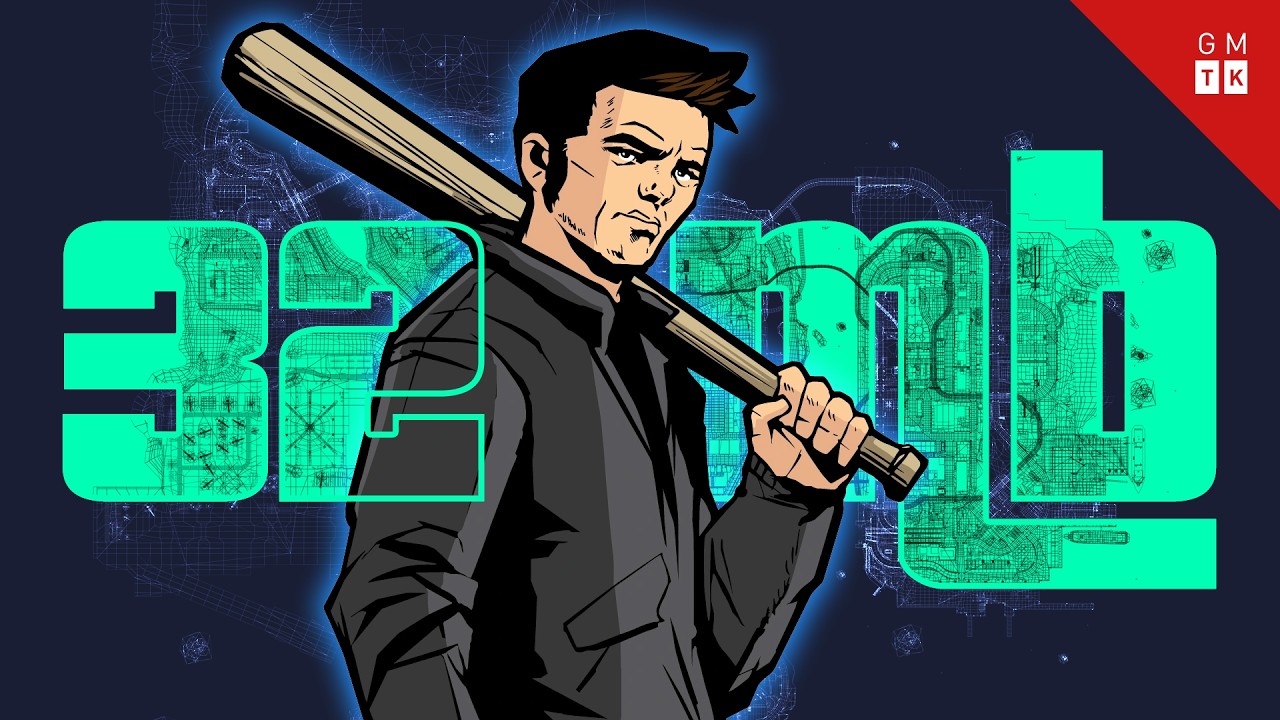
Simple enough in concept, but it's a magic trick that's effectively invisible while you're playing. So, to demonstrate how it works, Brown "got the GTA 3 source code," then "rewrote several sections of the program," and "compiled a brand new executable." His new version of the game, which you can see in the video above, demonstrates exactly how the streaming works, and it's very fun seeing small chunks of Liberty City pop in and out around the player's location.
"Now you can see the trick: how Grand Theft Auto 3 loads and unloads a small number of assets into memory as you move around Liberty City," Brown explains. "It secretly builds the world in front of you, and it silently deletes the world behind your back. Basically: instead of trying to fit a whole city into memory, Rockstar instead built a moving window which shows just enough of the city to make the illusion work."
Of course, this is a very simple explanation of how it all works, and one that ignores all the problems the devs had to solve along the way. For example: wouldn't players notice the assets pop in around them as they move? To solve that, the devs implemented lower-detail versions of the assets that appear in the distance, turning into the regular models as you get close. That, of course, is another technique still widely used in modern games.
The full video goes into many of the other behind-the-scenes problems that Rockstar solved, and is well worth your time if you're interested in the technical makeup of an all-time classic. Many of the tricks the devs used to make GTA 3 work weren't unheard of even in 2001, but the game that resulted was such a massive success that the entire industry would soon be following its lead. With GTA 6 on the horizon, that legacy is impossible to ignore.

