You are now subscribed
Your newsletter sign-up was successful
Want to add more newsletters?

Every Friday
GamesRadar+
Your weekly update on everything you could ever want to know about the games you already love, games we know you're going to love in the near future, and tales from the communities that surround them.

Every Thursday
GTA 6 O'clock
Our special GTA 6 newsletter, with breaking news, insider info, and rumor analysis from the award-winning GTA 6 O'clock experts.

Every Friday
Knowledge
From the creators of Edge: A weekly videogame industry newsletter with analysis from expert writers, guidance from professionals, and insight into what's on the horizon.

Every Thursday
The Setup
Hardware nerds unite, sign up to our free tech newsletter for a weekly digest of the hottest new tech, the latest gadgets on the test bench, and much more.

Every Wednesday
Switch 2 Spotlight
Sign up to our new Switch 2 newsletter, where we bring you the latest talking points on Nintendo's new console each week, bring you up to date on the news, and recommend what games to play.

Every Saturday
The Watchlist
Subscribe for a weekly digest of the movie and TV news that matters, direct to your inbox. From first-look trailers, interviews, reviews and explainers, we've got you covered.

Once a month
SFX
Get sneak previews, exclusive competitions and details of special events each month!
A funny thing happened to me in the weeks I've spent playing Dragon Quest 7 Reimagined: I fell in love with its 25-year-old PS1 predecessor instead. Playing both versions side-by-side, it's clear that the remake does a brilliant job of sanding off the original's rough edges, speeding up the grind and making sure you're always pointed at your next objective. But it's the very orneryness of the old game that I've come to find so delightful about this piece of the Dragon Quest canon.
I'm an avid collector of retro games, so when the opportunity to play an advance copy of Dragon Quest 7 Reimagined came my way, I figured this would be a perfect excuse to spend entirely too much money on eBay for a copy of the PS1 original. I'd be able to make some direct comparisons between the two versions, and would have a fresh copy of a classic JRPG to display on my shelf. But as I put more and more hours into both versions, I've found myself sticking with Reimagined largely because I have an assignment to write about it. The original is the one I keep wanting to return to.

On its original release at the turn of the century, Dragon Quest 7 – or Dragon Warrior 7, as it was known in the US – was already something of a throwback. Back then, it looked downright primitive against the visually spectacular Final Fantasy games on PS1, never mind the downright astonishing looks that Final Fantasy 10 would soon provide on PS2. Similarly, its combat is perfectly old-school, fully turn-based stuff, as true to the random battle spirit of the grandaddy of JRPGs as any Dragon Quest sequel.
Today, its combination of 2D sprites and 3D backgrounds is positively charming, looking almost like a prototypical version of the HD-2D art style that Square Enix returns to so regularly in the modern era (in fact, our Managing Editor Rollin Bishop found the Dragon Quest 1 & 2 HD Remake a great jumping on point at the end of last year). The battles are a warm blanket, one I find pairs best with a sip of coffee on a Sunday morning as I slowly build up my party's power to endure the length of the next dungeon.
Adventure time

The largely episodic story sees you visiting an array of troubled realms in the ancient past.
What gives Dragon Quest 7 its unique flavor is its structure. The largely episodic story sees you visiting an array of troubled realms in the ancient past, solving their problems, and returning to see how things have changed in the present. Along the way, you collect fragments of stone tablets that combine to open up the portal to the next location. Each section is pretty self-contained, usually featuring a single village, dungeon, and major boss, offering a mini-adventure you can complete in a handful of hours.
There's an emphasis on light puzzle-solving, as well. In one instance, you find yourself in a town full of people who've been turned to stone, and reliving the memories of the petrified villagers gives you a clue on where to find a secret entrance to a cavern you need to enter to progress the story. There's a lot of dialogue, and a fair bit of running back and forth between NPCs, looking for the chain of events that'll push the plot forward. As a long-time lover of dialogue-heavy point-and-click adventure games, it's a big part of why I've come to enjoy Dragon Quest 7 so much, but it's also a big part of why the game has such a reputation for tedium among those who prefer their RPGs crunchier.

What, then, does Dragon Quest 7 Reimagined bring to the table? No more random battles, for one thing. That's a change that was first introduced in the now-decade-old 3DS remake (a version I've also played a bit of, but one I won't spill much ink on here so as to avoid getting bogged down in the minutiae of three-way comparisons), but the new version goes a step further by introducing a Persona-style early attack option. Make a trivially easy strike on an enemy on the field, and you'll do a little extra damage to them heading into battle. Weaker enemies will be killed outright by an advanced strike, awarding you a little less gold and experience as you bypass combat entirely. That's a nice change to speed up exploration, and getting to instantly take out monsters you previously had to battle does a nice job of making you feel powerful as you level up.
Then there are the objective markers – big, colorful exclamation points hovering over wherever you're meant to go next. This is where my frustration with Reimagined starts to emerge. None of the puzzles in the original are particularly taxing, but following the breadcrumb trail of NPC dialog to your ultimate objective offers a gentle sense of satisfaction. In the remake, the steps are the same – talk to a handful of characters in a particular order to push things forward – but the added convenience of the quest markers ironically ends up just making the process feel more tedious. It's as if the game is constantly saying, "This part's not important. Do you want to just skip ahead?"
Dungeons and dragging on

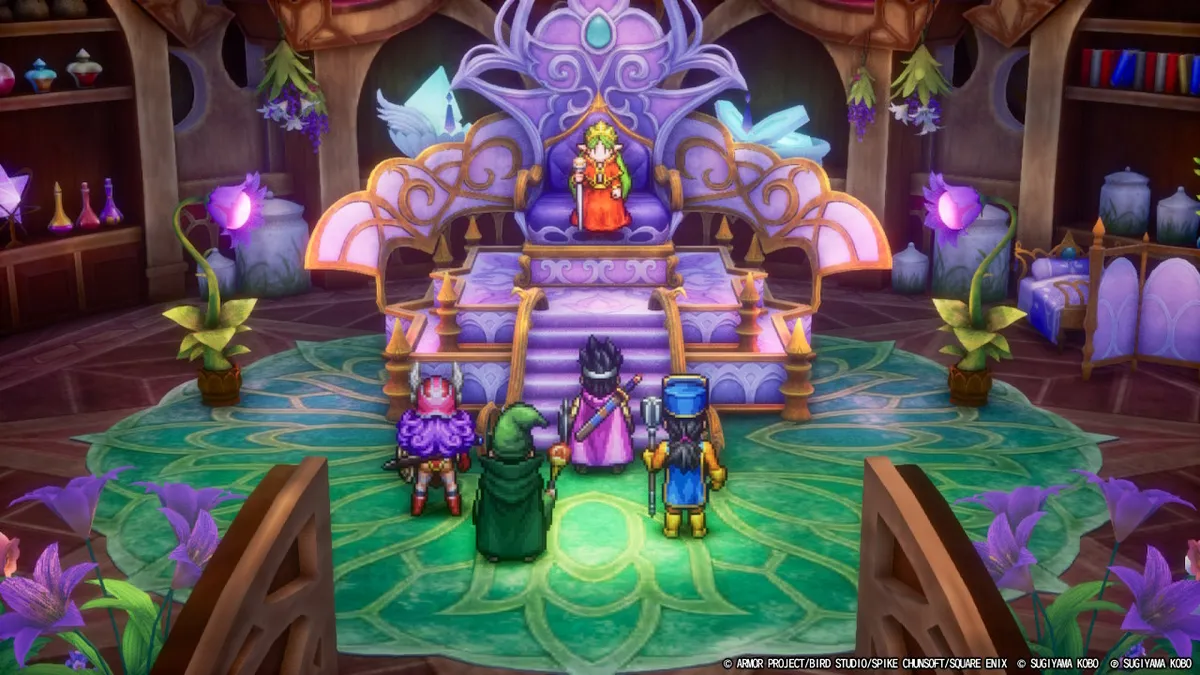
This JRPG's classics keep coming! We called Dragon Quest 3 HD-2D Remake a "pixel-perfect overhaul" when it launched. What could be next?
In any classic-style JRPG, the core challenge isn't found in any one particular battle. The thrill is in completing each encounter while exploring a dungeon with a dwindling pool of resources. Do I use my offensive spells now to end these basic fights fast or conserve my MP for the boss? Will my strategy survive if there's another floor before the end? Do I need to pull out now and heal up before rather than risk a total party wipe and a game over screen?
In the original Dragon Quest 7, leveling up doesn't restore your resources. In Dragon Quest 7 Reimagined, you level up more frequently and every level fully replenishes that character's HP and MP. In the original, you can only save when you speak to priests located in castles and villages. In Reimagined, there are new save points located at the entrance to every dungeon and before every boss. In the original, you can only fully restore your party's MP by paying for an inn. In Reimagined, you can get all your HP and MP back for free at each of the newly introduced save points.
You can see how this would change the vibe of dungeon-diving in Reimagined. Dungeons are no longer hard-won battles of attrition. Instead, they’re hallways full of monster piñatas popping out XP and treasure as you rush to the boss. The generous, healing save points have resulted in more challenging boss encounters with more strategic depth, but that comes with the unfortunate side effect of making every other aspect of the dungeons – you know, the whole 'dungeon' part – feel superfluous.

At this point, it might be starting to sound like I hate Dragon Quest 7 Reimagined, but that's not the case. It has a delightful visual style, its goofy voice acting is undeniably charming, and the heart of the gameplay systems that have driven Dragon Quest for decades still beats strong. Yet I can't help but feel that its focus on convenience, expediency, and avoidance of frustration have cut away at what makes this particular entry in the series memorable.
Dragon Quest 7, in its original form, is notoriously slow-paced, even by the standards of PS1 JRPGs. But there's a reason this is often seen as the genre's golden era. These were big, epic adventures that lasted for dozens (and dozens, and dozens) of hours, ones that paid back that time investment with intricate worlds and characters you can grow to love.
There's a long-running joke about long JRPGs, with how many of them take 30 or more hours to "get to the good part." And with the mountains of excellent games to play in the modern era, I won't begrudge anyone for wanting to cut down fluff. But sometimes, the best part comes when you've put in the hours truly exploring and growing to understand a game's inner workings, even if at times it seems like it's trying to push you away.

The new version feels less like a remake – one that preserves the spirit of its predecessor – than a set of CliffsNotes.
That's the experience I've gotten from the original Dragon Quest 7 – a mountain of a game where I've got to constantly prepare myself for the challenge of the climb. To stretch that metaphor out, Dragon Quest 7 Reimagined is a paved hiking path with rest benches and water stations positioned every few feet.
There's still a charm to a breezy JRPG where you can sit back, mostly turn your brain off, and wind your way through a lighthearted story. But playing the original Dragon Quest 7 and Reimagined side-by-side, the new version feels less like a remake – one that preserves the spirit of its predecessor – than a set of CliffsNotes for a much deeper and more engaging game. On paper, every single change made to Dragon Quest 7 Reimagined is an objective improvement, but those changes sum up to a lesser game than that aging PS1 title.
Dragon Quest 7 Reimagined was played on PS5, with a code provided by the publisher.
Looking for more adventure? Our best JRPGs ranking has more for you!

You must confirm your public display name before commenting
Please logout and then login again, you will then be prompted to enter your display name.