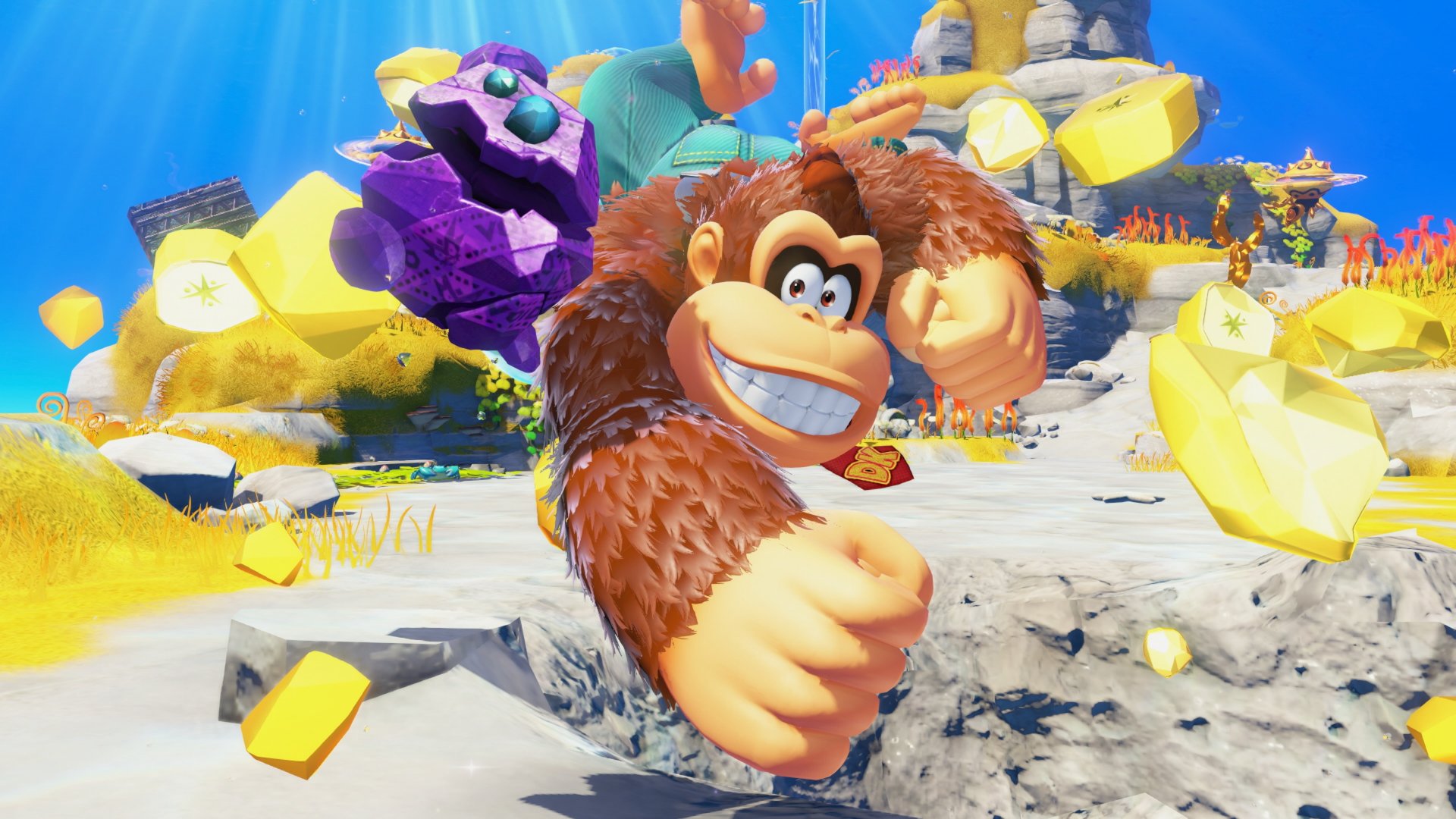
Donkey Kong Bananza is hardly the only game that allows you to destroy the levels you play in – after all, Minecraft and its many imitators all let you tear their worlds apart and rebuild them piece by piece. But merely destroying blocks wasn't quite fun enough, as the devs at Nintendo found when they first started prototyping Donkey Kong's latest adventure. No, for it to be fun, you really need to be destroying something pretty.
In a talk at the Game Developers Conference, attended by GamesRadar+, programmer Tatsuya Kurihara explains that, even when the team built the ability for you to destroy levels, "the satisfaction of destroying them was still lacking." The devs soon realized that "it's more fun to destroy something that doesn't look like it can be destroyed. It is more fun to destroy that which is beautiful. With this in mind, the development team set out to pursue destruction."
The underlying building blocks of Donkey Kong Bananza's levels are just that: blocks. Or more accurately, they're voxels. "Voxels are three-dimensional versions of pixels and can be thought of as boxes containing data arranged in a three-dimensional grid," Kurihara explains. "By dynamically changing that data within the game, you can create interactions at a voxel level, which is more granular."
Producer Kenta Motokura explains that "voxel everything" was the concept driving Bananza's development.
"The producer makes it sound easy when he says he wants to create everything out of voxels," Kurihara jokes. "How do we actually do it?"
Well, in Donkey Kong Bananza, each voxel contains information "such as density, material properties, damage, wetness, and more." Then, Kurihara explains, "polygon meshes are dynamically generated from this voxel data. To maintain 60 frames per second as much as possible we kept the number of polygons limited."
But even if the polygons displayed are limited to save on performance, there's still a massive number of voxels underlying it all. "To give you a sense of how much voxel data there is, the rather big Canyon layer actually has about 340 million voxels," Kurihara says.
Here are all the upcoming Switch 2 games you need to know about.