GamesRadar+ Verdict
Pros
- +
Enormous level of content
- +
Unparalleled sense of accomplishment
- +
Bizarre character and level design
Cons
- -
Gotcha! ambushes
- -
Unreliable target lock-on/camera
- -
Framerate issues
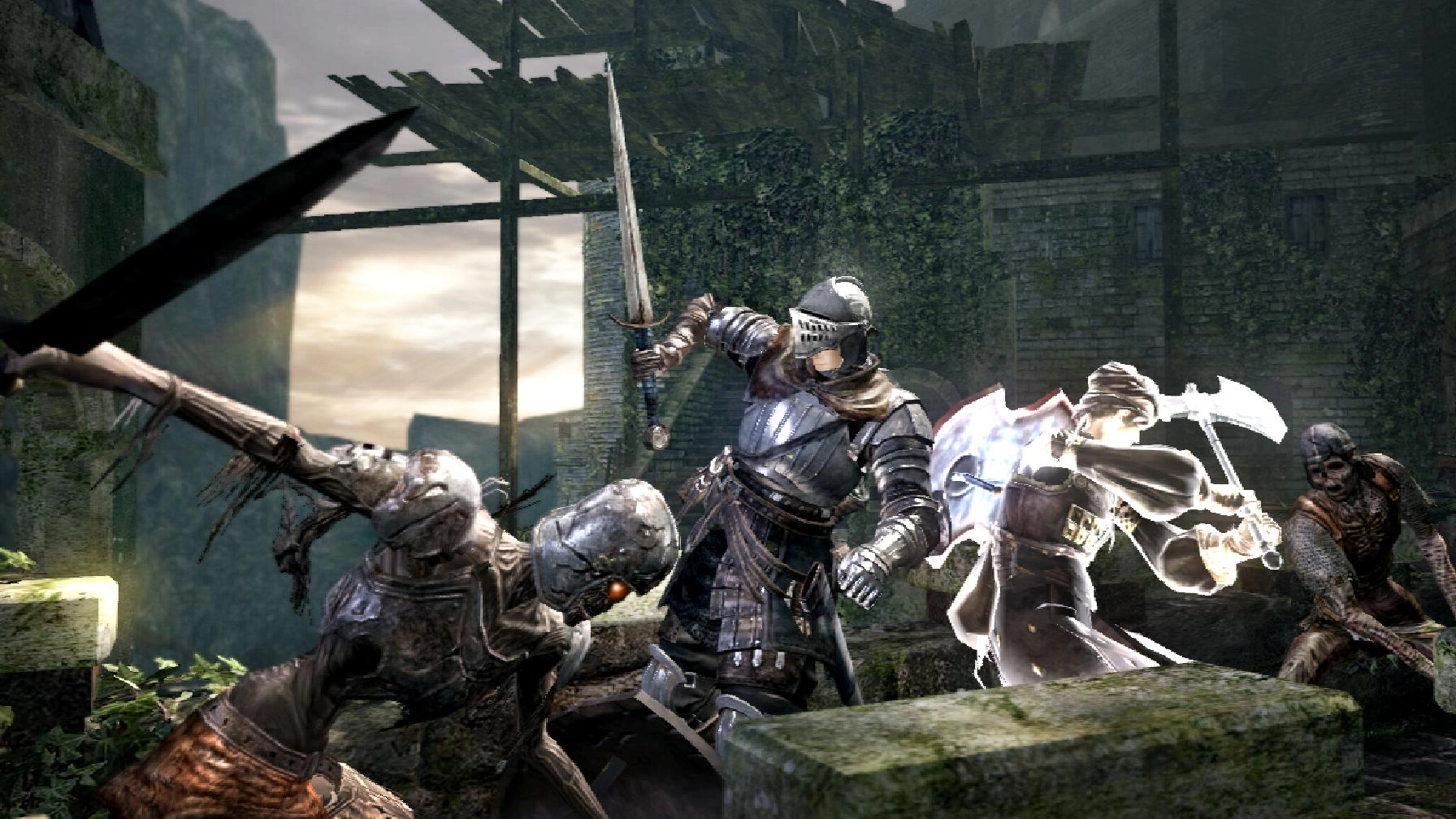
Demon’s Souls was an anomaly, a thoroughly modern 3D game whose mechanics and philosophy were plucked wholesale from the 8-bit era: unforgivingly brutal difficulty, a focus on repetitive attack patterns, and absolutely no hand-holding whatsoever. While all of these things are true of Dark Souls as well, it’s billed as a “spiritual successor” and not a sequel for good reason – in many ways, this is a wildly different experience.
Exploring the darkness
For example, while Demon’s Souls was based around the Nexus – a safe, central hub that players could return to between visits to the five surrounding worlds – Dark Souls scraps this for a nonlinear network of interconnected areas that you must discover and explore on your own, unguided. Scattered bonfires act as safe zones, restoring your health and activating checkpoints, but they also cause any enemies you’ve killed in your journey to respawn. In this series, there’s no such thing as a free lunch.

Above: The bonfires are your only respite from demons and the hollow
Each bonfire awards you 5 Estus Flasks, healing potions that essentially replace Demon’s Souls moon grass. “What!” you scream, enraged “Free healing items? DARK SOULS IS CASUAL NOOB BABY GAME!” Not so fast, sparky. Healing items are a bit more common, but the amount of blind exploring you’ll have to do in Dark Souls is infinitely more dangerous than the linear progression through its predecessor. It’s very easy to blunder into areas way above your ability level, and the developers have masochistically placed these cripplingly difficult dungeons directly next to your first proper bonfire so that you can happily stumble into them like an idiot. The only way to really know you’re somewhere beyond your current skill is by dying. Repeatedly.
Finding the path of least resistance, then, is your initial mission and learning how the different areas intersect is very important – while the game is not as open world as something like Elder Scrolls IV: Oblivion, it offers infinitely more freedom and choice than Demon’s Souls. You’ll unlock shortcuts between sections that drastically reduce travel time, but because there’s no in-game map, memorizing how to get from point A to point B is a huge part of the game’s thrill. Here it’s important to note the size of Dark Souls: an average first playthrough takes roughly 65 hours, and that’s not including the secret hidden areas, of which there are many. Dark Souls is filled to the brim with hidden weapons, armor, spells, and places that you will not only miss, but never even know exist.

Above: It isn't all just castles, Dark Souls has some gorgeous natural areas as well
Fear of the unknown
From Software and Namco have upheld the Demon’s Souls tradition of not telling the player anything despite the game’s vast size and complexity. Dark Souls opts for the information blackout, and the level of discomfort that this choice creates is key to the game’s strange charm. The development team knows what gamers like and need, then denies them those crutches in exchange for alienation and impotence. You will work to beat this game. You will grind. But when you do beat it, you will experience elation that not many other games can elicit.
This intensity and excitement is amplified by the fact that death, in the form of monstrous bosses and daunting enemies, lurks around every corner. One of the earliest wields a 14-foot long dragon’s tooth as a mace, while a later foe is literally a human infected with enormous spider eggs whose only attack is begging for you to kill him. This is not a happy world, but it’s beautiful and bizarre – a medieval fantasy infected with Lovecraftian nightmares.
Your character is fragile, too, and learning the precise mechanics of the combat is essential: how long each weapon takes to attack, how much endurance it consumes, and when you should block vs. when you should roll are all important considerations. As odd as the comparison may seem, Dark Souls plays a lot like a fighting game in this regard. You read your opponent’s moves, pay close attention to your spacing and meter, and punish whiffed attacks. You must constantly remain engaged and considering the risk vs. reward factor.

Should I play Dark Souls?
One of the most common questions we got asked from people watching us play Dark Souls was "Should I play this? It looks cool." They were rightfully apprehensive, knowing how hardcore the game's reputation is. For your convenience, we've assembled a small visual battery test that should help determine if you're the kind of person that will enjoy Dark Souls. Answer honestly, yes or no, do the following images appeal to you?

Above: Quick! Answer yes or no!
If you answered mostly yes, Dark Souls is for you. If you answered mostly no, you might want to give it a rental before you commit.
Gaps in the armor
While Dark Souls succeeds at most of what it sets out to do, the game still holds onto some of the clunkier elements from Demon’s Souls. Exploiting the enemy AI is possible, and though tricking opponents into falling off cliffs or peppering them to death with 500 arrows can be rewarding at times, it feels cheap in most cases. There’s also an overabundance of platforming, worsened by an unhelpful camera. The targeting lock-on feature is also problematic in close quarters combat, especially when facing multiple enemies. And while sporadic, we also noticed framerate issues from time to time; one encounter in particular brought the game to its knees as the animation crawled into single frame territory.
Multiplayer, in a sense
Dark Souls features the same sort of unusual passive multiplayer that the first pioneered, with players only being able to directly interact with one another in hyper specific situations. Players can summon direct help only immediately before boss fights, but only if they’ve used a rare consumable. More aggressive players can still invade other player's worlds and hunt them down, but there’s a major twist this time. Throughout the course of the game, the player may be given the opportunity to join a covenant. Covenants function like an online clan and can alter the way the player interacts with others online. One covenant allows players to not only invade other’s games, but infect their world with a detrimental curse that must be purged. Another serves as an anti-troll league, specifically targeting players who have been reported for repeatedly invading others’ games by sending members of its covenant to kill them. Don’t think joining these groups will be easy though, many of them are hidden far, far off the beaten path.

Prepare to die
Overall, however, the level to which Dark Souls gleefully rejects every modern gaming convention is impressive. Its brutal old-school difficulty and disturbing visual design were well-advertised, but the game’s mood and atmosphere are just as unique. Dour, brooding and isolated, the player is a weak husk that must trudge through a dying world with little to no help. The few people you do meet are desperately grasping to their last few marbles, and that’s only if they’re not actively trying to kill you. It’s a stark contrast to the generally upbeat, action-oriented nature of most modern games, in which the licensed rock song guitar solo peaks over some explosions as your wisecracking sidekick cracks wise.

Above: One wolf moon
Dark Souls is having none of that. Dark Souls is your curmudgeonly old grandpa that never upgraded his Vinyl records to CD, much less MP3. He likes things the old way, dammit, and he’s not having any of your newfangled guff. In a way, that’s really who Dark Souls is for – the gamer that remembers fondly how this hobby used to be, before games were multi-million dollar investments expected to sell to every male aged 18-35 on the planet. It takes you back to the era when games were made to challenge, and beating them was all the reward you needed, Achievement or Trophy be damned. The fact that Dark Souls even exists is to be applauded, proof that crusty old gluttons for punishment can still exist in an industry that outgrew them ages ago.
Oct 3, 2011

More info
| Genre | Role Playing |
| Description | Dark Souls takes every gloriously strange and punishing moment from Demons Souls and expands and improves upon it. While its fundamentals hew closely to the original's, Dark Souls is a completely unique experience with no direct competition on the market. For those who get it, it's undoubtedly one of the year's best. |
| Platform | "PS3","Xbox 360" |
| US censor rating | "Mature","Rating Pending" |
| UK censor rating | "Rating Pending","Rating Pending" |
| Release date | 1 January 1970 (US), 1 January 1970 (UK) |


