





I've always thought the best gaming laptops should fade into the distance, not take up my whole desk or backpack. That's why I've championed 14-inch machines for this long. I've been through generations of Razer, Asus, Acer, and HP's slimline rigs, shouting the benefits of compact machines to anyone who would listen. Now I'm putting them all head to head.
The subjects of today's trial are three of the most popular 14-inch gaming laptops on the market; the Asus ROG Zephyrus G14, Razer Blade 14, and Acer Predator Triton 14. Asus has held onto the crown for another year running, but it's last year's model doing that work - not the 2026 version I had on my test bench earlier in the month.
While the Zephyrus G14 is the best 14-inch gaming laptop I've tested so far, the new release is likely going to be significantly more expensive. The RTX 5070 Ti performance I benchmarked offered a real tangible boost in playable framerates (especially in more demanding runs), but we still don't know when these machines will hit the market and with supply chain difficulties, that all-important price tag is looking higher by the day. I've even spotted more budget machines retailing with just 8GB RAM, so there's no telling how high those luxury rates could climb. It may well be one of the best Asus gaming laptops, but if it's out of reach it's all for naught.
That means we're sticking to 2025's entry for the top performance slot, with Razer taking home the design award and the Predator proving best for those after a true hybrid work / play system.
The contenders
Full benchmark results
The best 14-inch gaming laptop performance


What we loved
- RTX 5080 configurations available
- Slick design and feel
- Brighter OLED display (on newer model)
- Excellent performance
- Lightest of the pack
What to consider
- 2026 iteration isn't out yet (and will likely be expensive)
The Asus ROG Zephyrus G14 does something very few 14-inch gaming laptops can; take you all the way to the RTX 5080. While Razer and Acer tend to halt at the RTX 5070, Asus pushes further with two more GPU classes above its competition.
The RTX 5080 2025 model I tested last year handled QHD gameplay far better than the GPU-capped Razer Blade 14, with Shadow of the Tomb Raider running at 155fps in its highest settings and Cyberpunk 2077 holding its own at 55fps in RT Ultra. There's a new kid on the block, though.
The 2026 Asus ROG Zephyrus G14 is the latest in line, and the RTX 5070 Ti configuration I've had on the test bench managed to beat last year's numbers thanks to a higher overall wattage. With all that under its belt the latest model can handle 60fps Cyberpunk in full whack - something I haven't seen from a 14-incher before.
There's a caveat to that performance, though, and one that brings me back round to last year's release as my primary recommendation. The new Zeph still hasn't hit the shelves in the US, and looking at the eye-watering pricing across the rest of the world it doesn't look like this is going to be an easy upgrade. With the cost of the 2025 offering packing significantly higher value I'd stick with the older model right now.
The best 14-inch gaming laptop design


What we loved
- Vibrant display
- Rock solid build quality
- Comfortable keyboard
- Sleek design
What to consider
- Capped at RTX 5070
The latest Razer Blade 14 has been my ride or die for months now, and I previously ran the model before it as my daily driver. It can't quite match the Asus ROG Zephyrus G14 for sheer performance (Razer can only get an RTX 5070 in this thing), but if look and feel are your primary concern this is an easy winner.
Razer hasn't changed the rulebook of its gaming laptop designs in some time, because it doesn't need to. Each machine is CNC milled aluminum with a supremely durable finish. That means this thing handles like a solid brick of luxury, but one that doesn't take up your entire backpack (or hurt your shoulders).
It's a super skinny 14-inch gaming laptop but there's no flex or creaking anywhere across the chassis. Not only that, but the premium feel continues inside with a gorgeous OLED panel and a particularly satisfying keyboard underneath.
This is no cheap alternative, though. While the Blade 14 can see its own price drops, that MSRP is pretty firm and an RTX 5060 build often comes in more expensive than RTX 5070 options elsewhere. If you need to balance looks with power, though, it's an excellent option.
The best 14-inch gaming laptop battery


What we loved
- Excellent controls
- More efficient battery
- Additional productivity features
What to consider
- Seriously annoying boot noise
- Tested performance is underwhelming
If you're hunting down the best 14-inch gaming laptop for battery, you likely need an all-day workhorse that can run your favorite games later on. That's precisely what the Acer Predator Triton 14 wants to do. The strange Intel Core Ultra 9 288V processor choice means you're not getting the full potential of the RTX 5070 (as tested) under the hood, but it does lend itself to a particularly power-economical device that can run your office for a full day before plugging in for some games.
The Predator Triton is a little confused in its use-case, but for those after a true two-in-one that could be a niche win. With a stylus included in the box, that slightly weedier processor (from a gaming perspective, anyway), and efficiency at its core, this is a real hybrid machine.
It's priced a little high for its benchmark results, I must say. Considering this rig can sometimes sit higher up the price scale than even the Razer Blade 14, its 2,593 Steel Nomad 3D Mark score raises some eyebrows and the fact it's just clinging on to 60fps in Horizon Zero Dawn: Remastered could give some pause for thought.
This isn't a framerate chaser, though, it's a jack of all trades for work and play. If you're happy bumping down to 1080p to get solid High-settings performance in more demanding games, all while benefitting from a slick and streamlined business machine, this is well worth investigating.
How we test 14-inch gaming laptops

I run all 14-inch gaming laptops through the same series of tests as any other machine, with each rig set to its highest preset performance profile. First up comes 3D Mark. This is a testing suite of benchmarks that put GPUs (and, to a lesser extent, CPUs) through their paces across demanding scenarios. I primarily use Steel Nomad, the most recent release, for the best real-world performance indication, but also run older tests Time Spy and Fire Strike to provide context around earlier releases.
Steel Nomad tests a system's graphical stability and speed across a non ray-traced scenario. Rendering techniques and devices like volume illumination, ambient occlusion, and depth of field are all core to this test, pushing a system's ability to maintain a smooth visual experience. Steel Nomad presents a score at the end of each benchmark - like all 3D Mark tests, higher is better.
I run each of these synthetic benchmarks three times, taking the final average score as my main result.
Then we're onto real-world performance. I benchmark in both 1080p and 1600p using each game's 'High' and 'Highest' settings, running each test three times and taking a final average score. Shadow of the Tomb Raider is the easiest test, before moving up to Total War: Three Kingdoms, Horizon Zero Dawn: Remastered, and Cyberpunk 2077.
Outside of pure performance testing, I work, play, travel, and live with each 14-inch gaming laptop for a minimum of two weeks before finalizing my review.
For more information on how we test gaming laptops, check out the full GamesRadar+ Hardware Policy.
Also consider

Acer Nitro V 14
The Acer Nitro V 14 is a cheaper-feeling 14-incher with a plastic chassis that didn't particularly impress during testing. Still, this is a surprisingly bright and vivid display, a nicely nippy processor and a subtle aesthetic considering you're spending a lot less than the big guns.

Asus TUF A14
The Asus TUF A14 is the brand's cheaper alternative to the Zephyrus, and it holds its own from a value perspective. Smart processing decisions and a crisp QHD panel don't go amiss here, and you'll find a far more agreeable price tag as well.
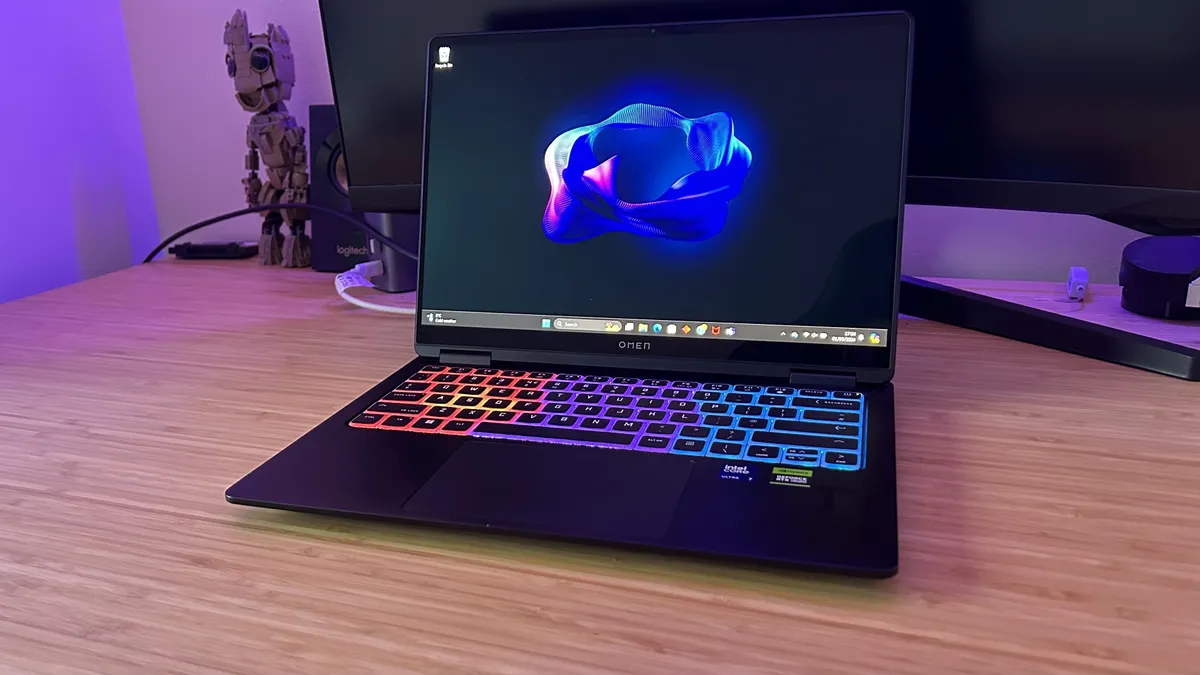
HP Omen Transcend 14
The HP Omen Transcend 14 feels almost like a Chromebook, but this super compact machine can hold its own in the benchmark arena. This is a weaker build quality, with noticeable flex in the chassis and a lot of screen glare, but that OLED panel is great at this typically cheaper price point.

Asus ROG Flow Z13
The Asus ROG Flow Z13 is actually the best gaming tablet you can buy right now, but it's going to cost you to get there. This is a fully integrated graphics system but I had no trouble running Avowed and Indiana Jones on the 13-inch screen. If you want a 14-incher for the versatility and portability this is well worth another look.
Should you buy a 14-inch gaming laptop?
I wouldn't recommend a 14-inch gaming laptop to everyone. After all, there are some performance sacrifices inherent in this more compact form factor. However, with SoC machines becoming a real possibility in the next few years, we could see a larger trend towards more portable power.
As it stands today, without the extra chassis space (read cooling space) of a 16-inch or 18-inch device, these rigs typically run hotter, have more trouble with thermal throttling, and cost you slightly more for the privilege. It's not easy to squeeze high-end components into a portable shell, after all.
I personally wouldn't buy anything else, though. I take my gaming laptop with me everywhere I go, working most of the time but also relying on it for gameplay when I'm away from home for a few nights. I don't want a chunky device that's going to take up all my bag space just for the sake of a few hours of gameplay. I don't want to have to lug a giant power adapter across the country. I'm happy to sacrifice a few frames to save my back, shoulders, and inventory space.
If that sounds like you, a 14-incher is absolutely the way to go. They're the best all-in-one gaming laptops for a hybrid work / play approach. If you know you're going to keep your machine at home for most of its life, a larger model is going to give you a more immersive display, generally better performance, and better cooling.
I'm also running through all the best Asus gaming laptops and the best Razer laptops on the market. Or, if you really want something a little chunkier, check out the best Alienware laptops I've tested.

