You are now subscribed
Your newsletter sign-up was successful
Want to add more newsletters?

Every Friday
GamesRadar+
Your weekly update on everything you could ever want to know about the games you already love, games we know you're going to love in the near future, and tales from the communities that surround them.

Every Thursday
GTA 6 O'clock
Our special GTA 6 newsletter, with breaking news, insider info, and rumor analysis from the award-winning GTA 6 O'clock experts.

Every Friday
Knowledge
From the creators of Edge: A weekly videogame industry newsletter with analysis from expert writers, guidance from professionals, and insight into what's on the horizon.

Every Thursday
The Setup
Hardware nerds unite, sign up to our free tech newsletter for a weekly digest of the hottest new tech, the latest gadgets on the test bench, and much more.

Every Wednesday
Switch 2 Spotlight
Sign up to our new Switch 2 newsletter, where we bring you the latest talking points on Nintendo's new console each week, bring you up to date on the news, and recommend what games to play.

Every Saturday
The Watchlist
Subscribe for a weekly digest of the movie and TV news that matters, direct to your inbox. From first-look trailers, interviews, reviews and explainers, we've got you covered.

Once a month
SFX
Get sneak previews, exclusive competitions and details of special events each month!
Escape From Tarkov's soul is contained within its extraction zones. Eight years since the game was first released to the public, those small, secluded areas of the map that represent both your objective and your only chance of survival have become monuments to the game's impact on wider gaming culture.
This was the first real extraction shooter – while developer Battlestate Games has drawn some general inspiration from zombie sandbox DayZ and military simulators such as Arma, Escape From Tarkov formalised what is now one of the most dominant subgenres in multiplayer shooters. When you finally reach the extraction zone, unsling your assault rifle and start reciting your prayer to the indifferent, all-deciding countdown clock, you are lying prone in a piece of video game history. You are also, for those agonizing, seemingly endless ten seconds, experiencing all of EFT's drama, tension and raw emotional power in a rush.
Locked and reloaded


This feature originally appeared in Edge magazine #418. For more in-depth features and interviews on classic games delivered to your door or digital device, subscribe to Edge or buy an issue!
Even now, when it's flanked by dozens of imitators and rivals, none of the other best FPS games impresses upon you more harshly the consequences of every single one of your decisions. Death is swift. Opponents are lethal. If you achieve one kill, collect a couple of fresh cans of food and make it to the exit with only a broken arm, two haemorrhages and a limp, then you've had a pretty good game.
Tarkov is sometimes referred to as a looter shooter, but the only thing it provides in abundance is hardship: you do not understand the true value, the significance, of a first-aid kit, a flashlight and a handful of loose 7.62 bullets until you've crawled all the way to the old gas station on Customs only to get shot in the head by a waiting Scav. When Battlestate Games created the extraction shooter, it also created a brutal metaphor for the capriciousness of reality.
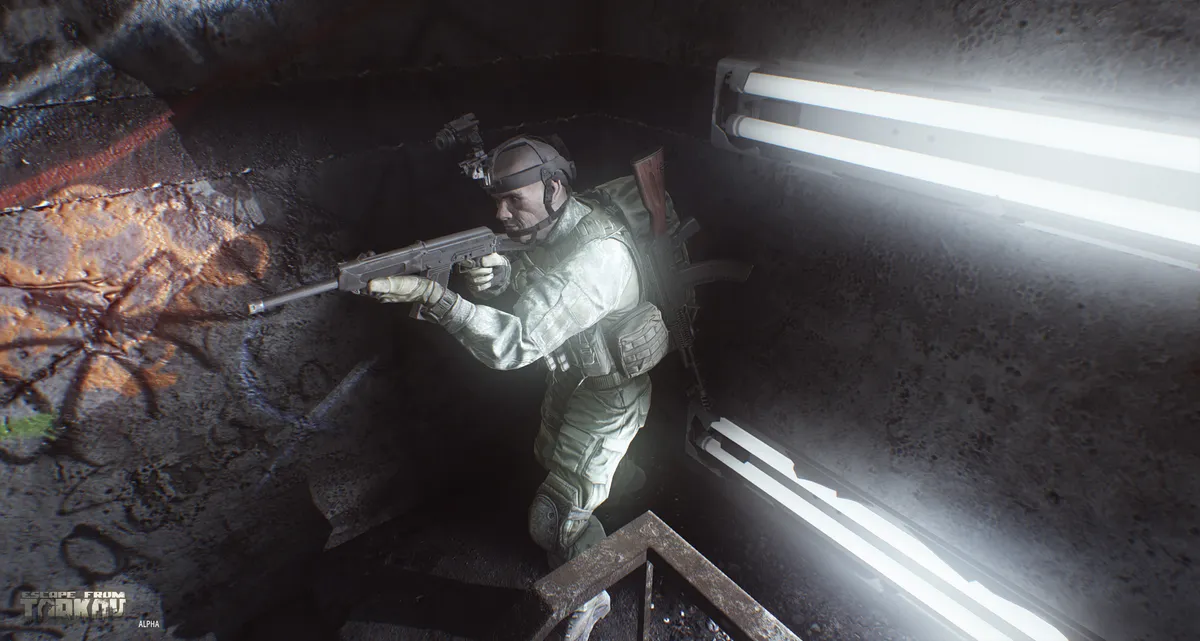
And now, more than a decade since it first entered production, Escape From Tarkov has finally been released in full. Marking the arrival of the completed Story Mode and the long-anticipated Steam port, EFT 1.0 is at last online. While this 'finished' edition represents a kind of ending for Tarkov (more updates and DLC, and years of live-service support, are still planned, but when you boot the game from now on you'll no longer get the disclaimer that it's technically still in beta), it also marks a new beginning for the FPS – and new challenges for its creator.
Liberated from the confines of Battlestate's own esoteric game launcher, EFT now has to gratify a new wave of potential players. The people who buy it on Steam are unlikely to have ever played Tarkov before and may be repelled by its uncompromising friction. Battlestate therefore has to make some concessions to its potential new playerbase, and revise EFT so that it's more welcoming and forgiving.
At the same time, the developer knows that difficulty, realism and a deliberate kind of opacity, whereby key mechanics and systems are left unexplained and players have to learn everything for themselves, are fundamental both to Tarkov's identity and its success. Even the tiniest wins – escaping from a gunfight without getting shot in the back more than once, say, or finding a pistol grip worth a couple of hundred Rubles – feel like terrific victories, because the game is so tough. If Battlestate makes Tarkov 'softer', it risks ruining the entire experience.
And so 1.0 has become the decisive moment for EFT, and for its creator and director, Nikita Buyanov. Officially, Buyanov is Battlestate's co-founder, co-owner and CEO. Over the past eight years, however, he's also become the face, the spokesperson and the ever-absorbent feedback sponge for the entire Tarkov operation. If there's a new update or progression wipe on the way, the first place you'll learn about it is on Buyanov's Twitter.
If you have criticisms about the latest patch or a concern about changes to the core mechanics, standard operating procedure is to write to Buyanov directly. And if you hate Tarkov, and you hate Battlestate, and you think everyone who's ever worked on the game should be fired, well, you can take your frustrations out on Buyanov if you want – but he may well fire some invective back your way.

The V1.0 launch marks a new beginning for the FPS – and new challenges for its creator.
Type Buyanov's name into the Google search bar and the autofill drop down says he's an "Internet personality". But before he earned that debatably inauspicious designation, and a long time before Tarkov 1.0, Buyanov taught himself game development by making mods for Half-Life and The Elder Scrolls IV: Oblivion.
His first true game was a tactical shooter called Street Wars. Featuring a skills system and a slot-based inventory, it was a testing bed for some of the concepts that would eventually define EFT. It wasn't until 2010, however, and the release of a multiplayer shooter called Contract Wars, that the story of Escape From Tarkov would really begin in earnest.
"It was only two or three of us," Buyanov says. "We didn't have anything – no funding, no experience. But the idea was to make something quick and simple, something in the style of Call Of Duty, and make some money from it so we could go on and make something bigger."
Contract Wars was an enormous success – "I don't remember the precise CCUs," Buyanov says, "but I think in the end we had something like 50 million installs across all platforms." It also marked the creation of Buyanov's first company, AbsolutSoft. The original plan was to develop a partial remake, with more modes, maps and weapons, and release it on Steam as Contract Wars 2.0. Buyanov, however, had grander ambitions. While the rest of AbsolutSoft mulled over the future of Contract Wars, he had a vision of a totally new kind of hardcore FPS, one in which players were at risk of losing everything they owned.
"I bought this spaceship in Eve Online, using real money," Buyanov says. "And then I lost it, of course. But this sparked the idea in my mind, and from there the concept of extraction was born. The very next day, I presented it to the guys: 'You start with nothing, and you need to find the loot as you go, and then you extract from a randomised location'. I thought it could be interesting for Contract Wars, like a survival mode. But one of the programmers said, 'Maybe we should do a totally new game'. And that was that."
Extraction evolution

I thought we should make it for ourselves, for a niche audience
Nikita Buyanov
The follow-up to Contract Wars would eventually make it to Steam in 2016 as free-to-play FPS Hired Ops. But as soon as he'd settled on the central extraction concept, Escape From Tarkov became Buyanov's life.
He left AbsolutSoft, founded Battlestate and began hiring the team to make his vision a reality. The early days of a game's production can be tough, as team members struggle to translate design documents into mechanics and wrestle with the limits of an engine, but according to Buyanov, EFT had terrific momentum from day one.
"In three or four months we had a lot of the baseline mechanics," he says. "A lot of things were created just right on point, without additional testing, without thinking: 'Is this good or bad?' We were super-tight, budget wise – we didn't have any investments – but I thought we should make it for ourselves, for a niche audience. We never planned the game to be for everyone."
Strictly speaking, the first Escape From Tarkov level was Factory, a dark, cramped interior that was built using leftovers from Contract Ops. It was supposed to be a deathmatch map, but Buyanov and AbsolutSoft had never quite finished it. The EFT version had a lot more substance, however, and became a showcase for Battlestate's eye for environmental detail, and for Tarkov's visual design overall.

The first true map, however – the first created specifically for EFT, entirely from scratch – was Customs. In 2015, when development of the game was just getting started, Customs served as a testing platform for the fundamental mechanics and systems. Today, it's required reading for all of Battlestate's designers.
"I made all the placements, all the spawns and the layout," Buyanov says. "I did all the principles. And then a lot of things on Customs were made just to test them. Weather. The day and night cycle. Long-range combat. Seventy-five per cent of all functionality for the rest of the game was there on Customs. And it created the trend for the future. Any of the new guys working on a location understand this is the standard."

Buyanov is clear on what he expects from his colleagues. "The lead artist on any location needs to be a Tarkov player," he explains. "This is 100 per cent super-important. He needs to feel and understand exactly how he'll be playing through this location and the emotions he'll be having during the gunfights. There are a lot of examples of triple-A games where, especially in the indoor locations, there isn't any detail. We wanted a multiplayer game but with the details of a singleplayer game."
We wanted a multiplayer game but with the details of a singleplayer game.
Nikita Buyanov
Especially today, after years of overhauls, refinements and remodelling, the world of Tarkov is comparable in its richness to The Zone from STALKER 2, or the more metropolitan corners of Fallout 4's Commonwealth. If Battlestate wanted to make an online game with the environmental lustre of a great campaign FPS, 1.0 is testament to its success. But Tarkov's maps also exemplify one of the studio's biggest challenges: the game has been an apparently endless push and pull between contradictory design philosophies, oppositional playerbases and commercial viability versus artistic fidelity.
When discussing the 'pure' version of Tarkov, where everything is driven by realism and challenge, Buyanov uses the highways on the Streets Of Tarkov map as an example. In other shooters, he says, a wide, open space such as this might be stippled with blown-up cars, lumps of concrete and other objects and items that players may use for cover, with the goal of creating a functional, enjoyable arena. But the guiding principle in Tarkov's level design is verisimilitude, because if you want grounded, hardcore gun battles, you need believable locations.
"If you don't want to get shot, avoid highways," Buyanov continues. "If you don't want to get killed, don't go there. This is a good thing. It creates something realistic. But then something else hits us: the mainstream. We get a lot of people in from other games and, if we want to make a really popular product, we need to make things for a wider audience. The combat starts between hardcore shooters, the midcore and the more casual players."
Fight or flight
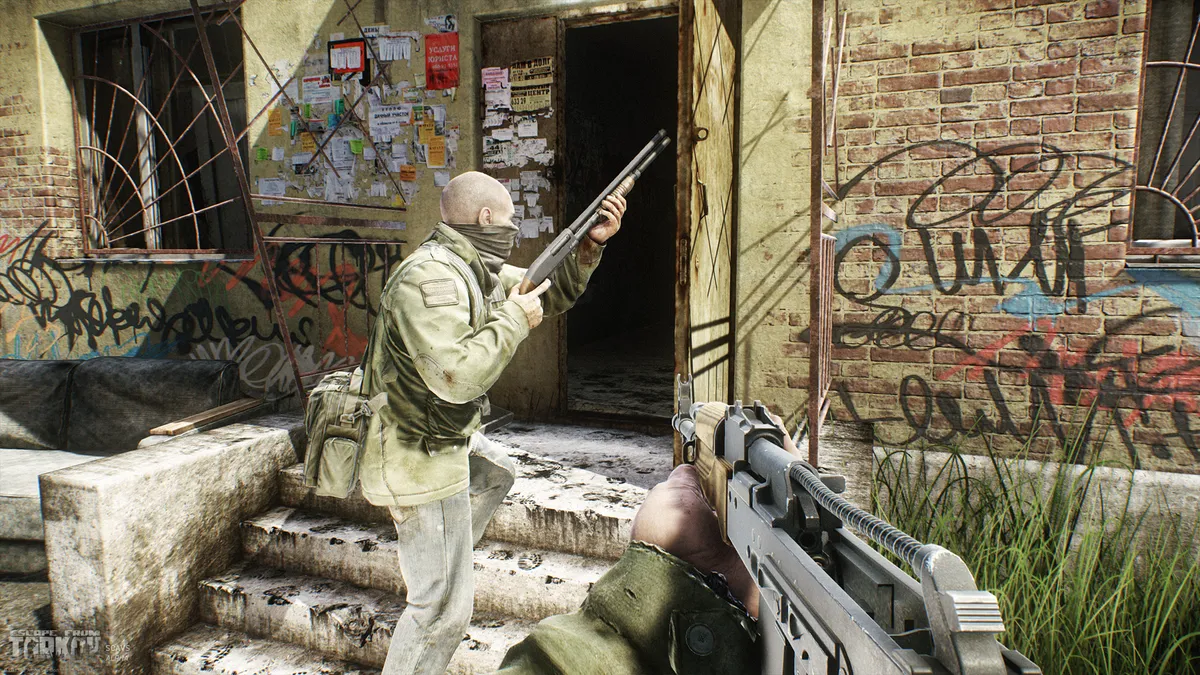
Throughout Tarkov's existence – the earliest stages of production in 2015, the initial launch in 2017, the build up to 1.0 during the past three years – this battle, between uncompromising friction and more accessible play, Buyanov's original vision and the realities of the market, has been at the centre of the game.
You might even say it is the game. When you see a cabin, a railway carriage or a shipping container in the middle distance, the sensible, 'realistic' thing to do – what you would probably do if this were actually happening – is to walk away. No matter how valuable, there is surely no loot that is worth risking your life over.
But that cold pragmatism comes immediately into conflict with a more playful attitude. It's only a video game, right? Why not throw caution to the wind, just have fun and see what happens? This is what you're wrestling with in the moment-to-moment situations of Tarkov. It's also what Battlestate has to consider each time it introduces a fresh patch.

I think it's a miracle that we've made it playable with this level of complexity.
Nikita Buyanov
The EFT community, however, is where you will find the most polarisation. Throughout its lifetime, the electric exchanges between differently minded players have provided Tarkov with its immense amount of energy.
On one side, you have the diehards – the fearsome veterans who have been with EFT since 2017, amassed thousands of hours of playtime, and believe the game should be as unforgiving as possible. On the other side, you have essentially everybody else. There's a reason ARC Raiders hit 265,000 concurrent Steam players on its launch day. A lot of people want the extraction shooter structure but without the impenetrable rock face of difficulty that Tarkov presents.
The nature of EFT's gunplay and mechanics means the two sides will always have plenty to fight over. Every weapon is defined by dozens of invisible metrics: weight, bullet velocity, drop off, volume, reload time, air friction, penetration, durability. And if Battlestate adjusts any of these values, even marginally, it can risk disrupting the whole Tarkov ecosystem.
"And of course you have the cheaters," Buyanov notes. "If a weapon has a lot of parameters, it gives the cheat developers a lot of options to change those parameters. It's super-hard to make this game playable. I think it's a miracle that we've made it playable with this level of complexity."
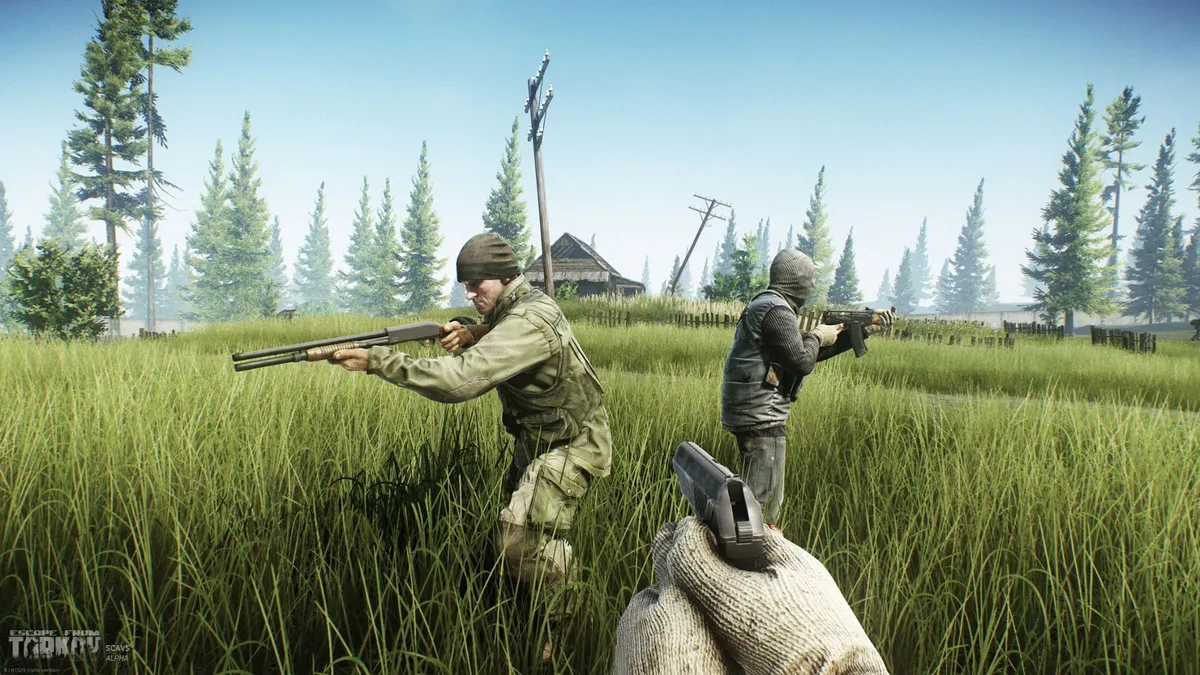
At the beginning of Tarkov's production, Battlestate employed about 40 developers. Now there are 400. But when things do go wrong and fans get frustrated, it's still Buyanov who goes out to face them. Sometimes he's able to smooth things over.
At other times, despite – or occasionally even because of – his efforts, what begin as esoteric concerns within the EFT community swell into bigger, more encompassing controversies.
In 2024, Battlestate released an extra-premium version of Tarkov called The Unheard, which gave all purchasers access to a new, permanent progression-based PvE mode. The problem? The previously available Edge Of Darkness edition, which cost US$150, was supposed to guarantee access to "all subsequent DLC".
Edge Of Darkness owners contested that the PvE mode counted as DLC. Taking to Reddit, Buyanov issued his and Battlestate's explanation to the contrary, and offered these players temporary access to the PvE mode for six months. Twenty-four hours – and 6,200 comments – later, Battlestate decided to give all Edge Of Darkness owners the PvE mode for free, forever.
"I feel like it's my duty to be right on the front," Buyanov says. "I think it's a good thing for Battlestate. They see that I am the lead officer, the tip of the spear. We made the game to get people together. But then they fight. They play to let the pressure out, to hate the game and to hate me. That maybe is the essence of Tarkov. It's not a gaming project. It's not something for fun. It's a social project which combines all of that."
But Buyanov occasionally struggles to be philosophical. "Sometimes they get under the skin and you feel like, 'Why the hell should I continue making EFT?' I can feel it physically. I feel sick for no reason. I think, 'Maybe a lot of people aren't happy with the latest patch and that's why I feel sick right now'. But then we come to conferences and a lot of people just want to say 'hi' and get a photo with me. I know this is my role."
Defining a genre

It's not a gaming project. It's not something for fun. It's a social project...
Nikita Buyanov
When you invent a new genre, everybody is going to have their own interpretations of how it should look, work and play.
The tug-of-war between Escape From Tarkov's players is emblematic of these growing pains and the ongoing process of trying to find and shape the game's identity. Even now, a decade since he first put mesh to renderer, Buyanov explains he never feels certain about EFT's success, or whether he and Battlestate are making the right decisions. "I was always unhappy and I'm still unhappy," he says. "Even if we achieve something, I always worry: 'Well, now something bad will happen'."
But Buyanov's apprehensions also seem to run deeper. The more he explains himself, the more you get the impression that developing Tarkov has taken something out of him. He admits to feeling exhausted, saying that he has an obligation to get the game finished, but conceding that the weapon customisations and the ultra-tough combat mechanics that he once found so exciting no longer have much meaning.

"For a few years I was thinking, 'Oh, it's such an innovative game'," he says. "But years pass. Sometimes I get into the position where I don't want to do anything at all. Not game dev. Not anything. I just want to lie there for ten years. I haven't lived life for myself during production. I started to feel like I would be stuck developing EFT forever."
Now the extensive Escape From Tarkov beta era is finished, it starts to sound like Buyanov is, too – he talks about wanting to do other kinds of work, and hints at future projects outside of the world of games. But when rival extraction shooters are mentioned, and the possibility that EFT's place at the forefront of the genre may come under threat, he suddenly becomes animated again.
"We created the genre," he says. "There are companies who try to copy us, and I don't know why because we've been here for ten years. Usually, they don't understand the point of an extraction shooter. They think if you take the concept and make it more casual, it will bring more players. And they don't forget to put a bit of shit on us: 'The next Tarkov killer'. Why? We are all here for good. You make a game. It's a good extraction shooter. Good for you. Why do you have to say this stuff about us?"

I haven't lived life for myself during production. I started to feel like I would be stuck developing EFT forever.
Nikita Buyanov
Buyanov doesn't reference specific names, but EFT has enough rivals that there's now a dedicated 'extraction shooter' genre page on Steam.
Arc Raiders is the big new competitor. Gray Zone Warfare, Arena Breakout: Infinite and Hunt: Showdown have also all emerged over the past eight years, each with their own variations on what was once the unique Tarkov formula.
There's even a parody game, Escape From Duckov, in which players control little yellow ducks, which averaged 100,000 simultaneous players per day in the six weeks following its release. And yet, despite all this competition, the community's reproaches and his personal anxiety, when it comes to 1.0 and the long-awaited story mode, Buyanov is more committed to his original vision than ever. Whether the full version of Tarkov flies or plummets on Steam, it will at least be on his – and Battlestate's – own terms.
"We've doubled down on everything that makes us who we are," he says. "Risky things. Expensive things. I am sharing all my cards, all my principles, and it's your choice to play. Only two or three per cent of people will actually be able to escape from Tarkov. Basically, I'm saying, 'Guys, you won't be able to complete the game – sorry'. I want it to be treated like an achievement. I'm even thinking of creating some kind of board of people who have escaped from Tarkov.
"And if people review-bomb it, I don't care. We just want to say, 'Guys, we did it. This is Escape From Tarkov without the beta badge. This is what we've been cooking for you for ten years'."
Time to die
We've doubled down on everything that makes us who we are
Nikita Buyanov
You will die in Escape From Tarkov, quickly, often and unfairly. You will spend hours accumulating precious resources only to lose them all in a single second. The menus are dense. The inventory system is complex. Actions which in other shooters can be completed simply by pressing a button require proactive learning – you will need to go and look up how to clear a weapon jam.
The only way you can play this game is by relinquishing your expectations of multiplayer shooters and committing yourself to understanding its rigid conceits. EFT will treat you unkindly, and you'll be frustrated and exhausted by it in return. But out of that conflict will come a strange kind of actualization; the game will push and pull you in various directions, and the sum effect of those forces is to make you a more capable player. You are strengthened by the struggle.
This has been the story of Escape From Tarkov as a project, Battlestate as a developer, and Nikita Buyanov as a director. Between initial anxieties about creating a new shooter genre, constant feedback from a raucous and reactive community, and the rise of pretenders to the extraction shooter crown, all three have been knocked, pummelled and peened – and emerged more focused and more determined.
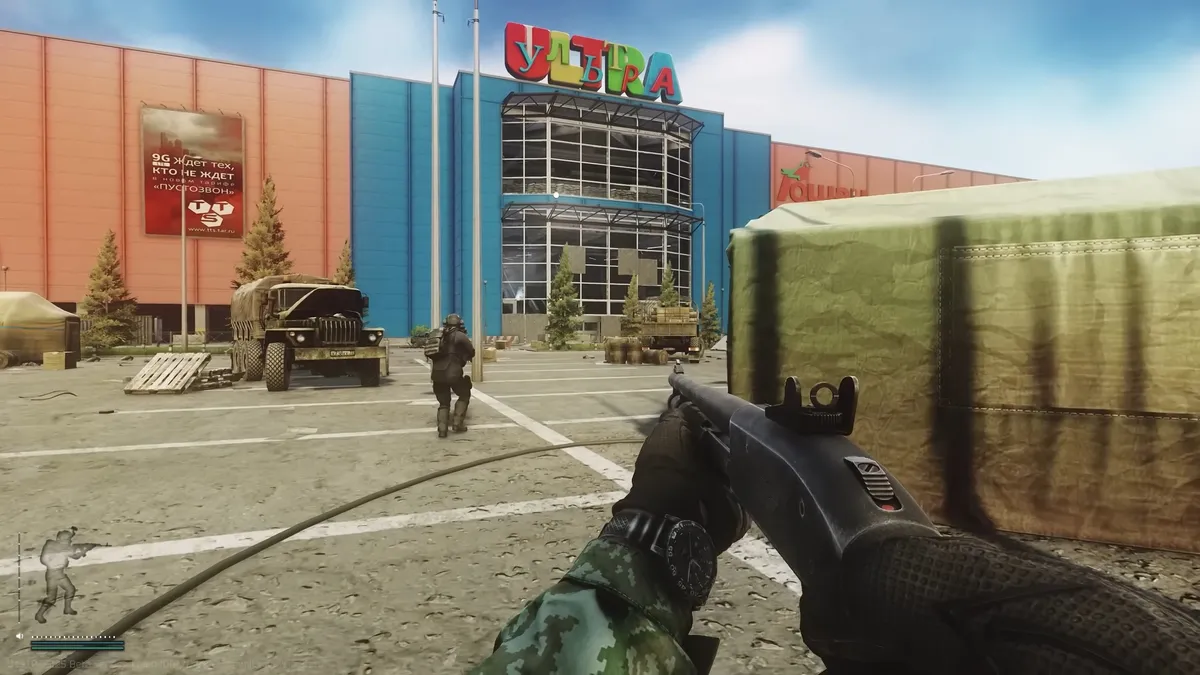
The game will push and pull you in various directions, and the sum effect of those forces is to make you a more capable player.
When games spend so long in beta or in early access, there is a risk that they will become compromised or anodyne, that 'listening to the fans' and 'building the game alongside the community' are really just euphemisms for gradually ceding creative ground.
In the decade since it first entered production, there have been times when Escape From Tarkov and its makers have had to mount tactical retreats. But now that the original extraction shooter has reached 1.0, what's most impressive is how true it remains to Buyanov's earliest concepts. "The other day, I actually checked the official list that I wrote ten years ago," he says, "and except for some minor things, everything is done."
The Tarkov team had an idiosyncratic, player-unfriendly new idea, and for a decade they have more or less refused to budge on their core principles; on the contrary, at every opportunity, they've dedicated their efforts to making Escape From Tarkov more unusual, more stubborn. And despite all of this, despite swimming against the conventional wisdom of the multiplayer FPS market, Battlestate has forged a success. Now all it has to do is do it all again: new platform, new players, new era. You struggle your way to the extraction zone. You make it out alive. And then you queue up for the next raid.
"My life is Tarkov, basically," Buyanov says. "I can't imagine myself without it. I lived through a lot of things as a developer, as a businessman and as a person. It didn't give me joy, really. I just realised that life is hard. That's how it will be for as long as I'm breathing. Always in the battle state."
Explore all the upcoming PC games coming in 2026, from Cairn to Nioh 3
You must confirm your public display name before commenting
Please logout and then login again, you will then be prompted to enter your display name.