You are now subscribed
Your newsletter sign-up was successful
Want to add more newsletters?

Every Friday
GamesRadar+
Your weekly update on everything you could ever want to know about the games you already love, games we know you're going to love in the near future, and tales from the communities that surround them.

Every Thursday
GTA 6 O'clock
Our special GTA 6 newsletter, with breaking news, insider info, and rumor analysis from the award-winning GTA 6 O'clock experts.

Every Friday
Knowledge
From the creators of Edge: A weekly videogame industry newsletter with analysis from expert writers, guidance from professionals, and insight into what's on the horizon.

Every Thursday
The Setup
Hardware nerds unite, sign up to our free tech newsletter for a weekly digest of the hottest new tech, the latest gadgets on the test bench, and much more.

Every Wednesday
Switch 2 Spotlight
Sign up to our new Switch 2 newsletter, where we bring you the latest talking points on Nintendo's new console each week, bring you up to date on the news, and recommend what games to play.

Every Saturday
The Watchlist
Subscribe for a weekly digest of the movie and TV news that matters, direct to your inbox. From first-look trailers, interviews, reviews and explainers, we've got you covered.

Once a month
SFX
Get sneak previews, exclusive competitions and details of special events each month!
Throughout Rockstar Games' rise to prominence, it played by its own rules, for better or worse. Unapologetically brash and ambitious, its cavalier attitude towards established conventions helped to reinvent the possibilities of gaming and turn it into a major cultural force. But Rockstar's pursuit of greatness often involved a gruelling workload that caused upset too. The creation of Bully was no exception.
"The memories of it are love-hate. It was a fun, weird, hellish, chaotic, awesome time," says Andrew Wood, one of just two environment artists at Rockstar Vancouver who stayed to see the game through to completion. "I reflect back fondly on the people and the times and the crazy things we did after hours, but then I think about the stress!"
School's out
This feature originally appeared in Retro Gamer magazine #277. For more in-depth features and interviews on classic games delivered to your door or digital device, subscribe to Retro Gamer or buy an issue!
Rockstar cofounder Dan Houser was the driving force behind Bully. Drawing on his time at St Paul's, a prestigious public school in London, he devised the concept and wrote the story, with the help of Jacob Krarup.
Although school life had been the basis for countless coming-of-age films and TV shows, this inherently relatable premise had gone largely unexplored in gaming.
"There was an energy and a vibrancy to the idea. The industry was just really starting to adopt open-world gaming. To see Bully taking that logic and putting it in a school playground was very interesting to us," says Wood. "We knew that a lot of the experiences really came from Dan Houser's own childhood. He was projecting himself into the story, but everybody's gone through school and those social cliques and stereotypes. It touched on all our childhood memories."
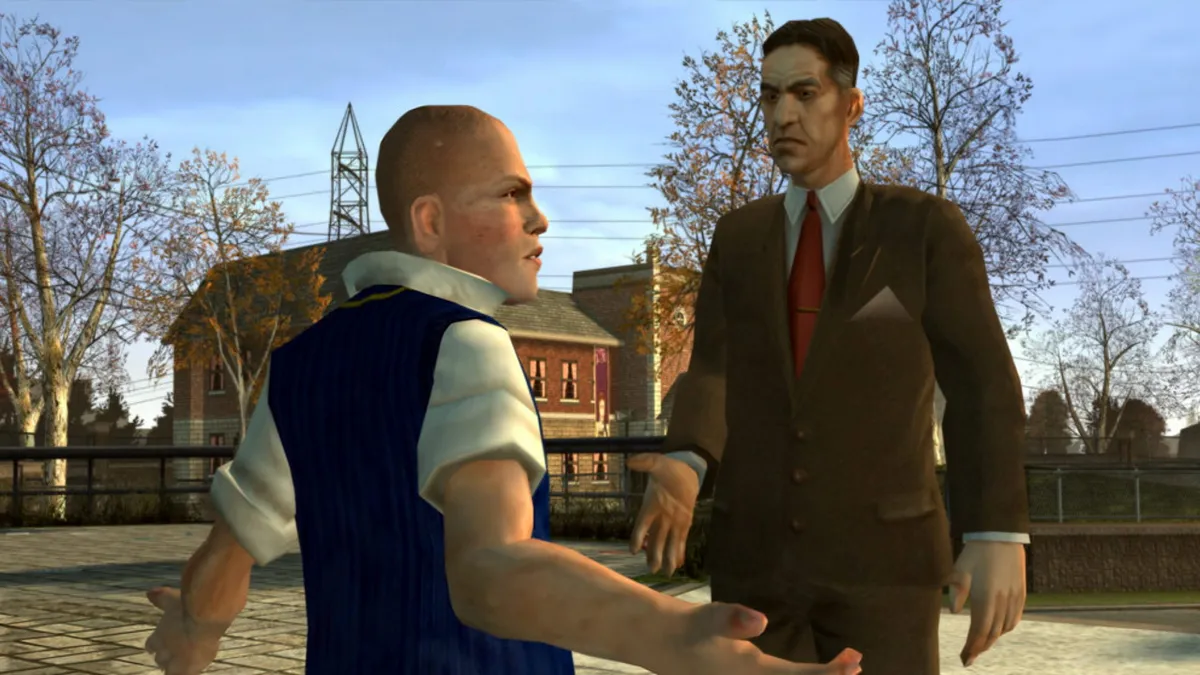
Jimmy Hopkins is the spiky 15-year-old protagonist of Bully. Like Holden Caulfield from The Catcher In The Rye, he's a cynical and disillusioned outsider. Rebellious yet fundamentally good-natured, he distrusts authority. After being expelled from various schools, Jimmy ends up at Bullworth Academy, a strict and old-fashioned institution presided over by Dr Ralph Crabblesnitch, where reputation is everything.
Bully starts with a cutscene. Jimmy is being dropped off at the boarding school by his distracted mother and her new husband before they go on a year-long honeymoon cruise, leaving him trapped. Bullworth's ominous motto (Canis Canem Edit, Latin for 'dog eat dog') and crest – featuring a rat, a skull, a snake and a fist – signal that a fight for survival awaits.

I love the fact that, almost 20 years later, people are still cherishing it.
Andrew Wood
Our introduction to this hostile environment is accompanied by the evocative strains of Bully's main theme, perhaps the standout track from Shawn Lee's original score, which delivers a powerful shot of nostalgia and strikes an appropriately unsettling tone.
"I was contacted by the music supervisor at Rockstar in New York – Ivan Pavlovich," recalls Shawn Lee, a musician who's worked across a wide variety of genres. "They flew me over and he showed me a couple of pictures of the game. They didn't really tell me that much about it, other than it took place in a school and you were going to be running around and fighting. I had to sign an NDA (non-disclosure agreement)."
"There were some creative discussions about the kind of thing they were looking for, which was quite vast, and relatively eclectic and complex," Lee continues. "They hired me to do 12 pieces of music originally that would give the overall soundtrack its character. It seemed like an interesting opportunity. It was going to be a challenge."

Over the months that followed, Lee delivered several batches of songs. The lack of visual prompts from the game to guide, or potentially constrain, his work turned out to be a blessing.
"It was all made from imagination, which is a bit like reading a book as opposed to seeing a movie. Your mind can make up vivid stuff and be quite creative filling in the blanks," he says.
"They gave me DVD-Rs full of reference music and basically all the clues were in there. All the things that they were into. Various film scores – vintage European soundtracks from the Seventies and Eighties, Donnie Darko, Danny Elfman. Then there were things like the Chemical Brothers and hip-hop. You had an eclectic jukebox full of music."
A sound investment

There was an energy and a vibrancy to the idea.
Andrew Wood
Rockstar takes music seriously. Whereas the Grand Theft Auto series is renowned for its use of radio stations with licensed tracks and distinct sensibilities, the developers realised that this approach wouldn't be suitable for Bully.
The game seems to exist in an ambiguous time period and Jimmy's transport options don't feature a built-in radio. The score was programmed to dynamically respond to the on-screen action. Lee performed all his own instruments, layering sounds on top of each other to achieve the desired effect.
He worked under pressure, hounded by phone calls and emails from Rockstar, but was pleased with the end result. "I knew it was going to be more classic, organic and human. It would have my personality and my musicality in there," says Lee. "They allowed me to do my thing, and I think that's why the music has lasted. I still get messages every week from people telling me how much they love the score and how much it was part of their life."

In essence, Bully is a toned-down version of GTA. While much less explicit, its themes are often dark and gritty.
Weapons, violence, sexuality and gang warfare are still present, but in a way more befitting teenage students. Supercars and helicopters are traded for skateboards and bikes. Grenades and assault rifles become cartoony stink bombs and spud guns. Beneath the childlike exterior, there's the same twisted sense of humour that Rockstar is famous for.
The mechanics of Bully are familiar too. "A good 80% of the RenderWare engine and code was from Vice City," says Wood. "Where we differed was our brawler-style gameplay that (lead designer) Mike Skupa, the animators and (animation coder) Liberty Walker really focussed on to make the combat fun and visceral. The choreography was hard for animators because you're getting into fistfights with other kids. If you took it too far, it would immediately get too violent and inappropriate."
School daze

Beneath the childlike exterior, there's the same twisted sense of humor that Rockstar is famous for
Compared to GTA, Bully gives players a relatively small, yet equally immersive, world to explore.
Jimmy is initially limited to the school grounds, before gaining access to Bullworth Town (the commercial hub) and Old Bullworth Vale (the upmarket suburbs). New Coventry (the dilapidated tenements) and Blue Skies Industrial Park open up later on. Billy Crane's Traveling Carnival and Happy Volts Asylum are two of the game's most memorable locations. Beyond the main story, each area contains numerous side missions, errands, collectables and races to enjoy.
Bully's original aesthetic was very different from what it eventually became, as Wood explains. "The game was pitched to me as an Americana piece. The goal was to have it look and feel more akin to a Norman Rockwell painting. That was cool because stylized graphics weren't really what they are today. A mandate came in from the Rockstar head office, midway through production, to make it more photoreal. That's when the art team pretty much purged itself from the studio, because we had to redo all the textures."
It turned out to be a lot of work. "We had to revisit models that were more stylised and wonky-looking – straighten them out, readjust them," continues Andrew. "In the scramble of trying to shift gears and change the art direction, we ended up with this mix of both that, in a very broken, strange, happy-accident kind of way, really worked for that particular game and narrative. It has its own identity because of that decision."
Bullworth is populated by a colourful array of characters. There are 60 students, each with their own unique appearance, name, voice and personality. Most are aligned to one of five different stereotypical factions – bullies, nerds, preppies, greasers and jocks.
Away from school, there are the townies. Many characters play significant roles in the story, which takes place across a whole school year, marked by changing seasons and missions related to specific holidays like Halloween and Christmas.

There are several teachers, from browbeaten alcoholic Mr Galloway and the flirtatious Ms Philips to the authoritarian Mr Hattrick and sadistic pervert Mr Burton. Jimmy is often dragged into their personal lives and disputes. He can also attend various classes – English, Art, Chemistry, Photography, Gym and Shop – that function as self-contained minigames. Successfully completing them unlocks new items and abilities, aiding his progress.
Jimmy, who exists outside of Bullworth's clearly defined social structure, ultimately looks to tear it down for everyone's benefit. He does so by challenging and defeating each faction's leader to earn their respect and unite the school, but his efforts are undermined by the manipulative Gary Smith.
As the first of Bully's six chapters – Making New Friends And Enemies – comes to an end, it's revealed that, despite welcoming Jimmy to the school, Gary has actually been conspiring against him, setting up the game's central conflict. Their rivalry propels the narrative forward, culminating in a dramatic confrontation at the top of the school bell tower.
The final push

We saw a lot of people leave. The relationship was very strained.
Andrew Wood
The production of Bully was defined by another running battle. "I don't think the capitalist, work-hard mindset from New York really gelled well with the more relaxed West Coast mindset, so there were a lot of clashes," says Wood. "Rockstar would demand more hours and Rockstar Vancouver would push back on that. We saw a lot of people leave. The relationship was very strained."
Rockstar's commitment to making exceptional, often ground-breaking, games, relied on an uncompromising approach that often took a huge toll on the people involved, damaging workplace morale and staff wellbeing. "Bully was chaotic from the day I started until the day it shipped. Back then, Rockstar was a very different company – the concern was about the game over the employees. It was tough. There was a lot of burnout and tempers rising," explains Wood.
"There were constant internal conflicts due to the stress of always being at work. A couple of people had mental breakdowns. They snapped. It was difficult to work in that kind of environment, but I knew that Bully was going to be worth it in the end, so I stuck it out."
Bully was almost permanently on the brink of collapse. As one former employee outlines, everything came to a head in 2005. When Sam Houser – Dan's brother, the cofounder and president of Rockstar – travelled to Vancouver, he was infuriated by the development team's supposed lack of progress. Extra help was called in to lead the creation of a demo for E3, which was being held in May.
The whole project was in a state of crisis and Rockstar Vancouver was under genuine threat of being closed down. A Spec Ops title it was working on had already been abandoned, alienating many of the team. Some left, while others moved over to Bully. There was lots of frustration, resentment and uncertainty.

It was a fun, weird, hellish, chaotic, awesome time
Andrew Wood
At the Vancouver office, a group of a dozen or so employees came together to work late each day, racing against the clock to deliver a workable demo in time for E3.
Most never realised just how perilous the situation was for both the game and the studio. Fortunately, Sam was delighted with the demo, which debuted at short notice on a Bully themed bus at the Los Angeles Convention Center, so everyone forged ahead.
Bully's final year was particularly draining for the development team, who were forced to accommodate some unexpected late demands. "Skateboards came in two weeks before we released, so that was fun!" laughs Wood. "We had a traversal system where the pedestrians interacted with the kerbs in a certain way. The skateboards didn't work with the kerbs because they couldn't ledge up onto them. They'd get stuck, so we had to go through every single kerb and put them at a 45-degree angle. This was all last minute. That's kind of how Rockstar worked."
Harsh restrictions were introduced too. "When we were pushing to release the game, we were revoked our lunch and our dinner breaks. They actually catered food into the office because they didn't want us leaving! It started to feel like a prison for a lot of people."
Graduation

This was all last minute. That's kind of how Rockstar worked.
Andrew Wood
This adversity created a strong team spirit. When Bully was finally released, staff were rewarded with a substantial bonus and three months' holiday.
Seeing the response to the game, which won awards, sold well over a million copies and earned a sizeable cult following, gave them a lasting sense of satisfaction. An enhanced Scholarship Edition, available on Wii, Xbox 360 and PC, came out in 2008.
Bully's initial release was accompanied by a media uproar over fears that it would promote violence and anti-social behaviour amongst teenagers. Many jumped to this conclusion based purely on its provocative title and Rockstar's controversial reputation. In the PAL region, covering much of Europe, the UK and Australia, the game was called Canis Canem Edit instead. In reality, Bully had a far more nuanced outlook than it was given credit for. It took risks and subverted expectations.

Bully had a far more nuanced outlook than it was given credit for.
"Honestly, in the studio, we laughed at all the controversy," says Wood. "They all made a big deal out of the name, Bully, but they didn't know that, ultimately, the game was an anti-bullying statement. We loved the attention because it was helping us to sell games. They were freaking out over something they didn't really know anything about."
Rumors of a sequel still resurface every so often. Rockstar New England were reportedly developing a game set in Jimmy's hometown during summer break after his first year at Bullworth, but the project was quietly discontinued in favour of Red Dead Redemption.
Even now, almost two decades after the first instalment of Bully, a charmingly idiosyncratic game that showed so much potential, fans remain hungry for more.
See why Bully is one of the best Rockstar games of all-time, even next to titans like GTA and RDR2
You must confirm your public display name before commenting
Please logout and then login again, you will then be prompted to enter your display name.