



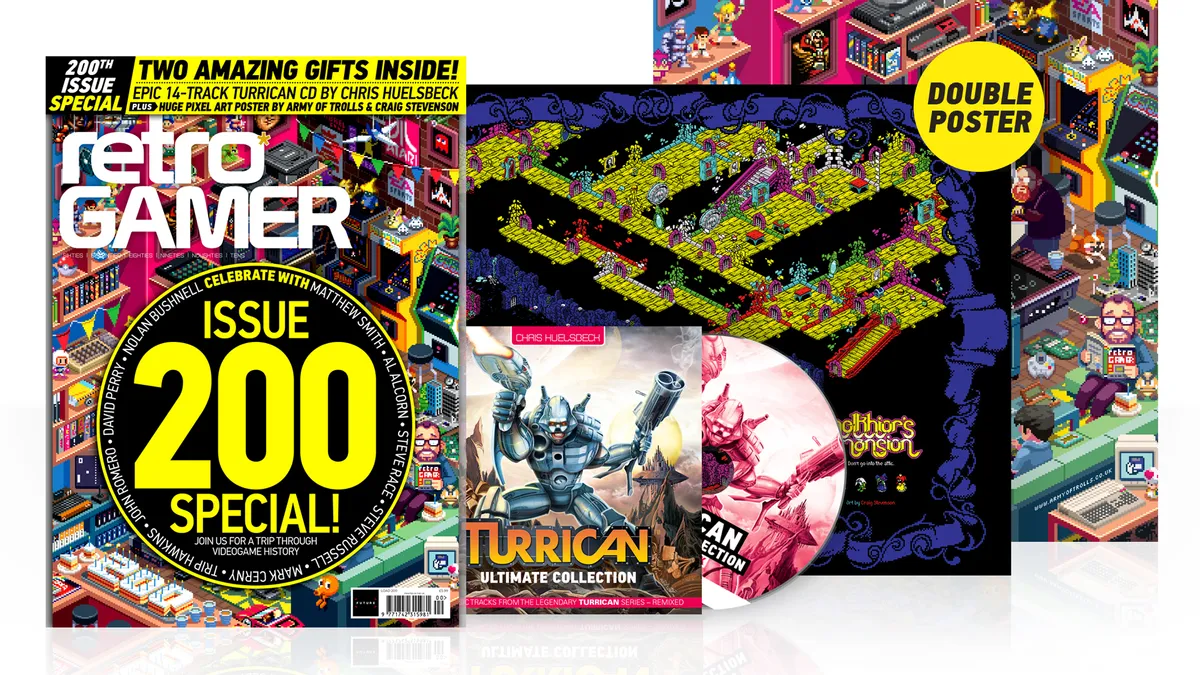
Love retro gaming? From SNES to Mega Drive, PSOne to Xbox, and Spectrum to C64, Retro Gamer magazine delivers amazing features and developer interviews about history's best games every month, and you can save up to 57% on a print and digital subscription right now.
Did you know that if you put a person inside a shiny metal contraption designed to go very fast, they suddenly become 12 times as likely to express hostility? It's a strange quirk of human psychology, but based on our entirely unscientific examination of the evidence, it's true – getting behind the wheel of a car can turn even the most patient anger management counsellor into an unrestrained rage monster. But the terrifying thing is that there's actually a simple way to make it considerably worse. Get a whole bunch of people in cars into one place, thereby clogging up the roads with traffic and ensuring that nobody can use the things. Within an hour, the collective outpouring of animosity will have generated enough energy to power the whole of Wales for a month.
Unfortunately, the most fun solution to this problem is liable to get you killed, and nobody wants to be the subject of a news report containing the phrase 'splattered across the back of a dawdling Volvo'. Thankfully, Burnout is there to scratch that itch – unlike most racing games, it's a series where the cars that aren't involved in the race are just as important as the ones that are. All the races take place on public roads filled with regular traffic, encouraging you to drive dangerously to get ahead. It became one of the most acclaimed racing series in gaming during the Noughties, but has since been left alone as its publisher has chosen to focus on other games.
Origin story

The original project started at Criterion Software as a PlayStation 2 game by the tentative name of Shiny Red Car, which was inspired by a French short film by the name of Rendezvous, and the movie Ronin. The films showed cars being driven through the streets of Paris at high speed, and this provided the basic concept of driving through dangerous urban environments. "We looked at a lot of movie car chases," says Alex Ward, the concept designer of the Burnout series. "The DVD market was just starting out so we imported a lot of American movies. The chase from Basic Instinct and a chase sequence from the film Against All Odds were two sequences we pretty much put into the software."
The silver screen wasn't the only source from which Criterion drew inspiration, though, as plenty of other games were drawn from. "Traffic was there because I was wanting to make something like EA Canada's original 3DO Need For Speed – it was about 'high-speed driving' on real roads. Real roads mean traffic. Traffic means crashes. All the other games were about simulating motorsports." As a result, few of the other games that the team looked at were traditional racing games, instead being driving action games that offered the ability to dodge and weave through traffic. "From the arcades, games like Thrill Drive, Crazy Taxi, Emergency Call Ambulance and even Jambo Safari were all things that had an influence."
But Burnout's unique selling point was developed after a meeting at EA Canada, while Criterion was shopping the game around to potential publishers. Hanno Lemke challenged Alex and studio head Fiona Sperry to create a compelling reason for players to drive into oncoming traffic. The result was the boost mechanic, which rewarded dangerous driving with extra speed. Dangerous actions such as drifting, going airborne, driving into oncoming traffic and passing close to other cars built up the boost bar, while crashing would reduce it. Once it had been filled, you could spend the boost bar for a limited burst of additional speed – and if you managed to use the whole thing in one go, you were rewarded with even more, alongside anything you accumulated while boosting. Skilled players could execute a burnout chain, draining and refilling the boost bar as long as they didn't crash.
Crash test

Of course, avoiding crashes was easier said than done. There was little margin for error in the original Burnout – the slightest brush against traffic was liable to send your car into a graceful pirouette down the road, or just as likely a flipping, messy wreck. They weren't pleasant to get into, but the Criterion team made the most of them anyway, showing off your failure from a variety of angles and even providing a 'Worst Drivers' high score table showing who had caused the most damage during races. These certainly helped soften the blow, but in a game where crashing was so ruinous, why was so much effort invested in crashes in the first place? "It's because they are entertaining and exciting to see," replies Alex. "Only a few games had them. Out Run and Thrill Drive in the arcades, and 3DO Need For Speed."
The original Burnout was a rock-solid arcade racer, featuring the usual checkpoint-based single race and championship modes, plus fun extras like a survival mode. The game released for PS2 in November 2001 with Acclaim doing the publishing duties, and versions for the GameCube and Xbox followed in the spring of 2002. All three were received positively by the press. Edge scored the initial PS2 release 8/10, cautioning that it "isn't the longest game in the world" but that a lap of successful risk-taking "ranks alongside the best moments this pastime has to offer". Play Magazine gave the game 77%, offering the criticism that "Burnout's unique selling point (namely its "horrific" crashes) exists only in direct opposition to the primary requirements of success – namely the intention and ability to avoid other vehicles." Official PlayStation 2 Magazine and XBM also both scored the game 8/10.

"Everyone worked hard and going to E3 felt like a military operation"
Alex Ward, concept designer
A sequel quickly went into production and once again, there was cinematic inspiration for the team at Criterion. "Funnily enough we saw The Fast And The Furious right before we started. We had a feeling it would be huge and pretty influential," says Alex. "So we thought we'd 'have a bit of that' in the game. I'm not quite sure we did. Still, it became something that me and Chris Roberts [designer] laughed about a lot over the years." Burnout 2: Point Of Impact improved the visual appearance, that being a goal in particular with Alex confessing, "I don't think any of us were happy with the HUD and level of presentation we got to for the first game." While the racing stayed pretty similar between games, the sequel did expand on the ideas of the original. Point To Point races were added as a change from the circuit- based tracks, and the new Pursuit mode was a Chase HQ-style affair, which saw players given a cop car and tasked with chasing down criminals in order to unlock their cars. This was the first element of combat introduced to the series, a part of the design that would become a much bigger deal later on.
But the most important new mode was the Crash mode. "It started off by seeing people play the game at E3 and just have no idea what was happening on-screen," Alex explains. With the original game's emphasis on spectacular crashes and monetary values assigned to all of your damage, it's easy to see people could misinterpret the aim of the game. "A few games had tried some sort of 'arena crashing' mode but we didn't think much of them. Chris Roberts found a PC game mode featuring toy cars that looked interesting. It sort of spawned from there really." The new mode actively encouraged the player to cause the spectacular pile-ups that the game was capable of displaying, with the goal of causing the most damage possible. Alex describes it as "akin to ten-pin bowling with a car," and that's a pretty good way of describing it.
Speeding fine

Despite the UK government's condemnation of its marketing campaign, which saw publisher Acclaim offer to pay all speeding fines on the game's launch day ("That sort of stuff was nothing to do with us," Alex clarifies), Burnout 2 sold well and impressed the critics. The game launched in the autumn of 2002 for PS2, and versions for the Xbox and GameCube followed in the spring of 2003. In an 8/10 review, Official PlayStation 2 Magazine stated "many of the ideas at work here are hardly revolutionary, but they succeed because they're so well executed". Edge was just as impressed, scoring the game 8/10 and praising it as "the perfect embodiment of the 'bigger, better, more' sequel mentality". The versions on Microsoft and Nintendo's consoles were similarly successful with the press, and the stage was set for another game.
The first thing that changed with Burnout 3 was the publisher, as Criterion had attracted the attention of an industry behemoth. "For various reasons we signed with EA for the third game," Alex recalls. "Don Mattrick's nephew Bruce McMillan came to see us after we'd walked away from working on a reboot of Skate Or Die with [an] ill-fated Chertsey group for a year." The negative experience of that project caused Criterion to request a high degree of autonomy with Burnout 3, and EA largely granted it – but ultimately, Alex credits them with helping to focus the game's vision. "The EA folks were pretty smart and helped us push to find what they called 'the big X on the wall' – something to align everyone and everything behind. That X was 'aggressive racing required' and takedowns became the name for the best thing you could do in our games, which was smack someone into oncoming traffic. I think Paul Glancey called them 'knockouts' but 'takedowns' sounded a lot more American."
Burnout 3: Takedown overhauled the racing model of the series into a much more combat- oriented experience. Takedowns were the biggest new factor – instead of avoiding collisions, you were now encouraged to cause your opponents to crash by smashing them into walls and traffic. To aid and encourage takedowns, the boost bar could be used at any time and would be extended and refilled with each successful takedown. The new focus even allowed for new modes like Road Rage.

"We were overruled by some posturing American idiot"
Alex Ward, concept designer
Surprisingly, the game was up and running very quickly. A games™ retrospective noted that the game was "presentation and effects aside, shockingly close to the finished game" after just six months of development time. "I think it was the only Criterion project where we had stable tools and a stable codebase after two previous titles," says Alex. "Plus we had the whole company on the project. We had something to prove to EA and we wanted to show them that we truly were one of the best teams on the planet at that moment on PS2. That game shows that we were."
That level of confidence was justified by the fact that development was going so smoothly. "We had a lot of stuff done in the first few months and started 'the ship year' in a good place. After that it got better and better and we were so ready for E3 it was incredible," Alex reminisces. "Everyone worked hard and going to E3 felt like a military operation. I'll never forget us rolling into downtown LA in a fleet of three Cadillac SUVs in convoy. We went to rule that E3 and we did."
The finished game had every bit of the big budget sheen you would expect from an EA game of that time. The game was visually astonishing, offering a true step up while maintaining the 60fps update of its predecessors, with crashes that put even those of the previous games in the shade.

The soundtrack was rammed full of licensed artists from Franz Ferdinand to My Chemical Romance. The game even included online play, after EA's well-publicised spat with Microsoft over Xbox Live ended. "We were the first game at E3 that EA had on Xbox Live. They told us in April and the show was in May. Their internal teams knew back in December yet none of them had anything online at that show," recalls Alex.
Once again, though, this development would have been more difficult without the assistance of the publisher. "The networking side of the game was handled by Paul Ross and Amy Phillips. They used and adapted existing EA technology that had been used for the sports games. Things were a lot different back then and they did a very good job."
Burnout 3: Takedown was released in September 2004 for PS2 and Xbox, and became the series' best reviewed game and one of the most critically acclaimed games of any kind. The game earned 9/10 from Edge, which praised the "confidently revised dynamic" of the racing model and described the game as "Criterion Games' finest hour". The game also received the full 10/10 from games™, which noted that while it wasn't a realistic game, nor one which offered much in the way of customisation, it was "the most fun we've ever had with any racing game". Burnout 3 went straight to number one in the all-formats chart and hung around the top ten for a couple of months. More than any other, this game would become the reference point for future Burnout games, and it was so good that EA acquired Criterion.
Taking Revenge

Burnout Revenge developed the formula with the introduction of the traffic check – a move which allowed players to use civilian cars to their advantage. By ramming traffic from behind, you could send it careening across the road, taking out further cars and potentially your opponents. "That came from wanting to explore how many cars we could draw on-screen at once, and what density of traffic we had," Alex explains. The game also emphasised the 'revenge takedown', a takedown performed on the last car to perform a takedown on you – and this was largely a branding decision. "The original name for the game was Burnout 4: Rush Hour. We were overruled by some posturing American idiot who told us that 'no successful game could ever have a four or a five after its name' and then they didn't like 'Rush Hour', so then they said 'get your revenge on rush hour' and 'revenge' stuck. I didn't like it then and still don't," says Alex. "The mode was a bit messy but I have good memories of working through the night with Hamish Young, Chris Roberts and Richard Franke trying to fix the many things that went wrong on that development. I did like the progressive scoring that Hamish implemented – hot shot, trick shot, money shot – that stuff was brilliant."
Burnout Revenge was launched in September 2005 for PS2 and Xbox and went straight to the top of the charts again, as well as earning praise from the press. While GamesMaster felt that the new Traffic Attack mode wasn't too great as "the way to win tends to be driving slower and making sure you hit everything", it praised the game as "virtually flawless" in a 95% review. PSM2 felt that the new traffic check was "un-Burnout" as it removed the element of danger from much of the game's traffic, but still praised the game for being "hugely exciting and laden with instantly- rewarding fun," scoring the game 93%. Burnout
Revenge also showed up on Xbox 360 six months later. "This was because the market was tough at that time. New platforms came out, and naturally EA wanted all their games on every platform. That became our first HD game," says Alex. But it wasn't the next-gen experience that its successor would ultimately offer – with development time being limited, only so much could be done to improve the game. "Hardware didn't really allow us to do that much without starting all over again. We 'spanked' all the textures, fixed a few bugs and came up with a cool 'save and share' experience where you could upload all your best moments to Xbox Live." Xbox World 360 scored the game 87%, praising it as a "showcase version" but noting it offered little over the previous generation's versions.

"Real roads means traffic. Traffic means crashes"
Alex Ward, concept designer
With the next major Burnout game for HD consoles still some way off, Burnout Dominator was released for PS2 and PSP in the spring of 2007. This game attempted to blend the mechanics of the earlier Burnout games with the combat sensibilities of the more recent ones. Takedowns were included and featured prominently, but the traffic check was ditched and the burnout mechanic was revived – you could still boost at any time, but if you waited until you had a full boost bar, you could earn boost while boosting and start a burnout chain. The new Burnout Challenge mode emphasised this mechanic, while the Maniac mode encouraged players to rack up a high score by driving dangerously without crashing. The game was reviewed well, but not to the same extent as previous games. Edge awarded the game 7/10, calling it "undeniably exciting and well-formed" but felt that the game was a stopgap and criticised the omission of Crash mode, which it felt was "sure to baffle and infuriate long-time fans". PSM3 gave it 81%, complaining of a sense that it was "trying to shoehorn two separate types of racer onto one disc to please everyone."
The next game in the series was the true leap into the HD era. Instead of featuring closed circuits and point-to-point races, Burnout Paradise took place in Paradise City, a full open world environment which hosted a variety of both classic Burnout events and new challenges. "The game was really about learning and exploring the city. The game was just something that you did whilst doing that," says Alex. "My mantra for it was 'not playing the game is the game' (which was pretty risky) – I'm lucky that Fiona, Hamish, Matt, Craig, Pete and PG all went along with it as well."
Risky business

Given that he has said how radical and risky a shift this was, we couldn't help but wonder why Alex and the team would choose such a design. "Two reasons," says Alex when asked. "Firstly, I was really into open-world games, especially Mercenaries by Pandemic. It dawned on me that 'the world is the game' and you could have many, many hours of fun just exploring and doing things different ways." That's not so surprising, as 3D open world games had become enormously popular over the course of the early Noughties. The second reason is more surprising, though. "After four games most of our artists didn't quite get on with each other," Alex reveals. "Tracks tended to be made by a single person for the whole development. An open-world game would force them to collaborate and communicate and hopefully we'd get a better result, better game and better team." Using the game design to resolve internal studio tensions is an interesting approach, and not one we're sure we've heard of before. But before any developers reading this get any ideas, Alex is quick to note that the intended result was not achieved. "But looking back that was because the tools and workflows were horrific," he says. "We were totally not ready to move to PS3 and not ready to do anything other than 'make PS2 games on PS3' so it became a massive headache. It was okay in the end, but not quite worth the hardship endured by everyone who worked on it."
In fact, Alex remembers the game being a difficult development in general. "That one is all about HUD and navigation really. We weren't that great at those things," he explains. This was a hugely important factor, as the racing model of the game didn't specify routes within the open world – you were free to reach the goal any way you liked. This meant that traditional directional indicators were useless, and the team had to come up with its own solution. "I think we sort of got there in the end. I liked what we did with the overhead road signs and I remember making the decision to make all the races end at compass points on the map." Limiting the number of finish lines helped to reduce the burden on the player, as they typically knew where they were going and mostly had to keep an eye on how they were getting there.
Despite the difficulties in developing the game, Burnout Paradise blended core Burnout features with the open-world concept very well – the new Showtime mode was a reimagined version of Crash mode, focused on gaining distance by keeping your car bouncing, while Stunt Runs let you show off your driving skills by performing tricks for points. Cars now had different boost types, with Speed being similar to the early games, Aggression being similar to Burnout 3 onwards and a Stunt type that encouraged performing tricks. Open-world elements were smartly worked into the game design – damage to your car persists between events and you need to seek repair shops to fix it (this is less onerous than it might sound, as it's an instant process) while driving through gas station forecourts would award you with a full boost bar.

In January 2008, Burnout Paradise arrived for Xbox 360, PS3, and PC. Edge described the game as a "build-your-own Burnout" where "if you don't like what lurks around one particular corner, you just drive along to the next and score some leisurely points en route." Praising it as Criterion's "most courageous game to date", the magazine claimed that it was "hard not to see it as the birth of a new era" and awarded it 9/10. Other critics broadly agreed – the game scored 9/10 in X360 Magazine, 90% in GamesMaster and 9/10 in Official PlayStation Magazine. Not everyone was quite so impressed though, with games™ scoring it 7/10 and Play awarding it 74%, criticising it for being too repetitive.
But that wasn't the end of the Burnout Paradise story, as the game received a considerable amount of DLC. "We only did that because the whole 'second sale' thing was huge in the US at the time. We decided to create a reason for people not to trade our game," explains Alex. "We also knew that EA sales people sold our game for a week or two, then went onto The Sims, then Tiger Woods golf etc. Few of them really understood our work or believed in Burnout as a franchise. We wanted to create a reason for the game to continue to sell so all the updates fell out of that." Features added included new game modes, day/ night cycles, motorbikes, and even a whole new stunt-friendly area called Big Surf Island. "We did a lot of groundbreaking stuff and everyone stepped up, artists, programmers, the ops people, everyone. We broke new ground with the format holders as no one had ever done so much DLC at the time." This ultimately led to the release of Burnout Paradise: The Ultimate Box, a package that collected the game and its expansions. In fact, there was more Burnout Paradise content than players ever saw. "We also did a lot of stuff that never came out – we had planes, helicopters, multiple players [in] a car and bike, we had lunar challenges on the Moon... again all groundbreaking stuff," Alex reveals. "I don't think you'll ever see anything like it ever again really."
Perhaps fittingly, it seems that we're unlikely to see Burnout again. Criterion moved on to revitalise the Need For Speed series, bringing much of the Burnout experience to that series. And apart from the downloadable game Burnout Crash, there hasn't been a new game in the series for over a decade. Though Burnout Paradise Remastered went to the top of the charts when it was released in 2018, there's no sign of a new game in the series, so Burnout fans wanting their fix on current systems have limited options – though one of them is Dangerous Driving, the spiritual successor developed by Alex's current company Three Fields Entertainment. But if you're reading this, then you likely have access to the hardware needed to run the thrilling originals, and they hold up beautifully today – so go pick one up and have a smashing good time.

Save up to 57% on a Retro Gamer magazine subscription bundle and have the best retro gaming features and interviews delivered to your door each month.

