You are now subscribed
Your newsletter sign-up was successful
Want to add more newsletters?

Every Friday
GamesRadar+
Your weekly update on everything you could ever want to know about the games you already love, games we know you're going to love in the near future, and tales from the communities that surround them.

Every Thursday
GTA 6 O'clock
Our special GTA 6 newsletter, with breaking news, insider info, and rumor analysis from the award-winning GTA 6 O'clock experts.

Every Friday
Knowledge
From the creators of Edge: A weekly videogame industry newsletter with analysis from expert writers, guidance from professionals, and insight into what's on the horizon.

Every Thursday
The Setup
Hardware nerds unite, sign up to our free tech newsletter for a weekly digest of the hottest new tech, the latest gadgets on the test bench, and much more.

Every Wednesday
Switch 2 Spotlight
Sign up to our new Switch 2 newsletter, where we bring you the latest talking points on Nintendo's new console each week, bring you up to date on the news, and recommend what games to play.

Every Saturday
The Watchlist
Subscribe for a weekly digest of the movie and TV news that matters, direct to your inbox. From first-look trailers, interviews, reviews and explainers, we've got you covered.

Once a month
SFX
Get sneak previews, exclusive competitions and details of special events each month!
During Rare's Nintendo days, the studio made a habit of producing cutting-edge games on aging hardware. In late-1994, its pre-rendered platformer Donkey Kong Country allowed the sprite-focused SNES to compete with the polygon-powered PlayStation. However, a contemporary project codenamed Project Dream was struggling to find form.
It too employed pre-rendered visuals, but was isometric rather than side-on. Dream was an action adventure featuring pirates that was intended to be vast in scale, and it was pushing the SNES even further than Donkey Kong Country. Character designer Ed Bryan joined the Dream team after cutting his teeth at Rare on a coin-op brawler. "I was in the Killer Instinct stable for a little while, after that I moved to a project in the Donkey Kong barn that was called Dream," Bryan recalls.
Gaming the system

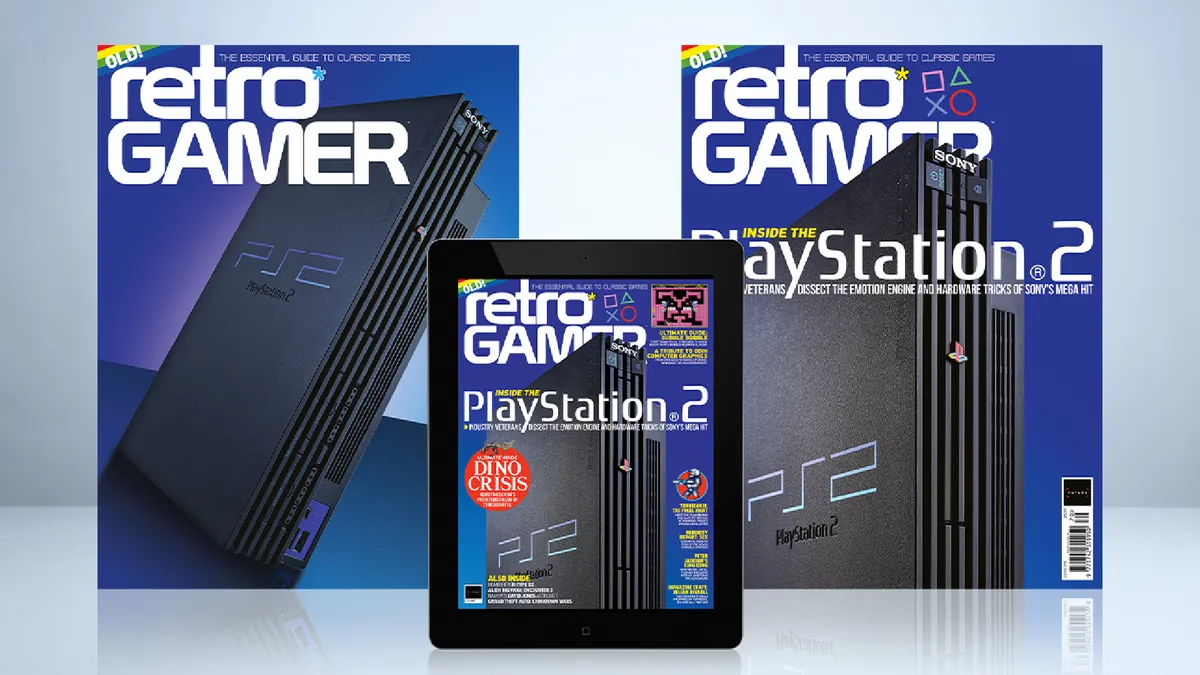
This feature originally appeared in Retro Gamer magazine #278. For more in-depth features and interviews on classic games delivered to your door or digital device, subscribe to Retro Gamer or buy an issue!
Sometime after Bryan started working on the project, it was moved to the N64. Then shortly after finishing Donkey Kong Country 2, coder Chris Sutherland joined him on Dream.
Sutherland reflects on some major changes as it went from one iteration to another. "The main character was a boy called Edison, but then it got changed to a bear," he recollects. "There was a top-down 3D environment where you were chased by Trolls, then we looked at doing something more like Donkey Kong Country but in 3D, and after that we went more to a fixed side-on camera. We were then shown what the Conker team was doing. It had managed to get very high-quality polygonal backgrounds, and so we took that approach as well. That was when we started Banjo-Kazooie, as it was to become later on."
The name Banjo-Kazooie came from its two player characters: Banjo; the aforementioned bear, and Kazooie; a colorful bird. Not only did Kazooie's introduction make sense of an otherwise nonsensical concept, but it also allowed for two contrasting move sets.
"We felt there should be a reason for the double-jump, and someone said there could be these wings that came out of Banjo's backpack that could flap," Sutherland explains.
"Then the extension to that was why not just have another character that had wings? That was where Kazooie came out of. We could then use her for other moves, like legs that came out the bottom of the backpack and run. It gave us more opportunities for variety. Otherwise we were limited by the fact that, for example, Banjo could only go at a certain speed."
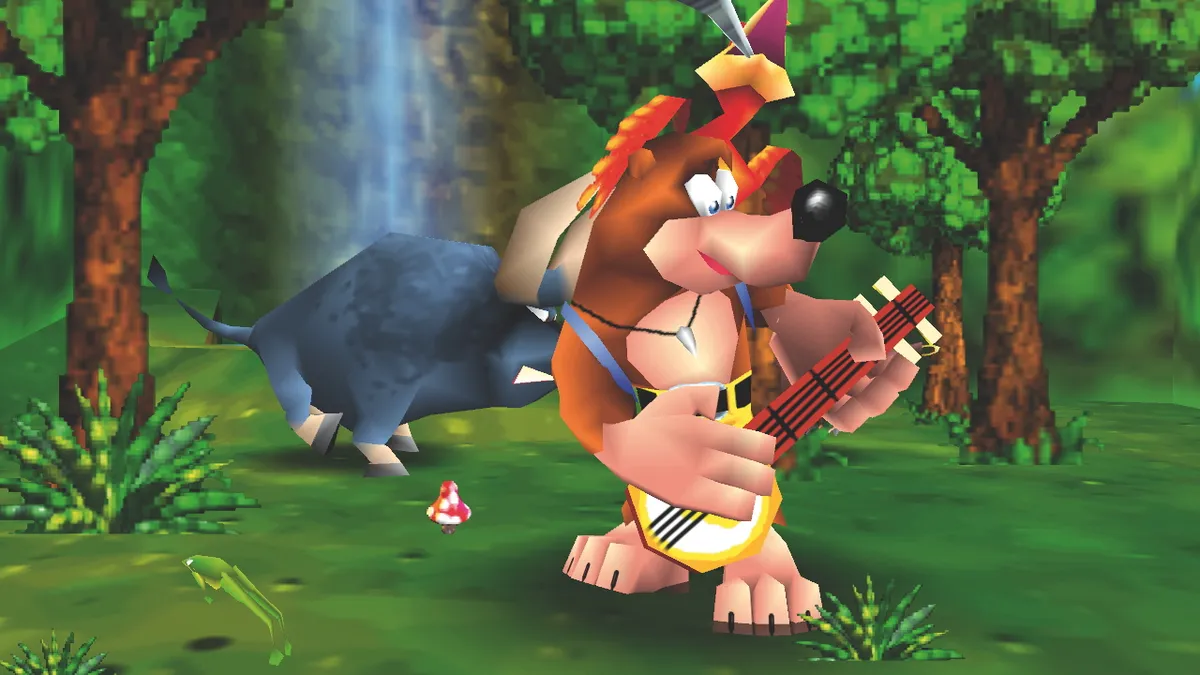
The Banjo-Kazooie team had some moves in mind that didn't necessarily suit their heroes, and in any case these might spoil the game's challenge.
Their solution was to limit these abilities to areas that Banjo could only tackle while in another form. "We didn't want you to be able to use those moves in the rest of the game because it would break everything, so we limited them by changing what the character was," Chris reasons.
"The problem was that when you went back to some areas they became a lot easier or it made it a lot more complicated in terms of design. Playing as a different character was also a much more fun experience. I mean, Mario has his different suits that he wears, and in the case of Banjo he transformed into a washing machine, or whatever it was."
Rare success
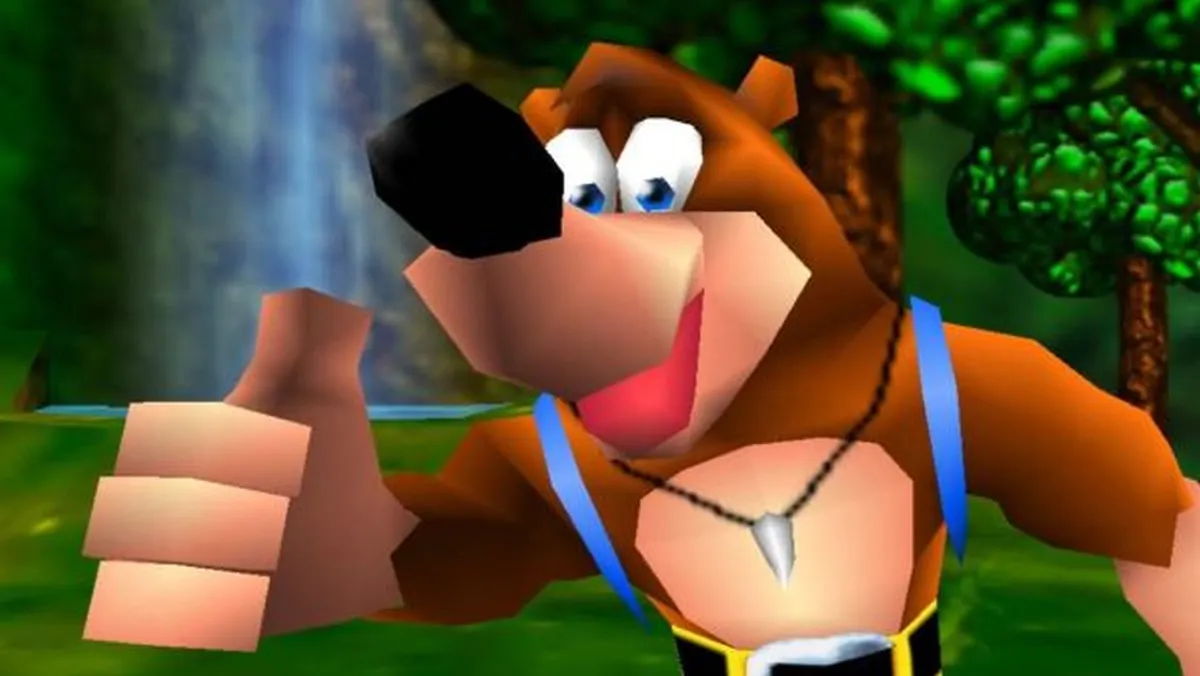
It gave us more opportunities for variety. Otherwise we were limited by the fact that, for example, Banjo could only go at a certain speed.
Chris Sutherland
The fact that Banjo-Kazooie sold millions on release reflected how well players responded to the game's two heroes, their moves and Banjo's transformations.
Bryan remembers being excited to start work on a sequel. "We were absolutely buzzing because Banjo-Kazooie had been a huge success, so we were thinking that we should just get on and make the next one," Bryan enthuses. "I think we were more relaxed about Banjo-Tooie, because of course we knew how to do it, whereas with the first one we felt like we were making it up as we went along."
There was still a certain amount of making things up for Banjo-Tooie, however, in that it had new features like solo missions for its two protagonists and FPS sections inspired by an earlier Rare title, as Banjo coder Sutherland notes. "There were four or five of us on the Banjo team that would play GoldenEye, probably every lunchtime for a couple of years, so that was a strong influence on Banjo-Tooie," he reminisces.
"Then I think Gregg Mayles always wanted to have Banjo and Kazooie separate and then join up. It just felt like the next logical step. Once we split the characters apart suddenly your moveset was reduced, so you couldn't do all the things you could do before. It was another way to give you a different set of moves. Then there were missions built around that."
A fresh approach was also taken with how the protagonists of Banjo-Tooie learned new abilities. They attained these periodically, like in the original, but only after a set number of musical notes had been collected.
Sutherland puts this down to pacing. "It allowed us to gate certain things, so that when the player had a certain number of notes then they must have done certain things, rather than them just rushing through and getting a new move too soon. So it was forcing the player to do more and complete more of the game before they could proceed. It was probably also the fact that it meant you couldn't shortcut the game if you knew exactly where to go; it meant you had to have a more thorough exploration."
Teaming up
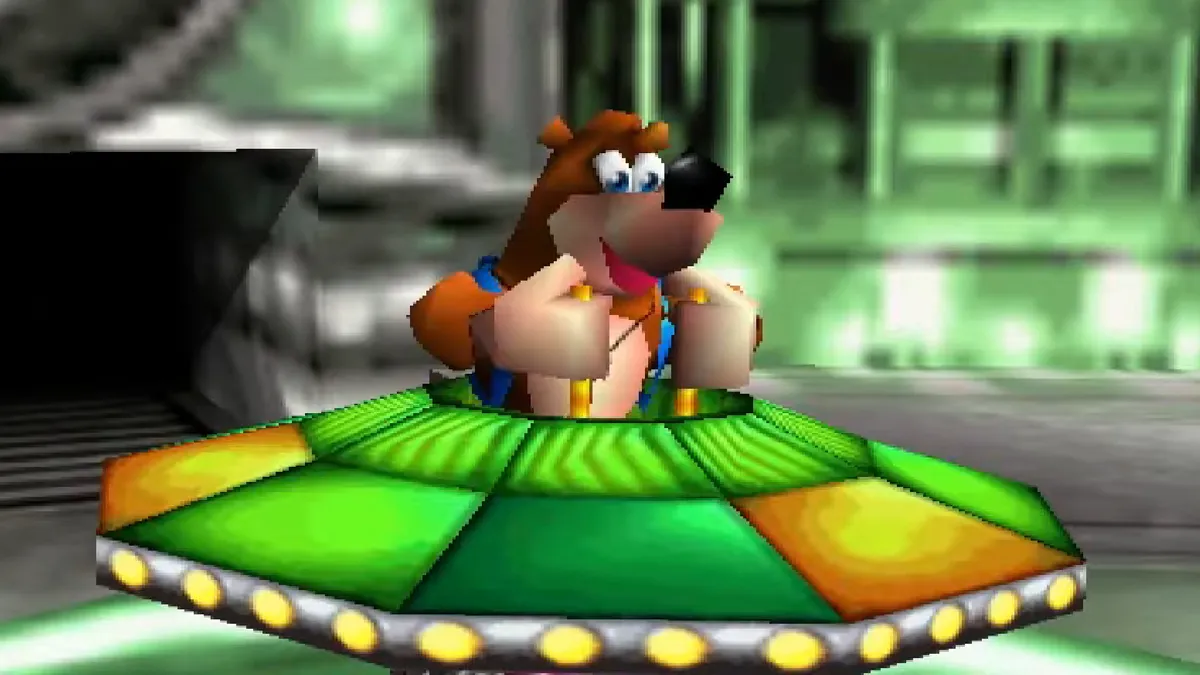
The first one we felt like we were making it up as we went along
Ed Bryan
One other novel area of Banjo-Tooie was its multiplayer mode. It lacked the adventure of the solo offering, but while Sutherland considers the N64 ideal for multiplayer he feels it made sense that Banjo-Tooie's implementation focussed on minigames.
"The N64 having four controllers was a move by Nintendo to say that the N64 was for multiple players, so Banjo-Tooie's multiplayer could have been to do with that," he reckons. "We could have made its minigames less disjointed with cutscenes, but I think it would have been quite challenging to make an adventure for the multiplayer because we would have had to design it so that multiple players could play it. If there was a split-screen challenge then it would have been difficult to not have the adventure split-screen too, meaning that the camera would have to pan out quite far."
Although Banjo-Tooie was well received when it came out, its development team, led by Banjo-Kazooie designer Gregg Mayles, decided against making a follow-up. This task instead fell to Rare's handheld team, which included designer Gavin Hood. "We wanted to get the feeling of a 3D game in a 2D game, but it was quite tricky," Hood concedes.
"We started with something similar to a Zelda-style Conker game that came out on the Game Boy Color, but we couldn't really do the kind of platforming we wanted. So our lead programmer put a 3D collision mesh inside a 2D engine. Then we used the GBA's layers system to decide what the player went in front of or behind. That was how we managed to get a feeling of height and depth, and jumping across to things."
Revenge mission

We wanted to get the feeling of a 3D game in a 2D game, but it was quite tricky
Gavin Hood
Having achieved pseudo-3D collision detection for their 2D GBA Banjo title – Grunty's Revenge, the team working on the sequel next borrowed a trick from Donkey Kong Country to give their follow-up pre-rendered polygon-based sprites and slick animation.
"The big conversation after we had the collision in place was about how we would represent Banjo and the enemies, because we wanted them to feel quite fluid," Hood says. "There was a lot of work involved in doing that. We did really high-res renders of all of the characters and rendered them out into different frames of animation to get them as smooth and natural as we could in comparison to the 3D Banjo games."
In terms of gameplay, Grunty's Revenge was an adventure-based platformer like its N64 counterparts, but it had points of difference. Most noticeably, it began with Kazooie getting kidnapped, leaving Banjo on a solo rescue mission for the first few levels. "Starting without Kazooie was mainly a story conceit," Hood observes.

"It was to make Grunty's Revenge feel different, and also to make use of the Pack Whack, where you would whack Banjo's backpack in front of him," Hood continues.
"One of the side effects of Banjo starting without Kazooie was that it allowed us to reintroduce players that had played the original Banjo to the moves. Because although a lot of them were the same you accessed them in a different way, or how you used them differed."
An aspect of Grunty's Revenge that differentiated it even more from the N64 Banjo games was its transformation system. Instead of being offered once on specific levels, all unlocked forms could be chosen when visiting shaman Mumbo Jumbo. "The level designs were structured to take account of you having access to all of those transformations, and certain levels were influenced by certain transformations," Hood remarks.
"So the haunted bayou being set in darkness was influenced by the candle transformation. We could have used the mouse transformation a lot more, because it meant Banjo could fit into lots of places. The mouse could also gnaw through things, and there were tons of puzzles we had planned for that. But we couldn't do them all because then the other transformations wouldn't get their time in the spotlight."
Fight and flight

We thought about how we could do them with planes, and decided we would make them feel like dogfights.
Gary Richards
After work on Grunty's Revenge was completed, but before it launched, a second GBA Banjo title was started. Using an abandoned Diddy Kong project as its basis, a team led by Gary Richards began development on a flight racer called Banjo-Racing.
"Diddy Kong Pilot got put in limbo when Rare separated from Nintendo. Then there was a massive gap between when it was that and when it became Banjo-Pilot," Richards reveals. "We were asked to get the game done as Banjo-Pilot because THQ wanted to do a deal where there were multiple GBA games involved. Diddy Kong Pilot had a few bits and pieces, so some of the tracks remained pretty much the same as they were originally, but the gameplay structure wasn't there. So a lot of what we did was putting game modes in."
The structure that the Banjo-Pilot team implemented included combat with bosses. The inclusion of these was influenced by a Rare title that the Banjo racer was a spiritual successor to, but visual effects took its sky-high boss fights to another level. "Kart racing games like Diddy Kong Racing featured boss races, and I think we took inspiration from that," Richards muses.
"But we thought about how we could do them with planes, and decided we would make them feel like dogfights. It looked quite cool with the two planes flying over the cloud layers, but it was just using the mechanics that were already there in the cheapest way possible. We had straight tracks in the boss fights that just looped, so they were super simple but were also very effective."
Tilt switch

Given that Diddy Kong Pilot was going to be a sequel to Diddy Kong Racing, it seems curious that the scrapped GBA title didn't focus on karts like the earlier game.
Banjo-Pilot retained planes as its mode of transport, but why was flight favored originally? "The original reason for having planes was that Diddy Kong Pilot used a tilt cartridge, because its team thought it would be a cool way to control a plane," Richards discloses.
"So planes made sense. Unfortunately, when we lost the Donkey Kong licence the tilt cartridge was just getting in the way, because Nintendo wasn't giving us the support. The big problem with tilting the GBA's screen with a racing game was that you couldn't see what was happening, because it was just rubbish when you moved it around."

Other aspects of Banjo-Pilot reflected the earlier Banjo games. The racer's pick-ups were taken from the previous titles, cutscenes were added to give a sense of an adventure and the two heroes of the series got to settle any scores that they had.
"It was especially important to have floating collectables because you had a lot of space since you could fly vertically, and it made players go off the racing line," Richards assesses. "The cutscenes were down to us trying to give the player a reason to do the races. I know the storyline was quite thin, but at least it made a bit of sense of the races. Then we had Banjo and Kazooie in a dogfight just because we had two player characters, so why not?"
Like Grunty's Revenge, Banjo-Pilot received solid reviews. Soon after its release, three Xbox 360 projects were begun, including remakes of the N64 originals, as Sutherland remembers. "I wasn't involved directly with the Xbox 360 releases, but I know [the games] went to 4J Studios in Scotland, and they did a lot of the work for those. They did an amazing job. They made the Stop 'N' Swop system work so that the two Banjo games worked together. You could get the Ice Key and the other things from the Stop 'N' Swop and they would actually work together. They did a load of other things as well."
Time to upgrade

Tim Stamper had the idea of a virtual Lego set to allow players to build vehicles
Steve Malpess
The studio trusted by Rare to update the first two Banjo games for the Xbox 360 naturally updated the N64 titles' visuals, but as Sutherland points out, it also addressed minor complaints that players had about certain aspects of the originals' gameplay.
"The framerates were a lot better, and the Xbox 360 versions were recompiled with updated textures. There were also improvements to the camera and controls. Another thing that 4J did was to improve the level of detail when you were close to things without things popping in. And in the original Banjo-Kazooie, if you tried to collect all 101 notes on each level and died you had to go back and collect them all again. 4J Studios took that requirement away in the Xbox 360 version."
The third Xbox 360 Banjo project went through almost as many iterations as Dream had. Steve Malpass worked with Gregg Mayles on the design for Nuts & Bolts, as it was ultimately called, and he explains how a Rare founder gave it its core concept. "There was quite a wait because it changed direction a few times, before eventually Tim Stamper had the idea of a virtual Lego set to allow players to build vehicles," Malpess comments.
"It was decided that we merge that idea with Banjo somehow. We had the first level of Nuts & Bolts – Mumbo's Mountain – and we put these vehicles in it. We then adapted the layout to accommodate them, so we had ramps and that sort of thing. Then we needed to make some kind of 3D editor user interface, which was a nightmare!"
Wheel progress

Having worked out how to allow players to build 3D vehicles, work started on a hub environment called Showdown Town that Banjo could walk around, although there would be less walking and more driving in the game's eclectic worlds.
"Showdown Town was the part of the game that was most like the previous games; that was where all the platforming was," Malpess reviews. "There were moments in the worlds where you would have to get out of the vehicle to put things in them, but the on-foot stuff there was pretty much limited to that. Showdown Town was divided into sections, but rather than having very obvious paths connecting them, the boundaries between them were quite blurred – much like a real town."
The Nuts & Bolts team called its challenge-filled levels 'worlds', and like real worlds they were spherical, although Banjo visited the inside of them rather than their surfaces.

The core gameplay in Nuts & Bolts rewarded players with abilities – much like the N64 Banjo titles.
Malpess puts their spherical shape down to that being the most fun option. "We designed the challenges with the thought that you had to navigate the worlds with a vehicle, and since they were set inside globes everything was circular.
"The whole 'game globe' idea came together during the design of Showdown Town. We wanted players to get an object from a dispenser, and then transport it to something. But what shape should the object be? Well obviously a ball, because it would be tricky to transport and would roll around if you dropped it. So as the worlds were contained in balls that meant they had to be circular."
As well as challenges and exploration, the core gameplay in Nuts & Bolts rewarded players with abilities – much like the N64 Banjo titles. However the Xbox 360 follow-up applied these upgrades in a different way than the original games had. "When you started the game you were in the town square, and you were surrounded by steep slopes, and it wasn't until you had certain vehicle parts like the High-grip Tyres that you could go up them," Malpess highlights.
"There was also a move where you put a spring on the bottom of the cars that you used to jump over houses or to get to high-up areas. So those abilities were achieved by upgrading your vehicle rather than getting new moves for the characters."

Although the construction element in Nuts & Bolts proved divisive on its launch, the sequel certainly had its fans.
At the time of writing no further Banjo-Kazooie titles have appeared, although Banjo and Kazooie surprisingly both featured as combatants in Nintendo's Super Smash Brothers Ultimate, while Yooka-Replaylee, the latest in a series of spiritual successors to Banjo-Kazooie, has just been released. It only seems fair then that Yooka-Laylee and Chris Sutherland has the last word on Banjo's first adventure.
"I think the thing that best stands the test of time is the characters and the repartee between them. That helped to inject more feeling into them rather than them just being token mascots. Graphically I think the game being quite cartoony means that it holds up better than contemporary games that tried to be super realistic. The music also stands up, and I suppose the odd noises that I had Banjo and Kazooie saying have stayed with people for many years. Who knew that was going to be a thing?"
The best N64 games of all time highlight how revolutionary the console was for Nintendo
You must confirm your public display name before commenting
Please logout and then login again, you will then be prompted to enter your display name.