





Nier: Automata creator Yoko Taro didn't mean to become one of the most interesting game directors in history. The way he tells it, his career as a director came out of good luck, Capcom, and a lot of blabbing.
Taro reflects on his time working at defunct developer Cavia on cult-y PS2 snake pit Drakengard, the 2003 action RPG published by Square Enix, and his directorial debut, in Archipel's new book The Worlds of Yoko Taro. In the excerpt journalist Matt Leone published on his oral history website Design Room, Yoko – as told to writer Teppei Fujiwara – reflects on Drakengard and how he couldn't stop talking.
"Initially, [Cavia producer Takuya] Iwasaki was also supposed to direct Drakengard," Yoko recalls. But, at the time, Cavia was also working on the 2003 light gun shooter Resident Evil: Dead Aim, published by Capcom, and it demanded most of Iwasaki's time.
"Given his situation," Yoko says, "they decided it'd be too much for him to take on the role of director. Which naturally led to the question of who would take his place." Luckily, Yoko "was the team member most vocal in expressing opinions," so Cavia decided he would do.
"They said, 'Why don't we just let Yoko do it, since he's got so much to say?' And that's how I landed the job," Yoko says. "It wasn't that I had some great ambition to become a director. It's just that events happened to unfold that way. That's how companies are, right?"
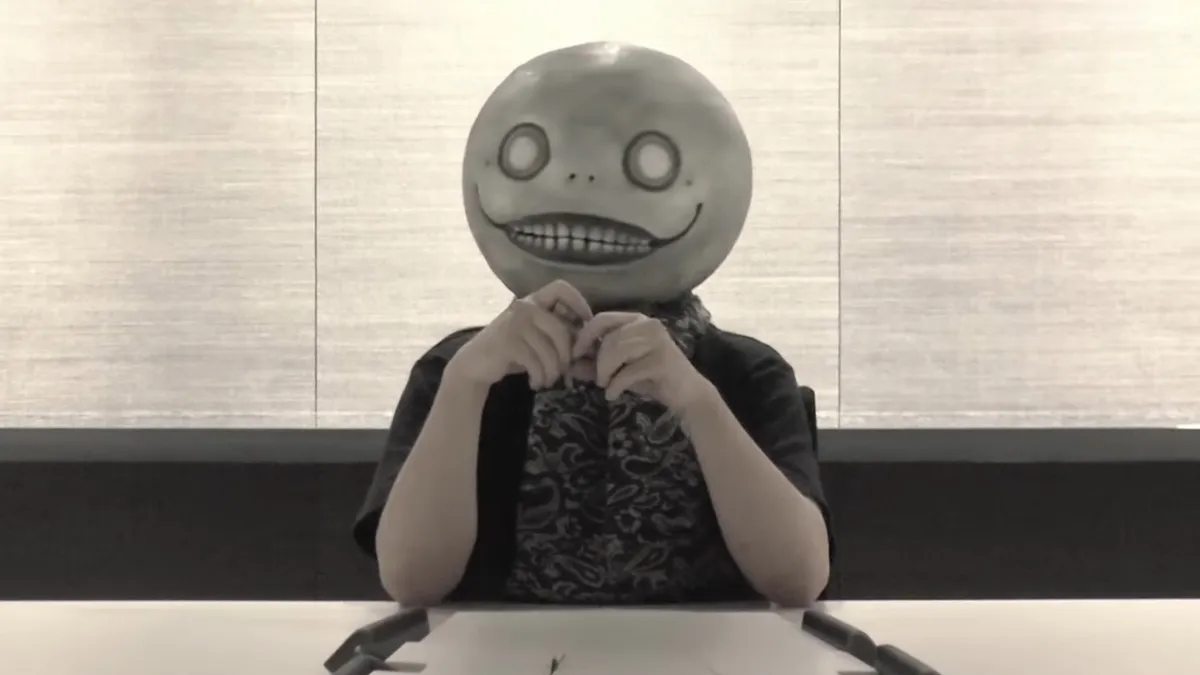
He might be being modest. Or nervous. From the moon-faced mask he always wears, his stylized stage name (his legal name, following Western naming conventions, is Tarō Yokoo), and the way he's flippantly referred to himself as "insufferable" suggests a propensity for playing hide-and-seek, never truly being vulnerable in how he presents himself – even in a coffee table book named after him. But the distinct, darkly funny apocalypses he creates for the Nier and Drakengard games – Drakengard 3 is a medieval bloodbath, for example, where prim heroine Zero kills people on reflex – demonstrate the sharp artistic vision he's unwilling to take credit for.
"So, anyway, I became a director," Yoko says, as casually as ever.
Square Enix had barely any say in the final version of Drakengard, so Yoko at least later admits, "that leeway, the producers' lack of interest, gave me the creative space to build that kind of world." But then he characteristically pulls back a bit – "That could also be said of my other subsequent works, but I never had the desire to express myself through my work at all. For me, it just felt like working on a kind of puzzle, finding solutions within a web of constraints."
"Sure, maybe some of my personality ended up in the results," he says about Drakengard. "But fundamentally, it started with an assignment from Enix, then analyzing the state of the game market at the time, and from there, just doing the calculations."

