You are now subscribed
Your newsletter sign-up was successful
Want to add more newsletters?

Every Friday
GamesRadar+
Your weekly update on everything you could ever want to know about the games you already love, games we know you're going to love in the near future, and tales from the communities that surround them.

Every Thursday
GTA 6 O'clock
Our special GTA 6 newsletter, with breaking news, insider info, and rumor analysis from the award-winning GTA 6 O'clock experts.

Every Friday
Knowledge
From the creators of Edge: A weekly videogame industry newsletter with analysis from expert writers, guidance from professionals, and insight into what's on the horizon.

Every Thursday
The Setup
Hardware nerds unite, sign up to our free tech newsletter for a weekly digest of the hottest new tech, the latest gadgets on the test bench, and much more.

Every Wednesday
Switch 2 Spotlight
Sign up to our new Switch 2 newsletter, where we bring you the latest talking points on Nintendo's new console each week, bring you up to date on the news, and recommend what games to play.

Every Saturday
The Watchlist
Subscribe for a weekly digest of the movie and TV news that matters, direct to your inbox. From first-look trailers, interviews, reviews and explainers, we've got you covered.

Once a month
SFX
Get sneak previews, exclusive competitions and details of special events each month!
Rayman, as a character, was fully created by the French game designer Michel Ancel during his teenage years. When he decided to present his Rayman video game project to Ubisoft, he brought a 150-page file describing the whole game and a demo. Totally convinced, the Guillemot brothers gave him two years to create his game for the expected Super Nintendo CD-Rom hardware. The ways of videogame history decided otherwise and Rayman became an Atari Jaguar project, and was also ported to the incoming PlayStation, thanks to Ubisoft's recently created Tokyo branch.
Often considered as reflecting his designer's somewhat eccentric personality, Rayman is a 2D cartoon-style character deprived of arms and legs, capable of launching his fist to defeat opponents or flying short distances thanks to his helicopter hairstyle. Very unique artistic and graphic designs helped the game reach quite a commercial success, meaning a sequel was inevitable.
Ray(man) of hope

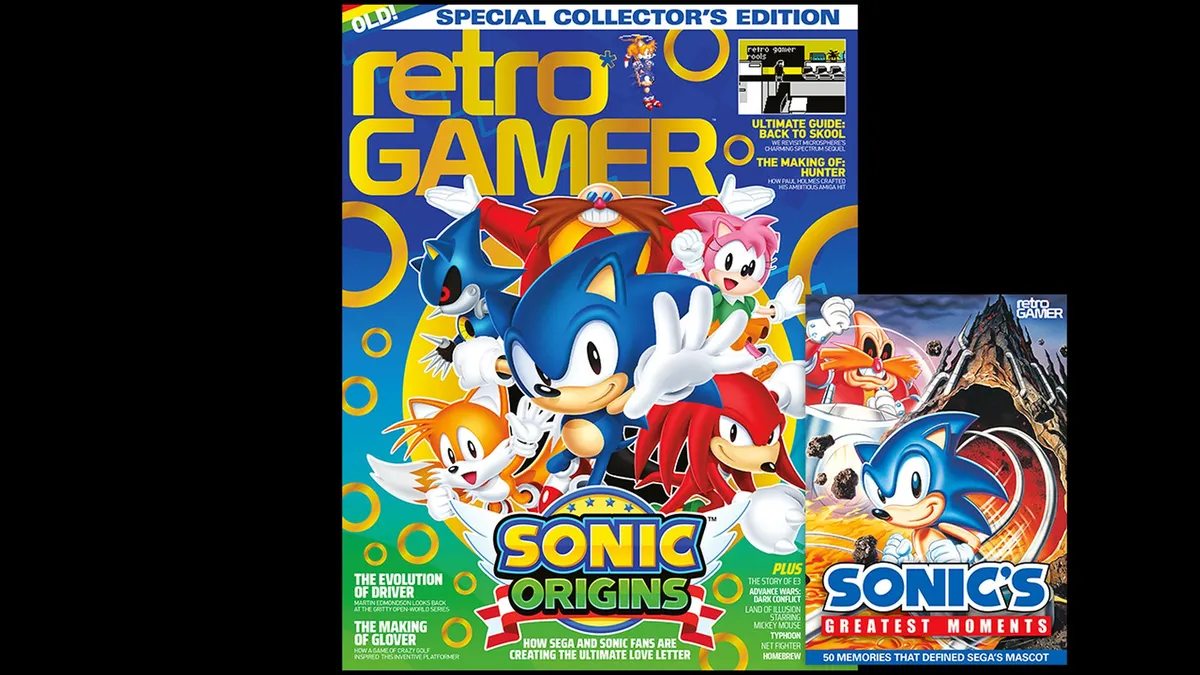
This feature originally appeared in Retro Gamer magazine #275. For more in-depth features and interviews on classic games delivered to your door or digital device, subscribe to Retro Gamer or buy an issue!
To avoid damaging Rayman's reputation, Ubisoft first launched the development of another 3D platformer named Tonic Trouble.
It seemed like a dry run at the time, with Ubisoft wanting to create its own 3D engine for this project. "The Tonic Trouble and Rayman 2 development teams were different, but we shared ideas and knowledge, working in different directions," recalls Palmieri.
Florent Sacré, Rayman 2's lead artist, who was first recruited by Ubisoft on the Tonic Trouble project, says, "It was the first game I worked on. The technological and research aspects implemented for Tonic Trouble helped design the tech used for Rayman 2. The Montpellier team was in charge of developing Rayman 2 at first, and when the Ubisoft Paris team eventually finished Tonic Trouble, they were assigned to help them. Two teams were assigned to Rayman 2's development, but by the end of the project only the Paris team was working on it."

Palmieri specifies that "in total 70 to 80 developers, dispatched between Paris and Montpellier, worked on Rayman 2 for more than two years", making it quite the project.
Going 3D was such a challenge for Ubisoft that many new team members were quickly recruited. Rayman's sequel was also a challenge in terms of technique and level design. "To make the players move around a 3D world with the required precision for a platformer was a real challenge," recalls Palmieri.
"We worked a lot on controls and on the camera to make it easy, fun and permissive enough. For instance, we allowed Rayman to be able to walk a bit further over the void from a platform, in order to succeed at jumping and to avoid falling. It was quite subtle but let the player have more fun and fail less."
By design

It was quite subtle but let the player have more fun and fail less
Olivier Palmieri
That wasn't the only tweak the team made to make the life of players as easy as possible.
"We also worked a lot on the 'level design cameras' to create game situations where the player didn't need to control the camera angle," continues Palmieri. "The purpose was to naturally give a direction to the camera that would allow the player to focus on the action and jumps. Sometimes, it even offered 2D gameplay situations in a 3D environment game."
Sacré also explains that the main difficulty related to creating a 3D game were the lack of references at the time. "We didn't have any references related to the Rayman background. There were useful references coming from Nintendo's Super Mario 64, though. We had a lot of freedom, meaning many back-and-forth transmissions between game designers and graphic designers, involving some tension. These tensions were also created by the lack of experience, we didn't really have a definitive pipe to use. Everything was very organic."

The new Tonic Trouble 3D engine, as Sacré remembers, was extremely complicated to use on the Rayman 2 project. "It was very hard to get something stable at the beginning. The first few months we spent a lot of time producing assets, but the following weeks we could divide the time spent working on one task or the other by two.
We could progressively work much faster. Even with this engine, that didn't allow us to create many things, we had enough to develop something enjoyable visually. This could also be achieved thanks to an engineering team in Annecy. They were very reactive and responsive to the other teams, and were developing anything we needed."
A new recipe

It was very hard to get something stable at the beginning
Florent Sacré
At Ubisoft, each level designer had to create ways to play with the 'game ingredients' they were assigned to work with. "I was attributed to work on levels with ingredients such as the walking rocket, or the updrafts allowing Rayman to ascend thanks to his helicopter ability, and the explosive barrel," recalls Palmieri.
"Other level designers were working with the bouncing prune or the flying barrel, for instance. This method let us focus on some specific ingredients and try to get the best we could out of them in order to create fun situations where the player had to think their way through. Thus, Rayman 2's gameplay became very varied."
Variety quickly became Rayman 2's main direction – variety of gameplay, of situations, of environments, of level design. The soundtrack accompanying each different sequence also needed to be varied, creating challenges for Eric Chevalier who composed Rayman 2's soundtrack. "There was a lot of artistic freedom at the time, which explains the very varied styles I used to create Rayman 2's music," he tells us.

"I had a lot of fun and many sources of inspiration helped working on it, considering the diversity of the different worlds and levels. Therefore you can listen to funk, jazz, sometimes folk music, even experimental music, experiencing the game. It's very open. The computers, samplers and synthesisers weren't as efficient as they are nowadays. They required more inventiveness."
Chevalier found that communicating with the development team was an essential process when it came to writing the game's music. "A permanent artistic dialog was necessary to work on the soundtrack – I was given pictures of the maps, videos, drafts of the ongoing production to be able to adapt the music," he explains.
"The main difficulty was to avoid music loops to bore the player. These loops were necessary since the allocated space on the Nintendo 64 cartridge was far from being infinite. The music needs to be interesting enough in case the player stays stuck in a level. Also, working on the cutscenes' music requires the same process as working on a film soundtrack."
The great escape

We didn't want the challenge to come from the character controls or the camera management.
Olivier Palmieri
Going from the first Rayman game to Rayman 2: The Great Escape also required some game design changes, as Palmieri explains. "Shooting light balls instead of launching Rayman's fist is the main added feature in the second iteration. The longer helicopter capacity, allowing the use of updrafts is another example.
"We also worked on the helicopter mode so that the lowering speed shortens in comparison to the first game. Thus, it leaves the player more time to control Rayman's directions. The majority of the new features really came from the aforementioned game ingredients, and from the interactions with these ingredients. Water-skiing with the swamp snake or bouncing on giant spider webs are examples among others."

Working on a sequel can sometimes be tricky, as the original game's spirit needs to be preserved, which becomes even trickier to achieve when a new dimension is added into the mix. "Part of the Rayman 2 team came from the first Rayman project, ensuring some coherence," explains Palmieri.
"We wanted to keep the small puzzles aspect, where the player's challenge is to think about the game's ingredients in order to make progress, or to find rewards here and there. We didn't want the challenge to come from the character controls or the camera management. We wanted the use of these game ingredients by the player to be the hardships to overcome."
Tuning in

Chevalier, on the other hand, didn't work on the first Rayman's soundtrack, and had to start from scratch to compose The Great Escape's musical themes.
"I first created the main theme. I then worked on how to use these main theme elements to create many variations depending on the styles. You can listen to the main theme all along the soundtrack. One can hear some darker ambient music playing Rayman 2, of the type you can listen to when watching a film. This is because some maps led me to this music aesthetic."
Rayman's 3D graphic identity was defined and preserved by Ubisoft Montpellier, as Florent explains. "Michel Ancel and his team had already worked on the first Rayman. They developed Rayman 2's artistic direction, creating solid bases. Then Ubisoft Paris used these bases to complete the project."
"I especially worked on modelization and backgrounds. Montpellier created functional kits, without exploiting their potential fully; Paris team's mission was to exploit these kits to create cool backgrounds. A few leads had been already followed in Montpellier but they hadn't created many backgrounds, maybe one or two. Then some members from the Paris team joined Montpellier's team to produce textures in order to develop some graphic uniformity for the game."

Some sequences were harder but this is also what brings a feeling of success to the player when he completes a level
Olivier Palmieri
The Rayman games are well known for their challenge, requiring sometimes to go through a level section again and again.
This is particularly relevant in Rayman 2's gliding sequences, and even more relevant regarding the game's rocket-related sequences. Rayman can ride legged rockets, flying powder barrels, and glide over lava on a prune, taking directions depending on the way he shoots light balls, among other examples.
Was this difficulty an impediment to reach a wide audience? Palmieri doesn't agree. "We tried to work on the difficulty level, and therefore on the distribution of the ingredients in the game, such as the legged rocket, for instance. We had done a lot of playtests to validate the difficulty level and the progress the player can make in Rayman 2. Some sequences were harder but this is also what brings a feeling of success to the player when he completes a level."
"Legged rockets or flying barrels phases came later in the game, and we were counting on the fact the player would be controlling the character perfectly at this point. From a design point of view, the character's 3D speed had to be finely tuned to offer a good feeling of speed, and also to manage the collision engine's capacity to avoid bugs. These levels required a lot of design work, integration, playtests and adjustments. We worked on the gliding phases in order to be in control of the descending speed and the engine to avoid collision issues."
Special feature

Needless to say, the situation became very complicated at first.
Florent Sacré
Palmieri has very good memories of these development years, including the discovery of new features they hadn't originally considered.
"[One was] finding out a way to make Rayman shoot after having launched vertically a barrel he's carrying," he says. "Using this feature the player could destroy incoming barrel missiles to destroy a machine imprisoning a faery. No one in the team really realized that this feature could be used at this point, and watching the other developers thinking their way to make progress on this particular level was very enjoyable," he recalls.
The Dreamcast port, arguably the most enjoyable version of the game, required very few people to work on, as Sacré remembers, "It was crafted at the very end of the project. A few engineers and gameplay programmers worked on it quite successfully. On the other hand, developing Rayman Revolution, the PlayStation 2 version of Rayman 2, had been another story."

"I left Paris for Annecy, where the local Ubisoft team was supposed to work on the PS2 port. I was appointed as art director on this port. It became quite tense, since they had already started working on another Rayman project, contrary to what had been planned. They were simply developing a new Rayman game. Needless to say, the situation became very complicated at first."
What most characterises the Rayman 2 project, starting with Tonic Trouble, was the fact that absolutely everyone among all teams involved were having difficulties finding points of reference regarding 3D game development.
"On the Tonic Trouble project Ubisoft hired 40 animators, for instance, which was completely oversized," says Sacré. "The publisher didn't have any reference back then to know how many animators were really needed. Everything needed to be designed or crafted at the time, which made this period really fascinating, all the more we were mostly young people in their early 20s, starting our careers in the video game industry."
Check out the best platformer games of all-time
You must confirm your public display name before commenting
Please logout and then login again, you will then be prompted to enter your display name.