
Steve Jobs is on stage, promising "one of the coolest [games] I've ever seen". He introduces Bungie co-founder Jason Jones, and his new game. "We're gonna see, for the first time, Halo." Perhaps you've seen this 1999 Macworld demo. If so, you know that it looks (and sounds) an awful lot like the Halo that would launch nearly two and a half years later. There's a soldier in green armour, and a jeep ride with a marine on the turret, all accompanied by the monkish chants of Martin O'Donnell's score.
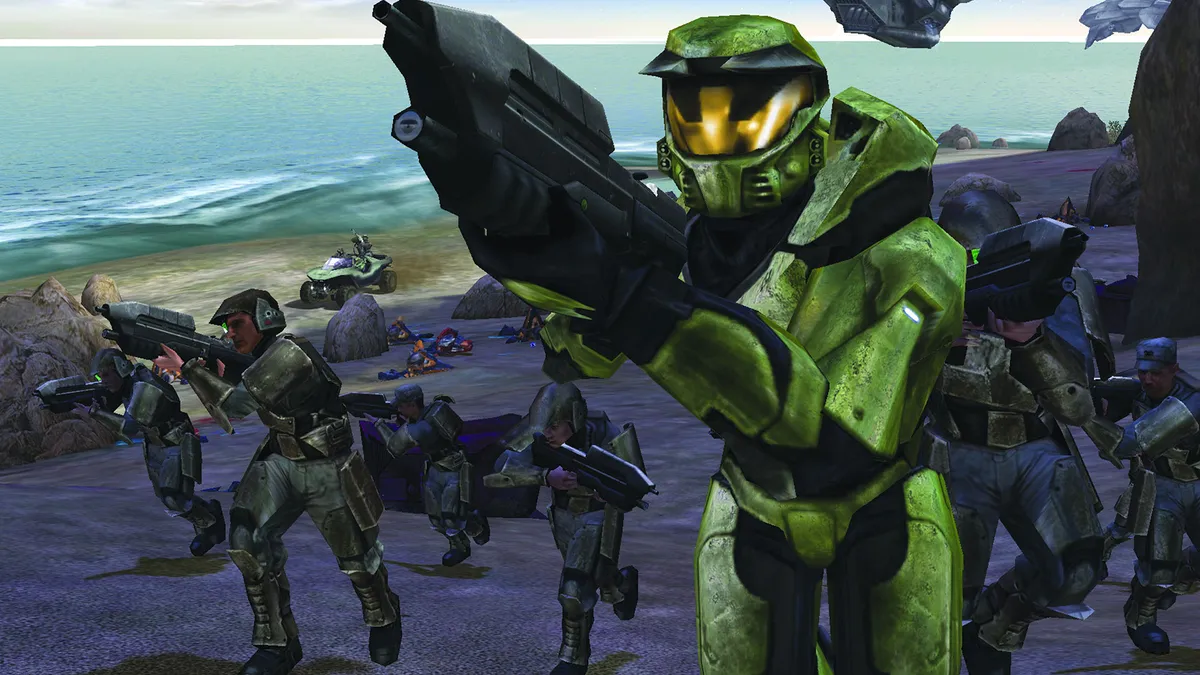
OK, the character designs aren't quite there yet, the planet they're on is a little too bare – but there are two rather more important distinctions to note. One: the demo, as Jones announces before showing it off, "is being rendered in real-time, on a Macintosh". Two: the whole thing plays out in third-person. By the time of its launch in November 2001, Halo would undergo a serious transformation. But even before it reached this San Francisco stage, the game had changed an awful lot from where it began, with Jones and art director Marcus Lehto tinkering while the rest of Bungie worked on Myth II, the sequel to the studio's fantasy RTS.
"We knew we wanted to create some sort of sci-fi, military adventure," Lehto tells Edge magazine. "It was based on Myth – it used the same engine. It was going to be open world. It was going to be more of a real-time strategy game where you were giving orders to your ground units, as well as vehicles, tanks and troop transport vehicles."
Good jobs

This feature originally appeared in Edge magazine. For more in-depth interviews, reviews, features, and more delivered to your door or digital device, subscribe to Edge magazine.
Steve Abeyta, who would go on to become Halo's environment lead and animation director, remembers seeing this early prototype. "It wasn't really my type of game. I'd played Myth, but I wasn't crazy about Myth. But I was super-impressed with the visuals," he says, citing the matte skybox, the lens flare, and the iridescence shaders on the insectoid carapace of the alien vehicles. His main memory, though, is of "these little characters driving around in these little Jeeps".
That's the formative memory for many people who worked on the game, including Bungie co-founder Alex Seropian. "Charlie [Gough] started doing the suspension physics on the jeep, which would become the Warthog," he says. "I remember seeing this tech demo of it going over 3D terrain. The camera was really close-up, and you'd have this reaction of, 'Wow, that's cool'. But then, when you put the camera way up high, you couldn't really see it. It wasn't as impressive. So, that's when the camera started getting closer, and closer – until eventually we experimented with just making it third-person, with direct character control."
In what Seropian refers to as the first of many "crucibles of iteration", the project therefore pivoted to become an action game. The initial emphasis was on multiplayer, informed by the team's fondness for Tribes and Quake III. "I distinctly remember the very first network games that we would play in the office," Seropian says. "Just a very early test, when it moved to third-person – there were a couple of weapons, a very simple map…" And yet they kept playing – a moment that would be echoed many years, and a fair few transformations, later in development.
When Jobs introduced the game to the world in July 1999, he attracted the attention of other, hungry tech companies. "After that demo, we started having lots of conversations," Seropian says. "And I'd say half of them were buyout offers." For Bungie, the timing couldn't be better. "What I didn't know at that time is how much we as a business needed money," artist Shiek Wang says. The PC version of Myth II had shipped with a bug that could erase the contents of the player's hard drive, leaving Bungie with a difficult choice. "We did a recall when, I think, many people would not have," says Hamilton Chu, lead producer. "It was a decision made just on the ethics and not the economics of it." This wiped out the small studio's savings, Wang says, so it started seeking deals that "would allow us to survive as a company, and continue to make games".
The first was a publishing partnership with Take-Two, which invited Bungie to its New York offices to see the demo of Microsoft's new console. We all know where that led – but at the time, it wasn't the most logical leap for a developer that had been so dedicated to Mac games. "For the Mac gamer community, it's like the worst betrayal possible, right?" Chu says, adding that the studio received death threats. "Which we kind of, I don't know, laughed off. These days, you'd take it much more seriously." However, Seropian says, the move away from Apple wasn't for lack of trying. "Our first call after [the Microsoft offer] was back to Apple, to let them know we were entertaining this offer – and they wished us luck: 'We love you guys, but games aren't our focus'."
"By the time Bungie arrived in Redmond, Seattle, in late 2000, Halo had become a first-person game. No one we speak to agrees on quite when that happened..."
Things could easily have gone another way, he says. "As we're signing the deal – literally, I'm on the top floor of the Bank Of America building in Seattle, looking at the closing documents, about to sign them – Phil Schiller from Apple calls me." Seropian laughs. "I excused myself from the room and was talking to him in the hallway. 'So, hey, I heard you're doing a deal with Microsoft – did you sign it yet?'" His laugh becomes a full cackle. "I was like, 'You gotta be kidding me. Come on!'"
By the time Bungie arrived in Redmond, Seattle, in late 2000, Halo had become a first-person game. No one we speak to agrees on quite when that happened – Lehto remembers it as part of the transition to Xbox, Seropian has it right around the Macworld presentation – but they're clearer on the thinking. "I remember talking to Jason about that connectivity it brought, that visceral feeling of being in first-person and connected to the action in front of you," Lehto says. Wang points to the "weird physics problem" created by third-person: "You're shooting from your camera, but the projectile exits from the model." He cracks an old joke: "We switched from third-person to first-person because Jason couldn't figure out the math." Seropian remembers feeling "almost a resignation to it, like this was inevitable. We wanted to do something different, but fuck it – we're gonna do what feels right."
Perhaps the reason this pivotal moment is so hazy is that the Microsoft acquisition brought a wealth of other challenges. There was the matter of relocating, from Bungie's native Chicago, and combining that team with Bungie West, the team that had been making Oni for Take-Two in California. "We were planning on working on a new IP," says Chris Butcher, a programmer who'd joined Bungie on the Oni team. This game, adds fellow Bungie West member and multiplayer lead programmer Michael Evans, was "tentatively called Monster Hunter", a title also mentioned by Abeyta. "But it became apparent, after just a few weeks, that Halo was going to require all the staff," Butcher says. He still has his daily records from that period, which clears up the timeline. "On February 12, 2001, I moved my workstation to the Halo room."
One of the reasons they were folded into the Halo team was that, with around eight months to go, what existed was just "the idea of a game", as Evans puts it. "We had the core mechanics," Lehto confirms, "and that was about it." Butcher, tasked with writing the AI of the Covenant enemies, remembers inheriting "a few C++ header files", and some notes on how they should behave. "There were no levels, there was no scripting engine, there was no ability to place encounters or anything like that. But there was, like, 3D space where you could be a first-person guy with a gun, and you could shoot at bipedal enemies. That was February 2001."
Gulch it down
"And so he went to the artists and the animators, like, 'I know John told you guys that we cut the tank, but we're actually going to do it'."
It seems like an impossible task, so how was it achieved? "We made a lot of difficult decisions to make that happen," Seropian says. "We cancelled projects, we combined three teams together, we compromised on scope… We shipped at least one level that we probably shouldn't have." He's referring, presumably, to the looping underground corridors of The Library, a level for which work hadn't even been started two months before launch. Abeyta remembers conversations on how it could possibly be made in time: "It's going to either be really, really small, or it's going to be really, really repetitive. And repetitive was chosen."
These decisions were being made against a backdrop of merciless cuts. The planned number of campaign levels shrank from around 25 to ten, including "a boat level", according to Butcher. Proposed enemies and weapons were abandoned, with some of the latter reserved for Covenant enemies, "because we ran out of time to build the first-person models". Meanwhile, the entirety of multiplayer – once the driving force of the game – found itself on the chopping block. "After the Microsoft acquisition, the focus changed to: what does it mean to be a console launch title? Well, we're going to need a singleplayer campaign," he says. "And that was the focus." Evans remembers being shown a dependency chart by Chu, and being told "there's no room" for multiplayer.
Not everything went, though. "Four weeks before ship, [lead designer] John Howard decides we're cutting the tank, because it's not ready," Butcher says. "And [designer] Paul Bertone was basically, like, 'Fuck that. I'm not gonna listen to you, John – without the tank, this game sucks'. And so he went to the artists and the animators, like, 'I know John told you guys that we cut the tank, but we're actually going to do it'. And they all just worked really hard, and a week and a half later, we're playing with the tank. And it works, and it's really fun. And John was upset about that, but ultimately he was, 'I guess if you guys crunched to make it work – I was trying to make your lives easier, but you clearly don't want to listen to me'."
This speaks to another big factor in the impossibly short turnaround of Halo's final months. "There were a lot of sleepless nights," Wang remembers. "That nine months, if you count eight hours as a full day, then we probably stretched it out to more like 12 months, at least." We hear something similar from every single person: "insane hours", "horrible crunch", "massive human cost", "death march". Yet, while they all acknowledge that it wasn't healthy, and wouldn't do it today, no one seems to regret it. When we ask why, there are a few common answers. That it was never mandated from above; that the team was young and mostly without other responsibilities; but most of all that they loved what they were making and the people they were making it with. "Especially since it all worked out – it's all misty watercolour memories now," Chu concludes. "But even then, you had this feeling of being in the trenches, with brilliant people, fighting the good fight."
This feeling was helped along by another of Seropian's development crucibles. Evans and other members of the Oni team had been posted on multiplayer, bringing it back from the brink with the aid of mapmakers from all manner of disciplines. "I don't know if it was every night, but it was a lot of nights," Evans says. "There was a little test room that people would shuffle over to at some point, and then we'd play matches for… probably way too long, considering everything else we had to get done. Once we started doing that, it was pretty clear we'd made a good choice to keep it."
This milestone again came surprisingly late in development: September 2001, by Butcher's estimation. "We had between two and five weeks – that was the time when 16-player system-link multiplayer was playable on Halo. So classic eight-versus-eight Blood Gulch – how many times did we play that? Maybe a total of 30 times. But during those last weeks, that's when we were like, OK, this is pretty good."
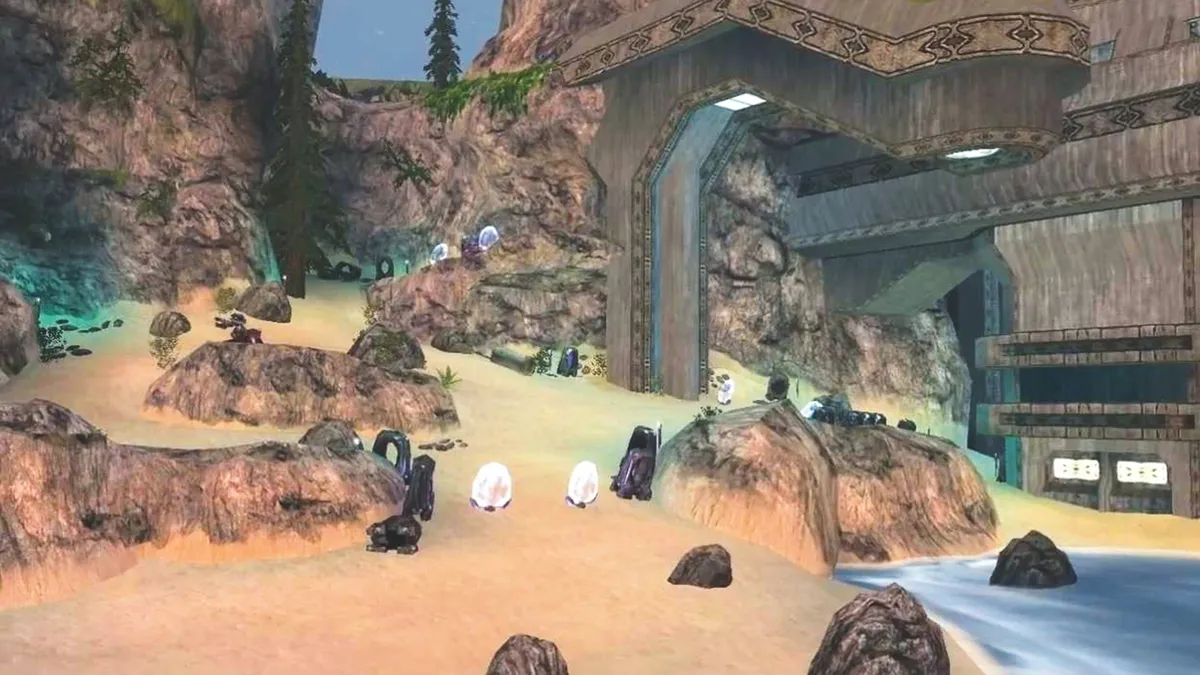
And, reader, it was. A game the developers tell us was always considered just another in Xbox's launch lineup, firmly behind Oddworld: Munch's Oddysee, became the console's biggest hit. We ask if anyone has a theory as to why Halo caught the public imagination, and why we're still talking about it. Seropian and Lehto both acknowledge there was an element of luck, with everything falling into place around it. Butcher mentions the effect of September 11 on the American psyche, and the desire for a simple good-versus-evil narrative, "where the good guys are gonna win". And, more simply, the very same thing that had made it click in the studio: "The multiplayer makes it iconic. People build memories with their friends, spending hundreds or thousands of hours playing together."
As for how that success felt on the ground, most just tell us they were too tired to take it in, busy enjoying some well-earned time off – or in many cases slinking back into the office early just to keep playing around with it. "We were taking the Halo engine and making race cars and unicycles and stuff," Abeyta says wistfully. "Because it was our job, but I think for everyone it was their favourite thing to do."
When release rolled around – after the usual weeks-long delay – a few team members, Chu and Evans among them, headed into Redmond for a local store's Xbox midnight launch event. "I remember watching the first guy in line, and he bought two copies of Halo," Chu laughs. "I was like, 'We are at a 2x attach rate for this moment of time!'" That's when Evans recalls having an inkling they had something special on their hands: "Games were smaller back then, but we all felt like rockstars, for this one moment.
This feature first appeared in Edge Magazine issue 390, which you can pick up right now here.

