Level select
First seen in: Mega Man (1987)
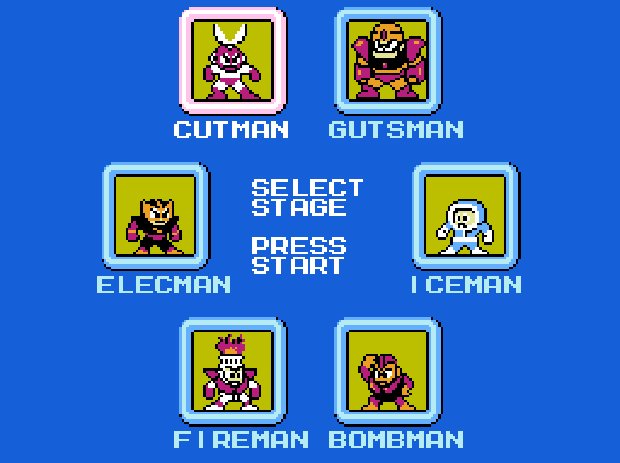
Important because: You could now play the game in whatever order you wanted. Granted, Super Mario’s Warp Zones sort of let you pick and choose which levels you would and would not play, but Mega Man actually let you select the order in which you’d encounter them. Right away, you could choose from six levels (Cut, Elec, Ice, Fire, Bomb and Guts Man) instead of being forced down a set path (like Mario) or dropped into a huge world with no instructions (Zelda, Metroid). However, it’s almost an illusion of choice, as the game’s bosses are weak to specific weapons gained in other levels, so in the end you did kinda have to obey a pre-conceived route. But hey, if you wanted to ignore that and try to kill ‘em all with your regular weapon, the choice was always there.
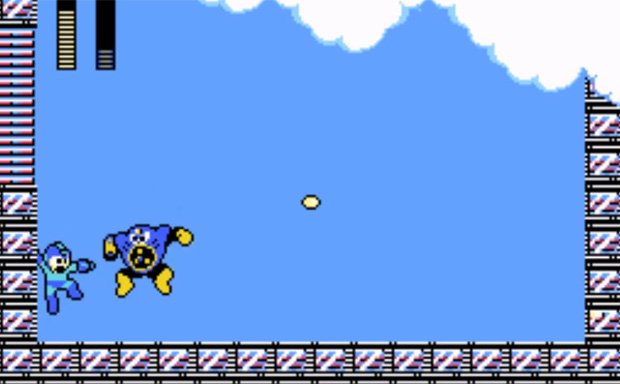
Above: It’s your funeral
Legacy: Linear games still have dominant sway, but there are innumerable instances of games leaving the path up to you. You could even draw parallels to GTA and Red Dead, where you can pick certain missions over others rather than blindly proceed through one official narrative. In a way, you can attribute something as basic as “level select” with birthing open world, multi-mission, side-quest-heavy games. A more recent example is Spider-Man: Shattered Dimensions, which gives you the option to choose which universe to play in, and in what order. It’s probably impossible to name every game that uses this feature, easily making it essential for any “greatest innovations” list.
Networked multiplayer deathmatch
First seen in: MIDI Maze (1987)

Above: Despite the crude cubicle walls and Pac-Man-like avatars, MIDI Maze introduced networked multiplayer deathmatch for more than two players
Important because: Today, multiplayer deathmatch is an expected feature in just about every game with a gun. But it wasn’t always this way, and in fact the very first game to feature it didn’t even have guns. While 1975’s two-player Maze Wars was the earliest example of competitive network play, it wasn’t until 1987’s MIDI Maze that more than two players – up to 16, in fact – could chain their computers together for face-to-face deathmatches. Released on the Atari ST, the game allowed players to connect their systems through the computer’s MIDI-In and MIDI-Out ports (hence the title). Games were started by the player running a ‘master machine,’ who chose the settings and levels for the match. If the systems were connected incorrectly, though, the match would slow down to a crawl.
So in addition to featuring the first instance of networked multiplayer deathmatch, MIDI Maze also broke ground by introducing the concept of a LAN party, a host, and lag!

Above: If MIDI Maze was before your time, you may recognize Faceball 2000, as it was known on Game Boy and SNES
Legacy: Quake, Unreal Tournament, and Counter-Strike are just a few of the franchises with communities that have thrived thanks to networked multiplayer. The fast-paced action was complemented by speedy networked connections at LAN events, which helped promote the rise of e-sports and competitive gaming in the west. Today, PC gamers still congregate at LAN events and conventions, like QuakeCon, to get their frag on with like-minded shooter fans. Despite more recent improvements in high-speed internet connections and multiplayer services, like Xbox LIVE, nothing beats the thrill of the high-stakes competition and low ping you get when you wire up in person for some old-school deathmatch.
Motion capture
First seen in: Prince of Persia (1989)

Important because: You like fluid animation, right? Characters who move in a way that appears convincing and realistic? Then motion capture is pretty essential, because without it animators would probably still be creating heroes who run like stiff-jointed robots. And while motion capture today is generally done in expensive, purpose-built studios with men covered in little ping-pong balls, it got its start in videogames with Prince of Persia creator Jordan Mechner filming his brother David running around outdoors.
Drawing frames of animation over film (or “rotoscoping”) was nothing new in 1989; Disney had been doing it since the ‘30s, and animator Ralph Bakshi is notorious for using it (sometimes to a too-obvious degree) in most of his films. But while games had featured some sharp-looking animation prior to ’89, Prince of Persia was the first to actually use rotoscoping, thereby securing its place in history as one of the most impressive-looking games of its era.
Legacy: While some 2D games would later follow PoP’s rotoscoped example (most notably Out of This World/Another World, Flashback and Shaq-Fu, all produced by developer Delphine), the practice didn’t really become standard until the 3D era made animating lifelike characters increasingly difficult. The solution was motion-capture technology, which started life primarily in sports games, but has since become standard in most big-budget releases.
AI partners
First seen in: A Boy and his Blob (1989)

Important because: Saving the world by yourself can get lonely! Far better to bring a buddy along, in this case a mindless blob that craves jellybeans and has transmorphic capabilities. He’d follow you around, always hopping a step behind, ready to tumble into a pit or get confused by something as daunting as a staircase. Luckily, there was a “ketchup” bean that made him instantly reappear in front of you (catch up, lul), plus he could never actually die, so that helped ease us into the idea of having to babysit another onscreen character.
We’re honestly more than a little surprised A Boy and his Blob is the first instance of an AI partner, as it’s such a weird niche title that we assumed most people forgot about until the 2009 Wii sequel. Before leaving a comment to tell us we’re wrong, though, be careful not to confuse an AI partner – which is controlled by the magical video game box on your shelf – and a dumbass Minnie Mouse who just jumps two seconds after you do. In other words, Mickey Mousecapade doesn’t count because Minnie was never under the machine’s control.

Legacy: Thanks to this helpless, gelatinous moron, we now have hundreds of games nearly ruined by shitty AI partners. They’re a great idea, and when done well add a personal touch to games (see Half-Life 2, ICO and Enslaved), but almost always end up causing you more trouble than they’re worth. Rise of the Kasai, Daikitana, Secret of Mana and countless others all suffered from varying degrees of frustrating idiocy. Luckily, we now usually have the option of turning the AI partner into a co-op buddy, as seen in Resident Evil 5.
Tech trees
First seen in: Sid Meier’s Civilization (1991)

Above: A snippet of the original tech tree
Important because: The tech tree is one of Civilization’s most copied innovations, and its impact on game design in general is significant. The flow chart allowed players to see their research progress and generate and reach their own goals - the antithesis of many games before and after it that treat upgrades as surprise gifts.

Legacy: The tech tree was originally designed for Civilization… no, not that Civilization, the ‘80s board game. A similar construct appeared in the 1991 PC strategy game Mega Lo Mania, but the video game form we’re most familiar with spawned from Sid Meier’s Civilization.
After that, tech trees started showing up in swaths of strategy games, from Dune II to StarCraft. But even beyond strategy games, the tool has made its way into RPGs, shooters, and just about every other genre.

Above: Dead Space’s upgrade trees don’t quite contain the complex and varied paths of Civilization’s, but they’re fundamentally similar
Facebook
N4G
bungalo-dave - October 6, 2011 7 a.m.