
 Join The Community





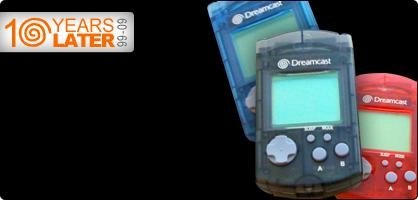

Above: Let’s cuddle up and enjoy some extremely simplistic games!

The VMU’s primary function is data storage, and it does the job superbly. The screen isn’t just a gimmick when you have six devices and need to remember which contains what, and they’re impressively reliable (if a little short on storage) compared to other memory devices of the day.
The only notable complaint with VMUs is their battery life - not in the sense that you’ll lose your saves (as in old-school cartridge batteries), but in that the screen only works if the device is inserted into a controller, or you keep it satiated with two CR2032 watch batteries. CR2032s are no more expensive than any other battery, but anyone who used their VMUs often knows that battery replacements were common.


Above: Those little flat suckers add up after a while
Nevertheless, playing minigames and browsing saved data independent of the console is a luxury, and few luxuries are free. VMUs still function as perfectly adequate storage devices sans the mobility.
Bonus Trivia! Sony made its own attempt at the same device with the PocketStation, but it was only released in Japan, and, like the VMU, didn’t make a lasting impact on memory device design. One feature it had over the VMU was infrared communication for sharing saved data or multiplayer mini-gaming. Typical Sony one-upmanship!

Above: Sega’s VMU and Sony’s PocketStation side-by-side (not to scale)
When plugged into a controller, the VMU acts as a second screen – kind of like the DS’s, though obviously much less sophisticated. It was used to display supplementary information, or whatever developer’s felt like. Unfortunately, too few utilized it as an informational display, and instead opted for a super-deformed character or other amusing-but-useless application.

Above: Soul Calibur displayed super-deformed versions of the fighters in various battle stances – cute, but nothing worth glancing away from the screen for
It seems odd that such an interesting concept hasn’t been retested, despite the technology to make it at least half-a-billion times cooler (sure it would be expensive, but imagine a 360 or PS3 controller with a screen that acted as a HUD replacement - I know I would be passively amused by it for a while).

